Alix Christie - Gutenberg's Apprentice
Здесь есть возможность читать онлайн «Alix Christie - Gutenberg's Apprentice» весь текст электронной книги совершенно бесплатно (целиком полную версию без сокращений). В некоторых случаях можно слушать аудио, скачать через торрент в формате fb2 и присутствует краткое содержание. Год выпуска: 2014, Издательство: Harper, Жанр: Историческая проза, на английском языке. Описание произведения, (предисловие) а так же отзывы посетителей доступны на портале библиотеки ЛибКат.
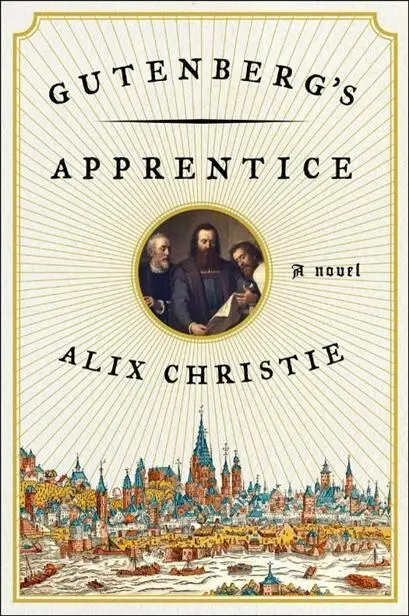
- Название:Gutenberg's Apprentice
- Автор:
- Издательство:Harper
- Жанр:
- Год:2014
- ISBN:нет данных
- Рейтинг книги:5 / 5. Голосов: 1
-
Избранное:Добавить в избранное
- Отзывы:
-
Ваша оценка:
Gutenberg's Apprentice: краткое содержание, описание и аннотация
Предлагаем к чтению аннотацию, описание, краткое содержание или предисловие (зависит от того, что написал сам автор книги «Gutenberg's Apprentice»). Если вы не нашли необходимую информацию о книге — напишите в комментариях, мы постараемся отыскать её.
Youthful, ambitious Peter Schoeffer is on the verge of professional success as a scribe in Paris when his foster father, wealthy merchant and bookseller Johann Fust, summons him home to corrupt, feud-plagued Mainz to meet “a most amazing man.”
Johann Gutenberg, a driven and caustic inventor, has devised a revolutionary — and to some, blasphemous — method of bookmaking: a machine he calls a printing press. Fust is financing Gutenberg’s workshop and he orders Peter, his adopted son, to become Gutenberg’s apprentice. Resentful at having to abandon a prestigious career as a scribe, Peter begins his education in the “darkest art.”
As his skill grows, so, too, does his admiration for Gutenberg and his dedication to their daring venture: copies of the Holy Bible. But mechanical difficulties and the crushing power of the Catholic Church threaten their work. As outside forces align against them, Peter finds himself torn between two father figures: the generous Fust, who saved him from poverty after his mother died; and the brilliant, mercurial Gutenberg, who inspires Peter to achieve his own mastery.
Caught between the genius and the merchant, the old ways and the new, Peter and the men he admires must work together to prevail against overwhelming obstacles — a battle that will change history. . and irrevocably transform them.
Gutenberg's Apprentice — читать онлайн бесплатно полную книгу (весь текст) целиком
Ниже представлен текст книги, разбитый по страницам. Система сохранения места последней прочитанной страницы, позволяет с удобством читать онлайн бесплатно книгу «Gutenberg's Apprentice», без необходимости каждый раз заново искать на чём Вы остановились. Поставьте закладку, и сможете в любой момент перейти на страницу, на которой закончили чтение.
Интервал:
Закладка:
And when he asked just why this miracle had come to Mainz, the answer came back just as clearly. This gift had been bestowed upon the city of Saint Martin, who tore his cloak in two to clothe a beggar. It was intended, then, for all mankind: the humble just as surely as the rich.
The testaments, of course, are full of trials. From the moment in the Garden that temptation raised its serpent’s head, God set his creature tests to prove his faith. So was it too inside the Humbrechthof as soon as they embarked. Within a week, the problems started.
The sheets were so large and unwieldy that they flapped and slipped. They’d miss a pin, and lodge lopsided when the frame was lowered on the forme . Ruppel, sweating, nearly lost his hand the first time he tried to straighten one that went half-cocked, only springing back just in time. Gutenberg stood over him, haranguing, cursing at each wasted sheet, threatening to dock his pay. He scooped up the wasted sheets, counting and recounting them, his face a frightful sight. A half a dozen, creeping Christ, a bloody fortune. He was seething as he called a halt. “Nail half a dozen extra pins on to that blasted cross.” Ruppel obliged, and the paper slipped much less, although the printing went more slowly for it. Each night the master gathered up those sheets that had been fouled and sourly counted them before he locked them up. Thank God the ones they lost were mostly paper, and not hide; the first time that the pressman and his beater lost a sheet of vellum, the master came up and tore it out of Keffer’s grip and rolled it in a bat that he used to whack him. Then it was laid to rest like a dead thing inside the crate of wasted sheets.
Nor did his glossy, sticky ink hold its shape in that furnace of late summer. With each advancing hour it melted to a slop that either beaded on the letters or just dribbled down their sides. Though Gutenberg reduced the oil and sent for drying agents, still it slopped. So then they’d have to work by cool of night, he said, and cursed the cost of extra candles.
And even so the pages dried and shrank before they had a chance to print the other side; they’d have to dampen the sheets again, but gingerly, and pray they held their shape. Of course the printed sheets could not be laid atop each other, out of fear of the ink smearing. Peter still remembers how young Wiegand staggered, arms held stiffly out, toes seeking out the ladder to the drying line. The drying pages hung above their heads, and swayed and rustled when the master thundered past: a flock of great white gulls that hectored them from overhead, with sharp, black markings on their sides.
Gutenberg was a blur in constant motion, darting back and forth from forge to press, back to the master book upon his desk, prodding, poking, pulling at his lips and beard. He was the only one who moved; the rest of them were chained to their respective stations. Fust appeared each evening as the crew began their nightly shift, but Master Gutenberg was always there: he never seemed to leave, even to eat or sleep. There was no moment — waking, sleeping, upstairs, down — when they were free of him, his beady eyes, his dark, oppressive presence.
And even so, the thing just crawled. A week passed, then ten days, and all they’d managed to produce was the first three pages of Saint Jerome’s prologue. They’d had to print two dozen extra copies of each page, to compensate for wastage. Then it was three weeks, halfway through September. Soon it would be Michaelmas, and they had managed only six pages in a book that ran to nearly fourteen hundred. At this rate, Hans said, chewing at his lip, even if you rounded, it would take them seven years.
Fust’s face grew blotched, the master’s blacker. Like rabid dogs they watched the crew: the more they watched, the more the ink balls slipped and the paper missed. Peter felt for Ruppel and Keffer; he sensed their fear of slipping and the sickness in their guts. He and Hans were not exempt: woe betide the man who made a setting error, if the master found it printed there. “F!” he’d bawl, or “M!” and reach a lightning hand to pluck out the offending letter. Hans or Peter would step out with the replacement, flinching as the reject whistled past. Gutenberg made not the slightest effort to control his temper, flinging, shouting, cursing, punching at the air. Pustules, cretins, misbegotten blackguards, spawn of Satan — he dispensed them all. He’d left no margin for such errors, it appeared — and that, to Peter, was the greatest error of them all.
The book had been designed to save on paper. There were no blanks left for a lavish painting; every line was calculated closely, to squeeze the most from every paper bale. Those bales, of course, were paid for out of Fust’s new capital investment, which he had borrowed not just for supplies but for the workers’ pay and room and board. It took no special skill to note the waste sheets mounting and the corresponding tightness in the partners’ jaws. Vast sums were riding on it, every man among them knew; the master had spent frugally, but freely. No man alive had ever before ordered ten full bales of paper and five thousand calfskins at a single stroke, Peter was quite certain.
He used to wonder what those herdsmen and those paper makers thought. There must have been a glut of veal and calves’ legs up in Swabia, he reckoned. Never in their lives had shepherds seen such quantities, such promises of guilders. They had to wonder, and no doubt aloud — though Fust was satisfied, he said, by the discretion of the leader of the butchers’ guild. No stranger came to Mainz who was not welcomed in the tavern of some brotherhood, and quietly paid on Fust’s account, and told to keep his business to himself.
The ring that circled them was hard to see, but it was there. When the harvest started, they found jugs of the last pressing of the grapes upon the granite stoop. Round loaves of bread were left, and honey, bacon, in a basket someone set up by the alley door. It must have been the second week when Peter noticed that there were sprigs of mugwort tucked around the eaves, a wreath of rosemary hung on the portal to the yard. The men of Mainz kept their lips shut; the women hung their charms to ward off evils; the Lord up in His heaven watched.
A month went by before Fust grimly said they had to find a faster way. The master flapped his hand at Peter the next morning just as soon as he arrived. Gutenberg was seated at his stool, the desk before him littered with odd strips of print. He started speaking before Peter even came in earshot: “… win more lines.” He brandished a poor waste sheet. “Cram in more words.” Peter saw that he had pasted one more line beneath each crooked column. “Don’t wag your head at me.” The master’s eyebrows bristled. “Just shut your mouth and do it.”
Mutely Peter took the sheet. In the composing room he walked toward the granite stone on which the second page of Genesis lay waiting. They’d printed off the first real page of scripture just the day before. Fury shook his fingers as he opened up the twine and pulled the top line from the second column, moved it to the bottom of the first. Just yesterday he’d felt his heart sing as he set: he’d marveled as he etched Creation’s shape, and laughed to think he’d set a whale, but never seen one. And now this madman planned to mar this perfect symmetry. Jaw clenched, he set the next two lines to fill the foot of that right-hand column. He tied it, carried it to Keffer. “Blasphemy,” he muttered, neck hairs rising as the master dogged him close behind. “I never said that you would like it,” Gutenberg growled in response.
He kept on droning even after Peter had joined Hans at their composing stools. They’d save the price of one whole book, he said. If they didn’t learn by doing, cutting costs, they’d never even make it to the Psalms. Already they’d spent more than anyone had reckoned. Peter heard the worm turn in his ear: We’ve got to beat this beast, or it will get the best of us.
Читать дальшеИнтервал:
Закладка:
Похожие книги на «Gutenberg's Apprentice»
Представляем Вашему вниманию похожие книги на «Gutenberg's Apprentice» списком для выбора. Мы отобрали схожую по названию и смыслу литературу в надежде предоставить читателям больше вариантов отыскать новые, интересные, ещё непрочитанные произведения.











Обсуждение, отзывы о книге «Gutenberg's Apprentice» и просто собственные мнения читателей. Оставьте ваши комментарии, напишите, что Вы думаете о произведении, его смысле или главных героях. Укажите что конкретно понравилось, а что нет, и почему Вы так считаете.