Alix Christie - Gutenberg's Apprentice
Здесь есть возможность читать онлайн «Alix Christie - Gutenberg's Apprentice» весь текст электронной книги совершенно бесплатно (целиком полную версию без сокращений). В некоторых случаях можно слушать аудио, скачать через торрент в формате fb2 и присутствует краткое содержание. Год выпуска: 2014, Издательство: Harper, Жанр: Историческая проза, на английском языке. Описание произведения, (предисловие) а так же отзывы посетителей доступны на портале библиотеки ЛибКат.
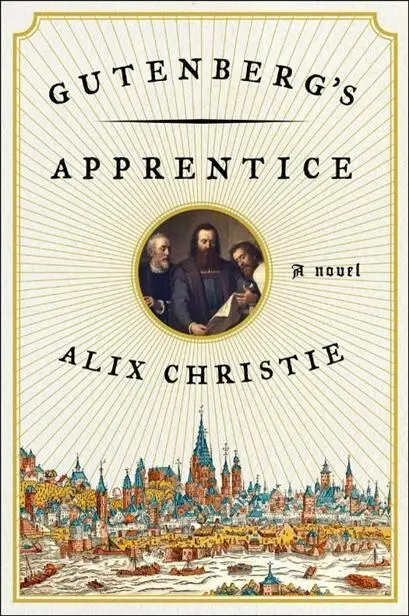
- Название:Gutenberg's Apprentice
- Автор:
- Издательство:Harper
- Жанр:
- Год:2014
- ISBN:нет данных
- Рейтинг книги:5 / 5. Голосов: 1
-
Избранное:Добавить в избранное
- Отзывы:
-
Ваша оценка:
Gutenberg's Apprentice: краткое содержание, описание и аннотация
Предлагаем к чтению аннотацию, описание, краткое содержание или предисловие (зависит от того, что написал сам автор книги «Gutenberg's Apprentice»). Если вы не нашли необходимую информацию о книге — напишите в комментариях, мы постараемся отыскать её.
Youthful, ambitious Peter Schoeffer is on the verge of professional success as a scribe in Paris when his foster father, wealthy merchant and bookseller Johann Fust, summons him home to corrupt, feud-plagued Mainz to meet “a most amazing man.”
Johann Gutenberg, a driven and caustic inventor, has devised a revolutionary — and to some, blasphemous — method of bookmaking: a machine he calls a printing press. Fust is financing Gutenberg’s workshop and he orders Peter, his adopted son, to become Gutenberg’s apprentice. Resentful at having to abandon a prestigious career as a scribe, Peter begins his education in the “darkest art.”
As his skill grows, so, too, does his admiration for Gutenberg and his dedication to their daring venture: copies of the Holy Bible. But mechanical difficulties and the crushing power of the Catholic Church threaten their work. As outside forces align against them, Peter finds himself torn between two father figures: the generous Fust, who saved him from poverty after his mother died; and the brilliant, mercurial Gutenberg, who inspires Peter to achieve his own mastery.
Caught between the genius and the merchant, the old ways and the new, Peter and the men he admires must work together to prevail against overwhelming obstacles — a battle that will change history. . and irrevocably transform them.
Gutenberg's Apprentice — читать онлайн бесплатно полную книгу (весь текст) целиком
Ниже представлен текст книги, разбитый по страницам. Система сохранения места последней прочитанной страницы, позволяет с удобством читать онлайн бесплатно книгу «Gutenberg's Apprentice», без необходимости каждый раз заново искать на чём Вы остановились. Поставьте закладку, и сможете в любой момент перейти на страницу, на которой закончили чтение.
Интервал:
Закладка:
No sooner had the press begun to punch those one-and-forty lines than Gutenberg was back, like a bad dream. His long nose poked in through the aperture that served as door. “We can get more. I’m sure of it. We can win more.”
Peter ground his teeth to keep himself from cursing him aloud. “You will destroy the page. Distort the golden mean.” He shook his head, past caring. “It will look cramped and cheap as any pocket Bible.” He threw his hand toward those close-jammed written sheets from which they set. The master turned and disappeared.
An hour later Wiegand summoned Peter. “Master says you have to come upstairs.”
Gutenberg and Fust were at the great oak table, standing and frowning down at two sheets laid out side by side. His father glanced at him, his arms held stiffly at his back. “You have refused, I hear,” he said, “to add another line.” His face was grave.
“It will distort it beyond measure.”
Gutenberg spread one stained hand across the text. “This shape is sacred, then, you say?” Peter curtly nodded. The master dropped his hand and stared off into space. “There has to be another way.”
He swept his dark eyes first toward Fust, then Peter. “Mechanics,” he enjoined his right-hand man. “Think on the mechanics. What other way is there, to gain more space upon the page?”
He spoke in singsong, like a Latin master. Peter frowned, and strained his inner eye. Blurrily at first, and then more firmly, he grasped his meaning.
“Take some away.”
The master waited.
“Take out some space,” said his apprentice. “Between the lines?”
“That’s how I see it, yes.” The gray, lined face began to lift into a smile.
Which is how the crew spent miseries of days and weeks in numbing labor, filing down the letters. The type was cast on shanks they had made slightly larger for their first, aborted missal. Now they could shave off a tiny sliver top and bottom, thus reducing space between the lines. It took three weeks and endless bellyaching from the men. Even Ruppel, with his fists like hams, was made to wield a file. Ingrates, scoffed the master: better fingerless than starved. When they had planed enough to make the page that followed, Peter set it up and Ruppel pulled a proof.
As he set it, he was filled with great foreboding. The text itself told of the fall from grace through greed and pride, and man’s expulsion from the Garden. And still man’s perfidy went on, and Cain slew Abel. Peter took the printed proof from Ruppel with a sickness in his heart.
And yet — O wonder — when he laid the proof beside its facing page, no difference could be spied. But to his scribal eye, that second page, for all its tale of woe, was even lovelier than the one it lay beside. The text was tighter, blacker, more a forceful mesh than airy vines. Peter stared at it, quite disbelieving. He looked up and met the master’s eye. “How did you know?”
“Ha,” he said. “Blind faith.” He gave his doggy grin. “Should cut the paper by a tenth.”
The wells beneath his eyes were dark with filing and fatigue, for he had whittled right beside them. To anyone outside he would have looked demented. Yet there was method in his madness, Peter had to grudgingly admit. He did not entertain despair: he did not even let it enter the same room. The man just kept on plowing, probing, pushing — almost seemed to relish how the matter twisted and resisted him. He had more patience for raw matter than for men, that much was clear — and even then some things were sacred, others must be shed. Peter learned this from him, for himself, when it came time to print the separate red lines.
Fust could hardly wait to see those printed rubricating lines. It would amaze his buyers, once they understood that they were inked not by a pen but by a press. The carmine ink the master mixed himself: oil of linseed boiled to varnish, mixed with powdered copper, cinnabar, some carbonate of lead. This yielded a glossy orange red. The oil was key; Fust nodded: he had seen that telltale shimmer in the new Dutch paintings at the fair. He trundled off then to the Kaufhaus, humming to himself, while they made up the forme .
At first, God smiled. The red lines starting Jerome’s prologue printed perfectly. Simple enough: they topped the column. The second red line, though, sat halfway down the facing page. Peter measured, tried to place the thing just right. They proofed it, tinkered, shifted the line up, then right, then left. Each time they peeled the proof sheet off they cursed, and wiggled it some more. Sometimes it overlapped the black, sometimes it stuck out past the margin. It took six tries — six wasted sheets, a quarter of a guilder — to get the damned thing right.
The whole time Gutenberg looked on, silently for once, eyes narrowed into slits. He’d let them fail all by themselves, thought Peter bitterly. Finally he just reset the whole cursed column, then took away the lines they had already printed black. One hundred thirty-five red lines went through the press that second hellish day, which stretched far in the night.
Fust had come in halfway through, then left; Gutenberg, too, waited to say anything until the run was done. It was past ten when Peter hung up his apron. Wiegand had informed him that the master wanted him upstairs. The boy shot off, no doubt to haul Fust back. Slowly Peter wiped the scarlet from his hands and dragged his body up the treads.
Gutenberg stood at the window, staring out across the lane on to the synagogue. He nodded briefly. “We’ll wait for him,” he said. Peter sat. His stomach growled. At length the master came and sat beside him at the table. “You tried it every way you could.” His voice was calm and uninflected.
Peter made a motion of disgust. “Without success.”
“Success is only ever an equation. Time invested, plus materials, equals the true price.”
They heard Fust’s tread then on the stairs. Gutenberg looked long at Peter, as if weighing something. When Fust appeared, he started speaking. “The red must go. Or it will ruin us, or kill us — maybe both.”
Fust’s face lost all animation. His eyes went flat, moving between his partner and his son. He strode to where the sheets lay waiting.
“This one looks marvelous.” He riffled lightly through the pile. “And this. And this.” Again his eyes rose, past the printer’s head, searching out his son’s.
“Barely half are fine,” the master shortly answered. “It took two days, and what — ten sheets, fifteen? — of waste.” He too turned, his eyes resting on his lead compositor.
Peter tried to sit up straighter in the chair. His eyeballs ached, his fingers, shoulders. But what hurt most was that he’d failed. He reached and pulled a sheet toward him and tried to shake the blackness that he felt.
“A Calvary,” he said, almost to himself. He looked at Gutenberg, gave a short nod. He could not meet his father’s eyes.
“We can’t reset each page, nor build another press, just for the red.” The master’s voice had softened. Even he knew Fust would feel it as a blow. “The only sane thing is to drop it.”
Peter felt his father stiffen. He raised his head, saw Fust shake his. “We had agreed.”
Surely, Fust said, turning now to Gutenberg, it was a matter of more thought, more calculation. “This was to be the crowning glory.”
“‘Who against hope believed in hope,’” the master said in answer. “I wish it were not so.” He put a hand out to his partner.
But Fust had twisted brusquely toward his son. “I can’t believe that you agree.”
“These lines took sixteen hours alone.” It pained him, but he saw no choice. “I don’t see how — though I regret it.”
Fust looked between them for a long time: from master to apprentice, both alike in filth and weariness.
Читать дальшеИнтервал:
Закладка:
Похожие книги на «Gutenberg's Apprentice»
Представляем Вашему вниманию похожие книги на «Gutenberg's Apprentice» списком для выбора. Мы отобрали схожую по названию и смыслу литературу в надежде предоставить читателям больше вариантов отыскать новые, интересные, ещё непрочитанные произведения.


Обсуждение, отзывы о книге «Gutenberg's Apprentice» и просто собственные мнения читателей. Оставьте ваши комментарии, напишите, что Вы думаете о произведении, его смысле или главных героях. Укажите что конкретно понравилось, а что нет, и почему Вы так считаете.