Alix Christie - Gutenberg's Apprentice
Здесь есть возможность читать онлайн «Alix Christie - Gutenberg's Apprentice» весь текст электронной книги совершенно бесплатно (целиком полную версию без сокращений). В некоторых случаях можно слушать аудио, скачать через торрент в формате fb2 и присутствует краткое содержание. Год выпуска: 2014, Издательство: Harper, Жанр: Историческая проза, на английском языке. Описание произведения, (предисловие) а так же отзывы посетителей доступны на портале библиотеки ЛибКат.
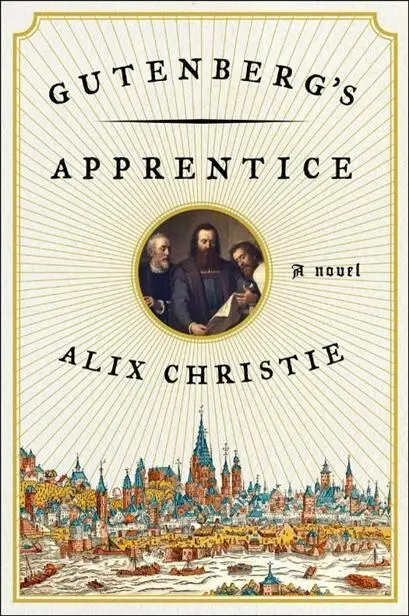
- Название:Gutenberg's Apprentice
- Автор:
- Издательство:Harper
- Жанр:
- Год:2014
- ISBN:нет данных
- Рейтинг книги:5 / 5. Голосов: 1
-
Избранное:Добавить в избранное
- Отзывы:
-
Ваша оценка:
Gutenberg's Apprentice: краткое содержание, описание и аннотация
Предлагаем к чтению аннотацию, описание, краткое содержание или предисловие (зависит от того, что написал сам автор книги «Gutenberg's Apprentice»). Если вы не нашли необходимую информацию о книге — напишите в комментариях, мы постараемся отыскать её.
Youthful, ambitious Peter Schoeffer is on the verge of professional success as a scribe in Paris when his foster father, wealthy merchant and bookseller Johann Fust, summons him home to corrupt, feud-plagued Mainz to meet “a most amazing man.”
Johann Gutenberg, a driven and caustic inventor, has devised a revolutionary — and to some, blasphemous — method of bookmaking: a machine he calls a printing press. Fust is financing Gutenberg’s workshop and he orders Peter, his adopted son, to become Gutenberg’s apprentice. Resentful at having to abandon a prestigious career as a scribe, Peter begins his education in the “darkest art.”
As his skill grows, so, too, does his admiration for Gutenberg and his dedication to their daring venture: copies of the Holy Bible. But mechanical difficulties and the crushing power of the Catholic Church threaten their work. As outside forces align against them, Peter finds himself torn between two father figures: the generous Fust, who saved him from poverty after his mother died; and the brilliant, mercurial Gutenberg, who inspires Peter to achieve his own mastery.
Caught between the genius and the merchant, the old ways and the new, Peter and the men he admires must work together to prevail against overwhelming obstacles — a battle that will change history. . and irrevocably transform them.
Gutenberg's Apprentice — читать онлайн бесплатно полную книгу (весь текст) целиком
Ниже представлен текст книги, разбитый по страницам. Система сохранения места последней прочитанной страницы, позволяет с удобством читать онлайн бесплатно книгу «Gutenberg's Apprentice», без необходимости каждый раз заново искать на чём Вы остановились. Поставьте закладку, и сможете в любой момент перейти на страницу, на которой закончили чтение.
Интервал:
Закладка:
Johann Gutenberg felt himself anointed, chosen, just as Peter did. But this was not enough. He had to rub their noses in it, claim it all — make sure that he was seen and praised, acknowledged by the world.
CHAPTER 6: JOHANNESFIRE
Feast of John the Baptist (24 June 1452)
ON MIDSUMMER’S DAY they laid the fire out in a flattened field behind the waters of the Bleiche. The air was too dry to risk the need-fire closer to the houses. The council had considered banning any bonfire altogether, until the livestock handlers howled. There was a need, that year as every year, to purge all sickness from the herds. There could not be relief, for man or beast, without Johannisfeuer.
Who did not feel renewed, indeed, by flames that burned the dross away? The summer bonfires of Peter’s childhood still were close inside his heart. “Higher, higher!” voices always chanted, children crying “Two ells, three!” and leaping and laughing to feel the hellfire licking at their feet and know the harvest would be just as high. Each year he’d watched the women gather the St.-John’s-wort on the bright and shadeless stroke of noon; how he had marveled, as a child, to see them rub those yellow stars that gave off bright red drops of Christ’s own blood.
The master let them put away their tools before the sun had started sinking in the sky. Not out of any kindness, or to free them for the celebration, though. Peter saw him make his way toward the quay and the Frankfurt market boat. Of course — for it was the feast of John the Baptist, the twenty-fourth of June, the day that payments on the Elders’ bonds were made. The only heavy hearts were on the councils of free cities that were forced to pay. Each rich man had his little sack of gold, each workingman a copper heller for his purse, which wife or daughter lined with orchid root to keep the luck from draining out.
Peter told Hans and Ruppel they should find a high spot on the hill to view the spectacle of bonfires burning on each distant slope, each village and each peak along the Rhine. It seemed to him that God above must love that sight, for all its heathen roots: the pinpoints strung along the river like a gleaming rope of fire. By the way that Keffer brushed his yellow beard, they knew that he would court that night — as Peter would himself this year. He’d asked Anna to come watch the fire with him on the hill of the Altmünster. It happened that the year was one in seven, so the pilgrims from the east had come by oxen train and mule to board in Mainz the ships that would carry them to Aachen. They camped outside the cloister walls, and reverenced the relic on its altar, a sweat cloth used by some early Christian martyr. It seemed to Peter quite a fitting place to stand and watch, for goldsmiths, most particularly, were cautioned to keep distance from the solstice flames — and he did count himself, by now, among their number. Their patron saint, Eligius, warned Christians quite expressly to beware the dancing and the chants, the heathen burning of the herbs for luck, as superstition if not worse.
Anna’s mother was a dyer and a weaver; for that reason Anna knew the Bleiche well, and gave him as a meeting point the dyers’ hut. She’d paid a boy to send her note; when it arrived, he tried to open it in private, but Ruppel saw it and sang out.
“Sweets for Saint Peter, eh?” He grinned and wiped his hands upon an inky rag.
“You know a setter does it with great feeling in the fingertips.” Keffer winked.
“I hate to think what pressmen do,” Peter laughed in answer, conjuring some strapping, well-built lass. “Each to his own, I say, and may we all come back half sober.”
He dressed with care in fresh fawn leggings, belted on a blue-green tunic. He did not wish to make himself too fine, yet as he prepared his body for her eyes, he felt that any less would be too little. Smoke was curling from the chimney as he neared the hut; the order had not yet gone out to douse the city’s fires. His heart pressed hard against his ribs, which seemed to spring and open like a lock when he first saw her waiting with a basket on her arm. She took his outstretched hand and put it to her cheek, then gave it back. He asked her what she hoped to gather in her basket, and she looked out from those dark almond eyes and laughed.
“What would you like me to collect?” she asked.
“My fingers, and my toes, my hair, my eyes, my clothes.” He made to peel each thing away in naming it, and cast each part inside her woven bowl.
“Ah, that would never do,” she said. “For I would have you whole.”
She showed him in. He understood that she was showing, too, the women gathered there that all was seemly and correct. Her mother smiled, and straightened from her stirring at the tub. She could not greet him properly; she flapped her blood-red hands. It shocked him, just a little — all those women with their skirts hiked up, above that boiling tub of madder root, their aprons stained as if with gore. They dyed the linen there in shades of coral, brick, and rose, and dried it on the posts along the brook. The boiling room was hot and close, like a confinement, he supposed. They fled at last to cooler air and sweeping vistas from the hill.
There was a little bridge that led them up across the fields and to the wilder bushes just below the Altmünster. Anna would not go beyond the hedges to the holy ground until she’d gathered up the herbs she’d need that evening. He nodded, dumbly, said he’d be her willing slave. Here we can find the comfrey and the elderberry bush, she said. He held her basket as she plucked and did not try to hide how much the watching of her slender, bending body pleased his eyes.
“But you can pick as well,” she said after some time. “Why should the woman do all the work?” He laughed at that, and called her rebel, and she flashed her eyes.
“I think such hands as yours are used to labor.” She took one, turning up his palm. He felt her trace the lines with every tingling fiber. “Such hands, on such a gentleman.” She laughed and shook her head. For they were rough, of course, and shiny with hard wear.
“The wonder is they have not lost their feeling.” He squirmed inside, recalling Keffer’s jest.
“Why should they? When they do the same, with God’s Word, every day?”
He wanted then to kneel before her and bury face and arms and heart. Yet when he raised his eyes he saw upon her face a strange, contorted look. It pierced him, how she seemed, all turned within herself. He did not know then how to read her.
“These hands,” he said, and raised her palm to place it praying to his own, “are simply tools. For gathering or painting, making letters, it is much the same.”
“You know that it’s not so.” She bit her lip and shook her head.
He thought he understood then her reluctance, her shrinking.
“What makes you think this hand is different?” he asked.
“You know as well as I,” she said, and looked severe.
“I do not, truly.”
She shook her dark and shining head; he saw the struggle on her lips. “It has — much finer things in store,” she said at last, her hand still captive in his own.
“And that’s the matter.” Unequivocally, he knew it. “That’s why you turn and look away. Because of who my father is?”
She took an elderberry from her basket, crushing it between her fingers. Pale green juice ran down her skin. “I am a painter’s daughter. You, a clericus .” She looked him gravely in the face. “I do not think your father has a bride like me in mind.”
“My father’s dead these fifteen years.”
But she was not convinced.
He told her then that Johann Fust could not refuse. How could he possibly, when he himself had chosen Grede? A craftsman’s daughter, and a binder, with strong hands like hers, though not so elegant and fine.
Читать дальшеИнтервал:
Закладка:
Похожие книги на «Gutenberg's Apprentice»
Представляем Вашему вниманию похожие книги на «Gutenberg's Apprentice» списком для выбора. Мы отобрали схожую по названию и смыслу литературу в надежде предоставить читателям больше вариантов отыскать новые, интересные, ещё непрочитанные произведения.











Обсуждение, отзывы о книге «Gutenberg's Apprentice» и просто собственные мнения читателей. Оставьте ваши комментарии, напишите, что Вы думаете о произведении, его смысле или главных героях. Укажите что конкретно понравилось, а что нет, и почему Вы так считаете.