Alix Christie - Gutenberg's Apprentice
Здесь есть возможность читать онлайн «Alix Christie - Gutenberg's Apprentice» весь текст электронной книги совершенно бесплатно (целиком полную версию без сокращений). В некоторых случаях можно слушать аудио, скачать через торрент в формате fb2 и присутствует краткое содержание. Год выпуска: 2014, Издательство: Harper, Жанр: Историческая проза, на английском языке. Описание произведения, (предисловие) а так же отзывы посетителей доступны на портале библиотеки ЛибКат.
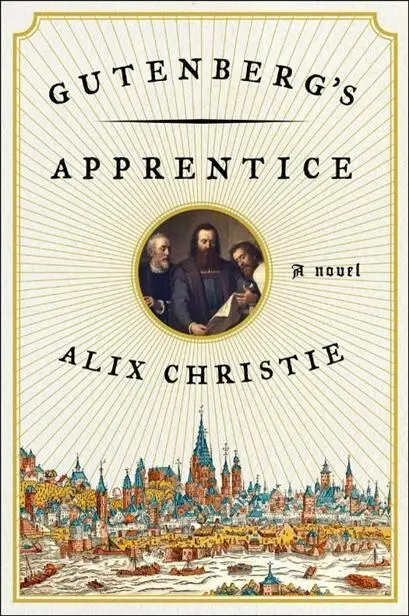
- Название:Gutenberg's Apprentice
- Автор:
- Издательство:Harper
- Жанр:
- Год:2014
- ISBN:нет данных
- Рейтинг книги:5 / 5. Голосов: 1
-
Избранное:Добавить в избранное
- Отзывы:
-
Ваша оценка:
Gutenberg's Apprentice: краткое содержание, описание и аннотация
Предлагаем к чтению аннотацию, описание, краткое содержание или предисловие (зависит от того, что написал сам автор книги «Gutenberg's Apprentice»). Если вы не нашли необходимую информацию о книге — напишите в комментариях, мы постараемся отыскать её.
Youthful, ambitious Peter Schoeffer is on the verge of professional success as a scribe in Paris when his foster father, wealthy merchant and bookseller Johann Fust, summons him home to corrupt, feud-plagued Mainz to meet “a most amazing man.”
Johann Gutenberg, a driven and caustic inventor, has devised a revolutionary — and to some, blasphemous — method of bookmaking: a machine he calls a printing press. Fust is financing Gutenberg’s workshop and he orders Peter, his adopted son, to become Gutenberg’s apprentice. Resentful at having to abandon a prestigious career as a scribe, Peter begins his education in the “darkest art.”
As his skill grows, so, too, does his admiration for Gutenberg and his dedication to their daring venture: copies of the Holy Bible. But mechanical difficulties and the crushing power of the Catholic Church threaten their work. As outside forces align against them, Peter finds himself torn between two father figures: the generous Fust, who saved him from poverty after his mother died; and the brilliant, mercurial Gutenberg, who inspires Peter to achieve his own mastery.
Caught between the genius and the merchant, the old ways and the new, Peter and the men he admires must work together to prevail against overwhelming obstacles — a battle that will change history. . and irrevocably transform them.
Gutenberg's Apprentice — читать онлайн бесплатно полную книгу (весь текст) целиком
Ниже представлен текст книги, разбитый по страницам. Система сохранения места последней прочитанной страницы, позволяет с удобством читать онлайн бесплатно книгу «Gutenberg's Apprentice», без необходимости каждый раз заново искать на чём Вы остановились. Поставьте закладку, и сможете в любой момент перейти на страницу, на которой закончили чтение.
Интервал:
Закладка:
“Why useless?” Peter asked.
“We’d planned to buy a farm.” Hans wrapped the ring and tucked it back.
“I’m sorry.”
Hans made a little motion with his head. “God has long since saved their souls. She died in childbirth, see, her and the baby both.”
Peter put a hand upon his shoulder. “I’ll pray for them.”
“It’s just the time of year. It happened at this time of year, that’s all.”
Peter thought of saying he had lost his mother, too. But there he stood: alive, full-grown.
They walked slowly back toward the Humbrechthof, past the grocers’ guild, decked out in bunting for the blessed birth, the shuttered workshops of the plumbers and the rope makers. The wind came scouring down the river gorge, pushing all the snow clouds to the south. Above them there were patches of deep black and stars. They both looked up but gave no heed to how they trod the snow below. Yet now, years later, as he looks upon them, Peter sees the way their paths diverged. Each went his separate way, to end the feast day in his separate church: Hans to join the master at St. Christopher, Peter to the Fusts at St. Quintin.
CHAPTER 9: WILDERNESS
[4.5 quires of 65]
January — February 1453
THE TASK before them was as blank and boundless as the winter fields. In five months they had barely made a dent — less than a tenth of those twelve hundred eighty pages had been set and printed. They trudged half frozen through the days and nights, dulled by the blizzard: the white sheets rose, and fell, and rose again to settle on their drying lines.
Gutenberg sat motionless for hours, perched on his stool. He kept his cloak wrapped tight beneath his chin, his long beard tucked from sight. The strange effect was of a barn owl: all that stirred was his queer mop of hair, rotating as he watched their every move. His head would ratchet, and his body bob in a strange rhythm as he counted. He measured each man’s output: lines per hour, the pages through the press each day; the time it took to move a forme from stone to press, then back. The time between the printing of one page, and then the setting up to print the next. He had Lorenz bring in a small brass clock that sat there ticking as he eyed it, quill pen scratching, noting every movement of each hand.
A week of this, and he made his pronouncement. Another press would be required. Keffer was to run it, and they’d need two new men to apply the ink, another boy or two. The quantities of type and ink would double. Fust, anxious at the slowness of their pace, had clearly given his consent. The hammers started pounding, and two beaters came to spread the ink, one Götz, from Schlettstadt, then another Hans, from Speyer. Ruppel and Keffer each thus had his own press, with its inker and its devil. Wiegand and two other lads kept the sheets dampened, and when printed, dried and folded. In the composing room, Mentelin sat between Hans and Peter.
The new arrangement helped, at first. They picked the pace up and managed two full pages every day, in a shift that stretched from dawn to well past vespers. But then the pressmen learned the ins and outs and soon could crank the sheets out well before the setters had prepared the next. Those empty hours drove Gutenberg into a rage. A three-gammed gimpy mongrel bitch, he called them, pulling at his hair; he’d have to stagger things, and print the pages in a different way. Keffer would print a recto in the afternoon, Ruppel the next morning do its verso — and then vice versa. The inks he’d trick, so Keffer’s, with a bit more lead, would dry in time; the winter chill ensured the pages stayed well damped. That way each press would get half of another run each day; the setters would work longer, to keep both presses well supplied. Dear God, each man thought to himself, and groaned inside, and put his nose back to the grindstone.
Hope waned with the slow waning of their strength. Lent was a week or two away, but it had been a poor year for the grain, and only rarely did Frau Beildeck rustle up some meat or eggs. She tried to keep them going with root mashes and strong beer. Nor was the master’s mood improved: by February they had finished just six quires. They weren’t paid to idle, he snarled, pacing up and down. If any man got out of step, he was to see him: he’d find him work to do. “As for you lot,” he bawled toward the composing room, “I’d whip your buttocks if I didn’t need them on the stools.”
Mentelin, as gentle as a choirboy, looked stung. Peter laughed and shot right back, “You do, and I will fetch the guild.”
Instead, they learned after the fact, he went to Fust and told him that they had to have another pair of setting hands.
Each piece of type by then had gone beneath the press some thirty, forty times. The faces had begun to chip, the edges wear. The first they cast had never been that sharp to start with. There came a day when Hans decreed they had to stop and melt them down, and cast some more. The master was in Strassburg to recruit, and Hans was still the foreman. He kept Mentelin at setting type, to feed one press; the others gladly spent the hours beside the forge. It was remarkable, how lightly they all worked without the master breathing fire. Each man was part, and yet apart, responsible for his own task — just like the scribes who penned the students’ books in sections. Peter thought a great deal in those days of that whole world he’d left behind. Anna did not notice any difference in him; it pained him, even as he hid his real life from her. The falsehood roiled within him, as it must have twisted inside Peter, his disciple, on the morning of Christ’s death, when three times he denied Him. How practiced he was now at lies, thought Peter Schoeffer, tossing on his narrow bed at night.
The peaceful interlude was broken when the master came back unannounced one early February afternoon. Some of the men were seated, stirring; Peter cast with Götz; the boys were grinding ores. All froze the moment he stepped in.
“A pretty picture,” he said, stomping off the snow. “Though I don’t hear two presses going.” He had a youth with him, apparently the latest hire.
“We needed letters.” Hans wiped his hands and went toward him.
“I left you stocked.”
“They were too battered.” Peter stood.
“If I paid you men to think, I’d pay you more.” He cast them his disgusted scowl and went to count the finished piles. “That’s it? Good Christ.” He jerked a thumb toward the youth. “You’d better learn him quick.” Ruppel knocked the lad a stool and case; Hans and Peter quietly conferred. They’d have to cast the extra letters for this new man after hours, Hans said, or Gutenberg would burst a vein for certain.
Peter looked across the room and saw the way exhaustion dogged the master, too. His face was gray, his skin stretched thin and folded at the turned-down corners of his mouth. It was fatigue so deep it went right to the bone: Peter knew that feeling. He didn’t think enough, though, at the time, about those trips Gutenberg made, nor ask himself how they had added to the strain. The man did not divulge whom he had gone to see or what he did — he simply disappeared, then reappeared days later, grayer, sharper, more irate. At the time they chalked it up to their excruciating, crawling progress — and then the ghastly inverse speed with which the costs increased. The master wore the proof on his face: that long, dark beard, which in six months had turned to pewter, gray mixed in with anthracite and white.
Peter set the dull and droning lists of Exodus: begats and more begats, the endless spawn of Abraham and Isaac. They swam before his eyes, slipping from his turgid fingers. Those generations spooling from their seed did little else but strengthen his desire. For eight months he had courted Anna out of sight; he’d not been back once to the brothel or the baths. When Father Michael spoke that Sunday of right reason, recta ratio , it loosened something in his mind. Aquinas said each man possessed this one defining line: the moral compass that should guide his life.
Читать дальшеИнтервал:
Закладка:
Похожие книги на «Gutenberg's Apprentice»
Представляем Вашему вниманию похожие книги на «Gutenberg's Apprentice» списком для выбора. Мы отобрали схожую по названию и смыслу литературу в надежде предоставить читателям больше вариантов отыскать новые, интересные, ещё непрочитанные произведения.











Обсуждение, отзывы о книге «Gutenberg's Apprentice» и просто собственные мнения читателей. Оставьте ваши комментарии, напишите, что Вы думаете о произведении, его смысле или главных героях. Укажите что конкретно понравилось, а что нет, и почему Вы так считаете.