Alix Christie - Gutenberg's Apprentice
Здесь есть возможность читать онлайн «Alix Christie - Gutenberg's Apprentice» весь текст электронной книги совершенно бесплатно (целиком полную версию без сокращений). В некоторых случаях можно слушать аудио, скачать через торрент в формате fb2 и присутствует краткое содержание. Год выпуска: 2014, Издательство: Harper, Жанр: Историческая проза, на английском языке. Описание произведения, (предисловие) а так же отзывы посетителей доступны на портале библиотеки ЛибКат.
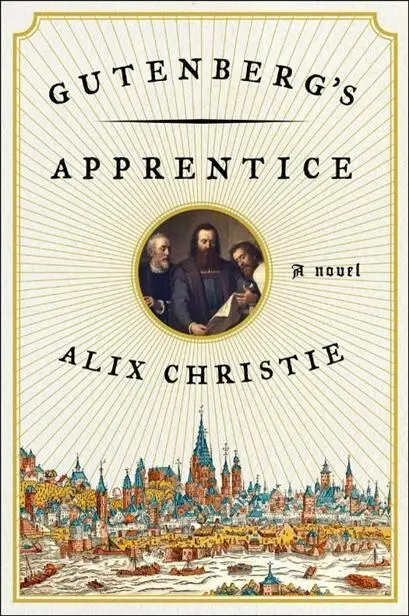
- Название:Gutenberg's Apprentice
- Автор:
- Издательство:Harper
- Жанр:
- Год:2014
- ISBN:нет данных
- Рейтинг книги:5 / 5. Голосов: 1
-
Избранное:Добавить в избранное
- Отзывы:
-
Ваша оценка:
Gutenberg's Apprentice: краткое содержание, описание и аннотация
Предлагаем к чтению аннотацию, описание, краткое содержание или предисловие (зависит от того, что написал сам автор книги «Gutenberg's Apprentice»). Если вы не нашли необходимую информацию о книге — напишите в комментариях, мы постараемся отыскать её.
Youthful, ambitious Peter Schoeffer is on the verge of professional success as a scribe in Paris when his foster father, wealthy merchant and bookseller Johann Fust, summons him home to corrupt, feud-plagued Mainz to meet “a most amazing man.”
Johann Gutenberg, a driven and caustic inventor, has devised a revolutionary — and to some, blasphemous — method of bookmaking: a machine he calls a printing press. Fust is financing Gutenberg’s workshop and he orders Peter, his adopted son, to become Gutenberg’s apprentice. Resentful at having to abandon a prestigious career as a scribe, Peter begins his education in the “darkest art.”
As his skill grows, so, too, does his admiration for Gutenberg and his dedication to their daring venture: copies of the Holy Bible. But mechanical difficulties and the crushing power of the Catholic Church threaten their work. As outside forces align against them, Peter finds himself torn between two father figures: the generous Fust, who saved him from poverty after his mother died; and the brilliant, mercurial Gutenberg, who inspires Peter to achieve his own mastery.
Caught between the genius and the merchant, the old ways and the new, Peter and the men he admires must work together to prevail against overwhelming obstacles — a battle that will change history. . and irrevocably transform them.
Gutenberg's Apprentice — читать онлайн бесплатно полную книгу (весь текст) целиком
Ниже представлен текст книги, разбитый по страницам. Система сохранения места последней прочитанной страницы, позволяет с удобством читать онлайн бесплатно книгу «Gutenberg's Apprentice», без необходимости каждый раз заново искать на чём Вы остановились. Поставьте закладку, и сможете в любой момент перейти на страницу, на которой закончили чтение.
Интервал:
Закладка:
No man could know, until it rose to greet him, which path the Lord had chosen. Nor, with respect, could Fust decide which partner he should have. Peter had been waiting long enough; there’d never be a better time.
He went to see his father in his counting house. At the landing he paused briefly to prepare himself. Up from the great hall of the Kaufhaus came a steady throb of sound. He knocked; his father barked, “It’s open.” His face went instantly from peevishness to something like relief. “I had expected Koestler, come to sell me short.”
Peter smiled and spread his hands. “Do I look like a thief?”
His father wiped his face. “Then sit.”
He did as he was bid, and drew a breath. “I’ve made it into Exodus, in time for Lent,” he said. “And the new lad’s working fine.”
“Excellent.” Fust leaned back, hands crossed on his paunch.
“It’s well and truly started.”
His father nodded, waiting.
“And so… I feel it’s time. You’ll understand that I am loath to face this thing alone.”
The broad face spread into a knowing smile. “Ah,” Fust said — and then the words that Peter hoped to hear. “Indeed. You’re right.” He reached into his cupboard for the glass decanter. “And here I feared you’d come from Gutenberg with some new demand for gold.”
“I’ve put a little by,” said Peter.
Fust laughed, and pushed the full glass toward him. “That shouldn’t matter, if the dowry’s right.”
“It’s not the dowry that concerns me.”
“It should.”
He steeled himself. “I want a partner, not a linen chest.”
Fust stopped, his glass half poured.
“You married whom you chose,” Peter pushed on. “And not some contract with an Elder clan.”
“I had achieved a certain standing.” Fust’s eyes were narrow now. “I had a certain latitude, from being widowed.”
“Standing.” Peter thought of Grede. He forced himself to keep a level tone. “A man can fashion his own standing, I would think. You’ve said yourself the world is changing.”
Fust raised his hands, as if to silence him. “You do not know the world.” His tone was sharp.
“I know enough to pull my weight.” Peter looked into the blue shards of his eyes. “And take the woman whom I choose.”
“Who would be—?”
“Anna Pinzler.”
His father’s mouth fell in a bitter line. “You are a fool then, after all.”
A rush of sorrow flooded into him as swiftly as a molten metal, hardening in an instant in his heart. This debt was never-ending, then: no sacrifice of Peter’s would suffice. He’d owe and owe until the last day Fust drew breath. So be it.
“You ask for my consent?” His father’s voice was hard. “Or simply tell me that you’ve plowed the wench, and so must do your duty?”
Peter might have struck him, had not reason or some ancient prohibition stayed the surge of heat inside. “Disgusting words,” he said, when he came back to something like himself. His nails bit deeply in his palms. “I never thought to hear such filth out of your mouth.”
“I’m not the one who will be shamed.” His father heaved his torso up toward him.
“You shame me now.”
“By damn, you’re obstinate.”
Peter pushed himself up slowly. Fust was tall and broad; the desk stood in between them. But Peter was no knave, no orphan boy who’d benefit from a hard knock — not anymore.
“I will not give you my consent. I did not raise you to throw out your brightest prospects.”
“My prospects?” Peter harshly laughed. “Mine — or yours? You know they never were for me — but just your own advancement.”
“That’s quite enough.”
“Indeed.” He looked at Fust, his face half mottled in his rage. Red marks like posy-rings of pox, he thought. “And if I left?” One last, sharp thrust. “Who would you get to make your Bible then?”
“So you resort to threats.”
“I know my worth.”
“You think too highly of yourself.”
“Not one of them can draw or carve as I do, and you know it.”
“No man is indispensable. Not you, not Hans. Not even Gutenberg.”
“And even so you wouldn’t like to lose me.”
Fust stared at him as if he were a stranger. “You’ve learned from him, I see — just how to bite the hand that feeds you.”
At that his son walked to the door. He glanced once as he put his hand upon the knob, but Fust had turned to look over the trading hall. All Peter saw was his broad back; all that he heard was that incessant roar.
He moved his things to the Humbrechthof that afternoon. There wasn’t much to take: his shirts and books and writing pouch. Before he left he sought out Grede to tell her he was going. She had been tucking in the children for their naps; with a finger to his lips, he drew her out into the hall.
“I asked for Anna Pinzler’s hand,” he said. “Your husband has refused.”
She put a hand up to her mouth. “Dear God.”
He couldn’t tell the reason for her shock — the choice of bride, or Fust’s reply.
“I’m leaving now.”
She gripped his arm. “No, Peter, surely—”
“You can reclaim your room. I’ll sleep above the shop.”
Her fingers tightened. “You could have asked me — why did you never think that I might help?” She stared at him, her dark eyes huge.
“He wants an Elder bride or none at all,” he told her brusquely. “I thought to spare your feelings.”
She stiffened. “You do not know him as I do.”
“I’m sure that’s true.” Peter took her hands in his. “I’m sorry, Grede.”
“Just let me try—”
He raised her hands and kissed them gently. “Too late. I should have thought of it before. But now—” He shrugged, and walked away down the long hall.
The workshop was locked tight. But Peter had been trusted once. His father’s son enjoyed the privilege of a key. He drew it out and locked himself inside. Keffer was the only man upstairs, curled up asleep on his straw pallet. He cracked an eye when Peter put his satchel down. A grunt, and then he pulled his blanket tighter, rolled back into twitching dreams. The place was freezing, frost on both sides of the thick, waxed windowskins.
Below there was a glowing heart deep in the ashes of the fire. Peter wakened it and fed it and then set to work. In work there was forgetfulness; through all those months and years the need for letters never waned. Each idle moment they would cast some more, and ever more, replacing those the press had worn, making ever-larger piles to feed that ever-growing crew.
Sometime during that snowy afternoon the master put his head in, to complain about the waste of fuel. “A step ahead,” replied the stony figure at the forge. “It makes more sense for me to sleep here too.” Gutenberg regarded him, one bushy eyebrow raised. “At least you don’t eat much, the way you look,” he said, and went away. It was, indeed, the gauntest season. Fitting, too, that his expulsion from the house of Fust should fall just on the cusp of Lent — the fasting hunger time.
He filled the space where gratitude and love had been with tin and lead. He did not feel he owed a soul an explanation. Hans knew better than to ask; Mentelin knew nothing of it; Keffer, though good-hearted, was a clown. Gutenberg had doubtless guessed that Peter and his father had had words. But he said nothing, for it suited him, of course, to have the whole crew underneath one roof. As it felt right to Peter too, in that dark time of year, to close himself inside the space where he had always lived, wrapped up in parchment, paper — tied with letters, ink.
He would not lie directly to her face. He could not. Yet even so he lived in fear that Anna — bright and observant as she was — would somehow learn that Fust had refused. It never crossed his mind to throw himself upon her mercy and confess their plight. He knew too well how Pinzler would respond. He’d be compelled, for honor, to withdraw and reject Peter’s suit. And so, though he was careful not to lie outright, he breathed deceit: he crept and he dissembled.
Читать дальшеИнтервал:
Закладка:
Похожие книги на «Gutenberg's Apprentice»
Представляем Вашему вниманию похожие книги на «Gutenberg's Apprentice» списком для выбора. Мы отобрали схожую по названию и смыслу литературу в надежде предоставить читателям больше вариантов отыскать новые, интересные, ещё непрочитанные произведения.









Обсуждение, отзывы о книге «Gutenberg's Apprentice» и просто собственные мнения читателей. Оставьте ваши комментарии, напишите, что Вы думаете о произведении, его смысле или главных героях. Укажите что конкретно понравилось, а что нет, и почему Вы так считаете.