Alix Christie - Gutenberg's Apprentice
Здесь есть возможность читать онлайн «Alix Christie - Gutenberg's Apprentice» весь текст электронной книги совершенно бесплатно (целиком полную версию без сокращений). В некоторых случаях можно слушать аудио, скачать через торрент в формате fb2 и присутствует краткое содержание. Год выпуска: 2014, Издательство: Harper, Жанр: Историческая проза, на английском языке. Описание произведения, (предисловие) а так же отзывы посетителей доступны на портале библиотеки ЛибКат.
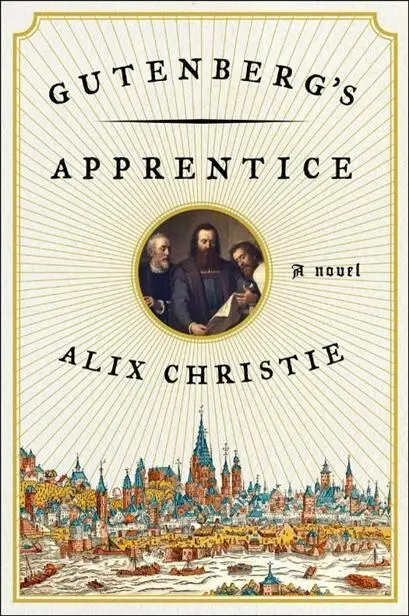
- Название:Gutenberg's Apprentice
- Автор:
- Издательство:Harper
- Жанр:
- Год:2014
- ISBN:нет данных
- Рейтинг книги:5 / 5. Голосов: 1
-
Избранное:Добавить в избранное
- Отзывы:
-
Ваша оценка:
Gutenberg's Apprentice: краткое содержание, описание и аннотация
Предлагаем к чтению аннотацию, описание, краткое содержание или предисловие (зависит от того, что написал сам автор книги «Gutenberg's Apprentice»). Если вы не нашли необходимую информацию о книге — напишите в комментариях, мы постараемся отыскать её.
Youthful, ambitious Peter Schoeffer is on the verge of professional success as a scribe in Paris when his foster father, wealthy merchant and bookseller Johann Fust, summons him home to corrupt, feud-plagued Mainz to meet “a most amazing man.”
Johann Gutenberg, a driven and caustic inventor, has devised a revolutionary — and to some, blasphemous — method of bookmaking: a machine he calls a printing press. Fust is financing Gutenberg’s workshop and he orders Peter, his adopted son, to become Gutenberg’s apprentice. Resentful at having to abandon a prestigious career as a scribe, Peter begins his education in the “darkest art.”
As his skill grows, so, too, does his admiration for Gutenberg and his dedication to their daring venture: copies of the Holy Bible. But mechanical difficulties and the crushing power of the Catholic Church threaten their work. As outside forces align against them, Peter finds himself torn between two father figures: the generous Fust, who saved him from poverty after his mother died; and the brilliant, mercurial Gutenberg, who inspires Peter to achieve his own mastery.
Caught between the genius and the merchant, the old ways and the new, Peter and the men he admires must work together to prevail against overwhelming obstacles — a battle that will change history. . and irrevocably transform them.
Gutenberg's Apprentice — читать онлайн бесплатно полную книгу (весь текст) целиком
Ниже представлен текст книги, разбитый по страницам. Система сохранения места последней прочитанной страницы, позволяет с удобством читать онлайн бесплатно книгу «Gutenberg's Apprentice», без необходимости каждый раз заново искать на чём Вы остановились. Поставьте закладку, и сможете в любой момент перейти на страницу, на которой закончили чтение.
Интервал:
Закладка:
Peter stared, and stared, and wiped his eyes, and stared some more. He stumbled to the casting bench, groped for a letter punch, a mallet. He held the punch against the still-warm metal, smote it once. It left a deep, sharp hollow of the letter, perfectly reversed. A letter B , as in Beatus : now a perfect, solid mold. He put his hand upon it, laughed a bit, then wept.
All through that night he worked, cutting squares of metal alloy, some still warm and others in degrees of cooling. He tried them one by one, held fast inside a clamp, testing for the perfect density, resistance to the hammer’s blow. By morning he had made a small, square letter mold of cold, hard metal. A mold entirely crisp and fine, a deep impression that would hold its shape through many castings. He did not know it then, but in his wretchedness he’d found that new technique that would transform their work, which printers everywhere would use forever after. A faster way to cast their letters crisp and clean, repeatedly from metal matrices — no longer prisoners of crumbling clay or sand. It was their doing — Master Gutenberg’s, and Anna’s — though he never told them so.
CHAPTER 10: SPONHEIM ABBEY
Winter 1485
TRITHEMIUS stops Peter there. His voice breaks in, a little squeaky and excited. “You mean to say that it was you? Not Gutenberg? But you who made it work — invented this technique the same as it is used today?” He pitches toward Peter, his quill suspended, pointing like a hound.
“Invention is a big word,” Peter says. A stab at immortality, which Gutenberg had never shied from using. His old apprentice nods. “But yes.” His voice is calm. “It’s fair to say I did invent a key part of the process.”
He holds two fingers up to show the size of that small letter mold. “The matrix, which we struck with punches, that’s the name we gave it.”
The abbot’s head is cocked, his forehead creased. “Yet we have not heard any of this until now.”
“I did not shout it from the rooftops.” Peter smiles a private smile. He had preferred to show his mastery in every book he made; he’d kept his distance from the man who claimed it all and trapped him in his shadow. “The world went on, and then he died, and after that I saw no point in making claims.”
The truth had slumbered his whole life, until this abbot in his cloister called. “But as you say, posterity deserves to know.” Peter clears his throat. He gives the facts, as clear as he can make them, so that this chronicler will set it all correctly down.
“First Gutenberg devised the art of casting letters, using sand, then clay. But we had come, as I have said, to something of an impasse. By then we’d spent a fortune — four thousand guilders, I would guess — yet made hardly any progress, before I found that faster way of casting letters. Our Bible printing changed completely after that.”
It was Peter’s hand that held the mallet. He alone who did it, no one else. And yet he sees now how Gutenberg propelled it, too. He was the kind of man who pushed until things gave, a brute who could extract from them more than they ever thought they had.
That matrix redeemed him, certainly. Peter can still hear the way the master crowed. Oh, he was pleased: he praised him loudly at the time, though not again — not at the end, when it truly counted.
“How did it change things?” Trithemius inquires. He seems deflated in some way: he’s gathered back into himself, busy again with ink and quill.
“It was a major step. From this we jumped right to the caster that a man held in his hand.”
Trithemius just gives him a blank look.
“The apparatus we designed to hold the mold, and cast a single letter at a time. This was the main advance that brought the art up to the stage that it is now.”
They evolved it slowly, over time; he perfected it a few years later with the Frenchman, Jenson. The metal mold itself could just as easily have come from Hans, if Peter had not beaten him to it. None of it sprang to life full-blown. Yet what could a young monk know of the beauty of mechanics? How could a layman understand the many tiny, vital steps of true creation? Always they said: it was this man, or that man, this great visionary, that genius. Yet invention is a process, unpredictable and long. All Peter knows for certain is that each of them had been essential in some way.
He remembers mainly now how stunned he felt that day. All he could see was Anna’s white, revolted face. Nor did his father see the benefit, at first. They could make more type, faster, Fust said: So what? They still couldn’t print the pages any faster.
“That had occurred to me as well,” the abbot says.
“Write down that Gutenberg’s true genius lay in ordering the work, in breaking down and rearranging all the pieces.” On that Shrove Tuesday, he clapped his hands and spun the whole thing magically around.
“The costs were fixed. The only thing that we could do, he said, was boost the revenue. It struck him almost visibly — that we could easily print more.”
“Ah.” Trithemius makes a note.
That was when they increased the print run. They added five-and-forty copies more, most printed onto vellum. Fust was certain he could sell more lavish copies to the merchants at the northern fairs. What extra cost might be entailed in raw materials paled beside the sums those extra copies would bring in.
“We settled on one hundred eighty, which — in theory at least — would right the ledger.” The printer shakes his head.
“A lot of sacrificial calves,” the abbot murmurs.
“Indeed.” Peter thinks of Abraham and Isaac. “One hundred seventy for every copy.”
They gaze at one another for an instant. Peter sees the green fields of the Rhineland in that spring, the frisky gamboling of calves and lambs. With what excitement they had parted after Easter: Fust against the river swollen with the Alpine melt, to sell in Basel, Austria, Tirol — up to Bavaria, then across the Thuringian woods back home. He took a quire from each of the first Bible books to show in every city to the merchants and the Brudermeisters of the guilds — in every country castle to the princes, dukes and margraves. It was a risky move, but they had little choice. They needed the deposits that those buyers pledged.
Rome was not built in just one day, and neither was that Bible. Each step was key, he thinks: a part of that long chain they forged together with enormous effort. The workshop and the crew, the master and apprentice. He feels the loss then, stirring in a dusty corner where he’d laid it long before.
“The Sunday after that was Invocabit,” he tells the abbot quietly. “You needn’t write that down.”
Trithemius smiles, and lifts his hands — a little raising of his palms that’s halfway in between a blessing and a clap.
Invocabit me, et ego exaudium meum.
He shall cry to me, and I shall hear him.
That first Sunday of Lent, in the year of our Lord 1453, Peter had stood once more beneath St. Quintin’s vaulted nave. Johann Fust had asked him back and Peter had agreed; the painter’s daughter in her flight no longer stood between them.
Cry to me . So spoke the Lord unto the Hebrew tribes. Cry to me, from your wilderness, your weariness: the day of your deliverance is at hand.
The miracle was the multiplying, Peter thought — then and always. From the one loaf, many; from the two fish, enough to feed a multitude. The mystery of God came in through skin and hand and eyes: take this light, this bread, these words, and cast them wide. It filled the air, the ears, this sound now of the punches striking, platens crashing: ceaseless re-creation, over and over, world without end.
Читать дальшеИнтервал:
Закладка:
Похожие книги на «Gutenberg's Apprentice»
Представляем Вашему вниманию похожие книги на «Gutenberg's Apprentice» списком для выбора. Мы отобрали схожую по названию и смыслу литературу в надежде предоставить читателям больше вариантов отыскать новые, интересные, ещё непрочитанные произведения.


Обсуждение, отзывы о книге «Gutenberg's Apprentice» и просто собственные мнения читателей. Оставьте ваши комментарии, напишите, что Вы думаете о произведении, его смысле или главных героях. Укажите что конкретно понравилось, а что нет, и почему Вы так считаете.