Alix Christie - Gutenberg's Apprentice
Здесь есть возможность читать онлайн «Alix Christie - Gutenberg's Apprentice» весь текст электронной книги совершенно бесплатно (целиком полную версию без сокращений). В некоторых случаях можно слушать аудио, скачать через торрент в формате fb2 и присутствует краткое содержание. Год выпуска: 2014, Издательство: Harper, Жанр: Историческая проза, на английском языке. Описание произведения, (предисловие) а так же отзывы посетителей доступны на портале библиотеки ЛибКат.
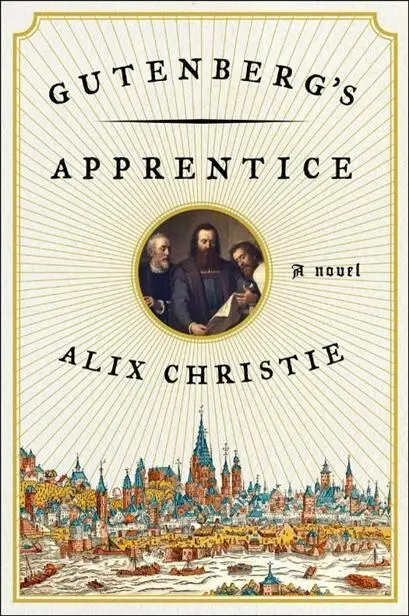
- Название:Gutenberg's Apprentice
- Автор:
- Издательство:Harper
- Жанр:
- Год:2014
- ISBN:нет данных
- Рейтинг книги:5 / 5. Голосов: 1
-
Избранное:Добавить в избранное
- Отзывы:
-
Ваша оценка:
Gutenberg's Apprentice: краткое содержание, описание и аннотация
Предлагаем к чтению аннотацию, описание, краткое содержание или предисловие (зависит от того, что написал сам автор книги «Gutenberg's Apprentice»). Если вы не нашли необходимую информацию о книге — напишите в комментариях, мы постараемся отыскать её.
Youthful, ambitious Peter Schoeffer is on the verge of professional success as a scribe in Paris when his foster father, wealthy merchant and bookseller Johann Fust, summons him home to corrupt, feud-plagued Mainz to meet “a most amazing man.”
Johann Gutenberg, a driven and caustic inventor, has devised a revolutionary — and to some, blasphemous — method of bookmaking: a machine he calls a printing press. Fust is financing Gutenberg’s workshop and he orders Peter, his adopted son, to become Gutenberg’s apprentice. Resentful at having to abandon a prestigious career as a scribe, Peter begins his education in the “darkest art.”
As his skill grows, so, too, does his admiration for Gutenberg and his dedication to their daring venture: copies of the Holy Bible. But mechanical difficulties and the crushing power of the Catholic Church threaten their work. As outside forces align against them, Peter finds himself torn between two father figures: the generous Fust, who saved him from poverty after his mother died; and the brilliant, mercurial Gutenberg, who inspires Peter to achieve his own mastery.
Caught between the genius and the merchant, the old ways and the new, Peter and the men he admires must work together to prevail against overwhelming obstacles — a battle that will change history. . and irrevocably transform them.
Gutenberg's Apprentice — читать онлайн бесплатно полную книгу (весь текст) целиком
Ниже представлен текст книги, разбитый по страницам. Система сохранения места последней прочитанной страницы, позволяет с удобством читать онлайн бесплатно книгу «Gutenberg's Apprentice», без необходимости каждый раз заново искать на чём Вы остановились. Поставьте закладку, и сможете в любой момент перейти на страницу, на которой закончили чтение.
Интервал:
Закладка:
They saw in their minds’ eyes the blood-red wave of conquest rolling over Europe’s eastern flank: eradicating Cyprus, the Knights Templar in their island fastness, Rhodes; spreading like a stain from Greece across the Balkans into Hungary, lapping at the boot of Italy, menacing Saint Peter’s rock in Rome.
“We’ll soon be levied,” Jakob said. “Though where the pope thinks we will find it, I don’t know.”
“Not in Aschaffenburg.” Fust grimaced. “Whatever army Dietrich raises, he’ll take out of our hides.”
“ If he raises an army,” Jakob said.
Peter pictured that huge languid head, its pale blue eyes. He’d never stick out his own neck: already months ago he had refused the pope’s call for another tithe.
“He wouldn’t dare refuse.” Fust looked genuinely shocked. “He could not fail to aid the church.”
Bitterly his brother smiled. “He does not give a damn.”
The smile was one they came to know in the ensuing weeks and months: of mirthless irony, and mockery, and self-defeat.
What good was government? Peter asked himself. What good those lords and masters, if they couldn’t at the very least assure the safety of the people in their lands?
“If he refuses, then at least he won’t take men and horses.” Grede leaned slightly forward, turning her white face toward Peter.
“True.” Fust too looked at his son. “At least for now.” He dipped his fingers in a bowl of water and wiped his forehead. “But God has acted for a reason. We’ll have to act as well, and soon.”
Peter knew by the way Grede looked at him that she wondered if he’d thought of Anna first in those sharp, awful instants on the square. His old friend did her best to read him still. Yet if she’d dared to ask, he would have had to disappoint her. He did not think of Anna then — nor had he, in the months since she had fled, appalled, except from time to time to marvel with a cold, hard mirth at how effectively the will of God was exercised, down to the smallest detail.
This miracle was never his to share.
This Bible was not his, nor Gutenberg’s, nor even Fust’s — but God’s.
In the first days, when, scorched and reeling, he’d reached out to her and tried to make her see, she had refused him. Such was his reward for breaking vows and baring soul and speaking truth. He’d written once again, and still received no answer; he had resolved to write no more.
Grede remonstrated with him, telling him that it was nothing more than a young girl’s superstition. It was that unknown, fear-filled world of letters: magic, potent in their strangeness and their power. But Peter saw it otherwise. The weak — corrupted, lacking faith — must all be punished.
Let others quake and mewl. He understood at last the Lord’s design. He bowed himself, a tempered thing passed through the fire, a hardened tool at God’s command.
The western powers held their breaths throughout the barren weeks and months that followed. Rain did not fall; the crops failed then, as if the Lord had also ordered nature to deprive them of all comfort. Word came of refugees that swarmed the Adriatic ports, emaciated, crawling from the stinking holds. The pestilence crept back with them, oozing up the river valleys, bringing its black marks of death — as if that dark avenging angel too must feed upon the weakened corpus of the world.
Who would now willingly recall the nakedness and sense of violation of that time, the strange, unmoored abandon that it bred? The layer that protected them was stripped away. Peter’s morning walks were filled with beggars and their speechless offspring, bowls held out, eyes hollow, forced like rats into the city from the desolation of the land. Each morning he saw farmers sprawled in their own vomit, dead to God or devil, stinking of the friars’ wine. The churches for their part were never fuller. The faithful rose to gird themselves at the dawn mass, to guarantee an angel at their side throughout the day. Grede, especially, was fearful of the failing of the crops and what it might presage. The news out of the east had come just on the feast day of Saint Margaret, the patron saint of childbirth, although her own time was still some months off.
And Gutenberg became a man possessed, as if he’d been hail fellow and well met before. They had to pick it up, get moving. He cursed the sky, the stars, the sun and moon. Lord only knew how long they had. If he knew more than anyone what Dietrich planned, he did not let them know it. He only took that chart on which they tracked their progress and stared at it unblinkingly, as if it were the Turin shroud.
The quires still left to print stretched to the right like empty squares on a chessboard. The rows marched two by two, stacked one above the other: Peter’s work and Hans’s, then underneath this, indented by some months, the quires assigned to Mentelin and the new fellow. “Hopeless,” Gutenberg said, one finger boring on the place they’d reached. Of all those quires, they had not printed even half. He looked at Peter, glittering, but did not see him; Gutenberg looked back, frowning at the lousy chart.
“It is the heat,” said Peter. “Unless you have some magic way to cool the day.”
The master only raised his eyebrows.
It was then that both those partners started viewing the whole workshop as a monster, Peter thinks — lumbering, insatiable, and slow. Devouring all they tossed into its maw, but for all that not moving one iota faster.
His own invention had done wonders for the text. The printed letters were extremely beautiful and dark, their edges crisp and biting evenly. But the metal matrix had not really helped with speed. Nor was it, frankly, as robust as he had hoped: it held for only thirty castings until the plate began to buckle. He’d shown the master one torqued piece a month before, and said they might try strengthening with copper, but Gutenberg had only snarled. “With what?” His eyeballs rolled. “Unless you beg it from your uncle, or your father has a mine up his backside.”
He’d made such remarks before, about how nice it had to be to lay one’s hands on ready gold. Once Fust had come back flush from Paris and handed every man a silver coin. The master had just sneered and said, “And me? And me?”
That late July he tapped his finger on the chart and said, “Another press, another team of setters. Or we’ve no prayer of finishing next year.” As if what any of them did would make a difference, Peter thought. “And even then,” the master went on, scowling: “The hounds of war might be unleashed, and buyers all the scarcer.”
He took a blade and lifted all the empty quires beyond the ten they’d been assigned, and placed them underneath in two new rows. There was no council, no debate, for Fust had left in haste for Basel to assess the damage to his Levant trade. Nor did Peter write to tell him. It was no longer his concern. He did not stand between them anymore; he floated free now, as he’d hoped, though differently. He was a tool, of this there was no doubt. But it was not this master or this father whom he served.
Peter found it telling that the first wares to be lost were regal dyes — the purple of the popes and kings, crushed out of Adriatic snails. Lost too the medicines: the camphor and the ambergris, the vomit of the whale against the plague. Pepper and salt failed next: Who harbored the illusion that their city and their workshop would remain unscathed? Grede spoke of nothing else each week when Peter came to teach his stepsister Tina. The merchants’ wives passed information with the plate that made its way along the pews. The strings of oxen out of Hungary, the convoys filled with oils and olives: none of these set out across the Alps. They said that Ladislaw, the kaiser’s nephew, quaked in Hungary, launching frantic calls for reinforcements. The Turks had overrun Salonika and Athens, and now encircled Budapest. As bad for the merchants was the fact that buyers in the West had taken fright, or like the Duke of Burgundy, diverted what they might have spent on goods to weapons for the coming war.
Читать дальшеИнтервал:
Закладка:
Похожие книги на «Gutenberg's Apprentice»
Представляем Вашему вниманию похожие книги на «Gutenberg's Apprentice» списком для выбора. Мы отобрали схожую по названию и смыслу литературу в надежде предоставить читателям больше вариантов отыскать новые, интересные, ещё непрочитанные произведения.











Обсуждение, отзывы о книге «Gutenberg's Apprentice» и просто собственные мнения читателей. Оставьте ваши комментарии, напишите, что Вы думаете о произведении, его смысле или главных героях. Укажите что конкретно понравилось, а что нет, и почему Вы так считаете.