Alix Christie - Gutenberg's Apprentice
Здесь есть возможность читать онлайн «Alix Christie - Gutenberg's Apprentice» весь текст электронной книги совершенно бесплатно (целиком полную версию без сокращений). В некоторых случаях можно слушать аудио, скачать через торрент в формате fb2 и присутствует краткое содержание. Год выпуска: 2014, Издательство: Harper, Жанр: Историческая проза, на английском языке. Описание произведения, (предисловие) а так же отзывы посетителей доступны на портале библиотеки ЛибКат.
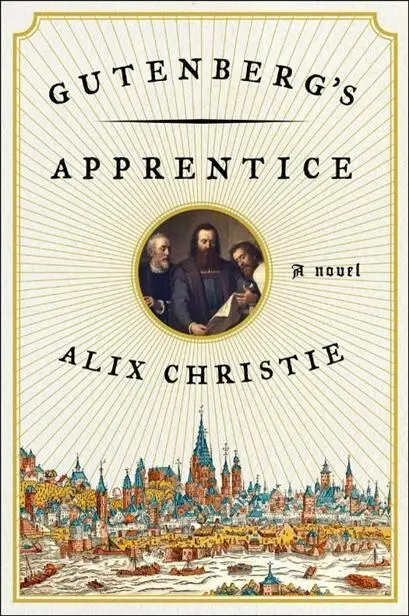
- Название:Gutenberg's Apprentice
- Автор:
- Издательство:Harper
- Жанр:
- Год:2014
- ISBN:нет данных
- Рейтинг книги:5 / 5. Голосов: 1
-
Избранное:Добавить в избранное
- Отзывы:
-
Ваша оценка:
Gutenberg's Apprentice: краткое содержание, описание и аннотация
Предлагаем к чтению аннотацию, описание, краткое содержание или предисловие (зависит от того, что написал сам автор книги «Gutenberg's Apprentice»). Если вы не нашли необходимую информацию о книге — напишите в комментариях, мы постараемся отыскать её.
Youthful, ambitious Peter Schoeffer is on the verge of professional success as a scribe in Paris when his foster father, wealthy merchant and bookseller Johann Fust, summons him home to corrupt, feud-plagued Mainz to meet “a most amazing man.”
Johann Gutenberg, a driven and caustic inventor, has devised a revolutionary — and to some, blasphemous — method of bookmaking: a machine he calls a printing press. Fust is financing Gutenberg’s workshop and he orders Peter, his adopted son, to become Gutenberg’s apprentice. Resentful at having to abandon a prestigious career as a scribe, Peter begins his education in the “darkest art.”
As his skill grows, so, too, does his admiration for Gutenberg and his dedication to their daring venture: copies of the Holy Bible. But mechanical difficulties and the crushing power of the Catholic Church threaten their work. As outside forces align against them, Peter finds himself torn between two father figures: the generous Fust, who saved him from poverty after his mother died; and the brilliant, mercurial Gutenberg, who inspires Peter to achieve his own mastery.
Caught between the genius and the merchant, the old ways and the new, Peter and the men he admires must work together to prevail against overwhelming obstacles — a battle that will change history. . and irrevocably transform them.
Gutenberg's Apprentice — читать онлайн бесплатно полную книгу (весь текст) целиком
Ниже представлен текст книги, разбитый по страницам. Система сохранения места последней прочитанной страницы, позволяет с удобством читать онлайн бесплатно книгу «Gutenberg's Apprentice», без необходимости каждый раз заново искать на чём Вы остановились. Поставьте закладку, и сможете в любой момент перейти на страницу, на которой закончили чтение.
Интервал:
Закладка:
That much was true.
“It is — an honor,” Peter managed to get out.
“We’ll see, when we have made it to the finish.”
“Hans—”
“—won’t give a damn. He’s happy in his corner. You’ll be the foreman now: you’ll set the schedule, parcel out the quires.”
“It is an order, then.”
“Indeed.” The master’s eyebrows twitched.
To be so elevated. Raised, anointed — set above his fellows. Peter drew a breath at last. There was a twinge somewhere beneath his skin, the panicked voice of that young boy: I am not worthy, Lord . For just an instant doubt and shame consumed him: that a mere shepherd’s son should be so singled out. And then he shook it off.
“I will not let you down.”
“Excellent.”
They bashed their two tin cups.
“The only thing you need is discipline. A hard hand that can drive them.”
He meant to share with him the wisdom of his years. “God drives us, I would say,” responded Peter.
The master smiled, a trifle ruefully. “You keep me honest, Peter, that you do.”
“You do not see my less-than-worthy thoughts.”
“I’ve seen enough.” Gutenberg pitched suddenly toward him. “No women, that’s my only rule.”
Peter did not flinch, although his skin went cold, then hot. “That’s in the past.”
“They’ll suck you dry.” The master nodded, sitting back.
He ought to know. Peter smiled and looked him in his beady eye. “I heard that once there almost was Frau Gutenberg.”
“Deluded wench, to think I’d make a decent husband.” Once more the master snorted. “She sued me, if you can believe it. Breach of marriage pledge. I won, of course.” His look went far away. “People make claims, Peter. They’ll clutch at you, and try to hold you back.”
“No chance of that,” he answered.
They stood, and Peter reached his hand. But Gutenberg had started shambling round the table like some old demented bear, reaching his arms around him — briefly, awkwardly, as if he did not in the least know how to do it.
Peter left his hand upon one shoulder when the master dropped his and sprang back. “I owe you—,” he began to say.
“All well and good.” The master’s voice was gruff. “We’ll count it up above.”
Hans said he’d seen it coming a mile off. Gutenberg got bored, he said; he started itching for the next thing once the tricky parts were past. Not to take a jot from you, he quickly added: come to think of it, they’d never yet got to the end of anything the man had started. Nor did it seem that any of the other men had dreams of standing in the master’s shoes. There wasn’t much to gain from it, so far as they could see. It was in many ways a thankless task.
When Peter thinks back on that time, he sees himself alone, a solitary figure like the one upon the master’s family seal, bent underneath its burden. Weeks passed without a sign of either partner. The three of them were like the figures on the tower clock: racing past but never touching, never meeting, only pausing when the bells were struck, then off again to trace their lonely circuits.
Thank God he had the crew. Right away Keffer opined they ought to celebrate down at the Mallet. As his first act as foreman, Peter overruled him. Besides, the tavern would be shut when they had finished with their shift at cockcrow, he had claimed. In fact the problem was, the shop was getting porous. The bell of silence that the guilds observed had cracks; as their numbers grew, their secret had become that much more fragile. Recently his cousin Jakob had accosted him, half-crocked in the lane. “Time’s a-wasting,” he had slurred; that shop of theirs had smelted lead enough to line a hundred coffins. God, or else the devil, knew what weapon they were forging, but they’d better get a move on. Mainz could use their help right now.
The crew therefore assembled at the break of day upstairs, to consecrate their newly elevated master.
“To second winds,” said Hans, and started pouring.
“And second halves.” Peter unfurled the chart and pinned it on the wall. Why not enlist them, he had thought, and let them know how far they’d come, how far they all still had to go? The men all looked and found their names, and traced the quires that marched in a long row beside them.
“Second books too, I would wager.” Keffer’s feet were on the table as he rubbed his eyes.
“You said that years ago,” said Peter, laughing.
“Still.” The pressman shrugged. “I’d like to know what he is up to.”
“I’m only glad he didn’t hand it off to me,” said Hans, and stepped up spritely on a stool. He rapped his mug to get attention. “Now,” he said, “look sharp. I guess I’ll have to do the Brudermeister’s duty.” He nicked his chin at Peter. “The man’s no master till he’s baptized, eh?”
He jumped back down, and Keffer, Ruppel, and the rest all stood, except the Bechtermünzes, who looked on, amazed. The table they shoved to one side; then all six rolled the sleeves of their right arms. Hans beckoned Peter to the edge of the ring they formed in the middle of the room.
Each man stretched out his hand and placed it over Hans’s, until all six stood linked, their arms connected like the six spokes on the city’s wheel.
Keffer reached to fill a cup with his left hand, and placed it on the topmost mitt. They started singing then, and raised their arms as they began to turn, lifting as they turned the tilting, sloshing cup. The great wheel spun as they all shuffled, moving clockwise in the age-old drinking song that ended with the journeyman’s or master’s bath. When all their arms were well above their ears, the man to be anointed ducked into the circle and looked up, and braced himself for the last bellowed “To our fellow!” Six arms heaved up the cup and scattered, leaving Peter, face upturned, eyes closed, legs braced, mouth wide to imbibe the brandy as it plunged.
The tumbler clocked him in the cheek, but he was quick enough to grab it and to slurp what had not spilled. “Silver sounds much better,” he called, grinning, spinning, showering them with the last drops. The Bechtermünzes were still gaping, ignorant of goldsmiths’ ways — until they too were plied with schnapps.
They laughed and guzzled half the day; Peter wondered once if they would pay when it came time to work again that night. But they so rarely got a chance to take their ease or tell bad jokes or tap their toes to Keffer’s flute. He owed them that, at least.
Heading toward the outhouse, he crossed paths with Mentelin. The sun was blazing; Peter’s head felt hollow. They balanced on a trough and let the heat scorch the fatigue away.
“Salve,” said the gold-scribe, squinting at him and holding out one hand. “If that is what I ought to say.”
“I never asked for it.” Peter looked beyond him, blinded by the brightness. “I only thought about the task at hand.”
“I noticed that about you.”
Peter smiled. He was fanatical — perfectionist, he knew. He looked as closely as he could into those green and slitted eyes. “I have to take it as God’s will.”
Mentelin was nodding. “That’s what I told myself when I met Gutenberg.” Something in his tone made Peter ask. “You don’t believe it now?”
“I think the Lord must have a sense of humor”—he scratched his freckled face—“to put His faith in such a man.”
It hit Peter suddenly: Gutenberg was gone. “I’ll need your help,” he said. “If we are going to make it.”
Mentelin looked at him levelly. “I have no doubt.”
“I wish I shared your confidence.”
“‘Prepare ye the way of the Lord, make straight in the wilderness the paths of our God,’” the gold-scribe said.
Читать дальшеИнтервал:
Закладка:
Похожие книги на «Gutenberg's Apprentice»
Представляем Вашему вниманию похожие книги на «Gutenberg's Apprentice» списком для выбора. Мы отобрали схожую по названию и смыслу литературу в надежде предоставить читателям больше вариантов отыскать новые, интересные, ещё непрочитанные произведения.











Обсуждение, отзывы о книге «Gutenberg's Apprentice» и просто собственные мнения читателей. Оставьте ваши комментарии, напишите, что Вы думаете о произведении, его смысле или главных героях. Укажите что конкретно понравилось, а что нет, и почему Вы так считаете.