Alix Christie - Gutenberg's Apprentice
Здесь есть возможность читать онлайн «Alix Christie - Gutenberg's Apprentice» весь текст электронной книги совершенно бесплатно (целиком полную версию без сокращений). В некоторых случаях можно слушать аудио, скачать через торрент в формате fb2 и присутствует краткое содержание. Год выпуска: 2014, Издательство: Harper, Жанр: Историческая проза, на английском языке. Описание произведения, (предисловие) а так же отзывы посетителей доступны на портале библиотеки ЛибКат.
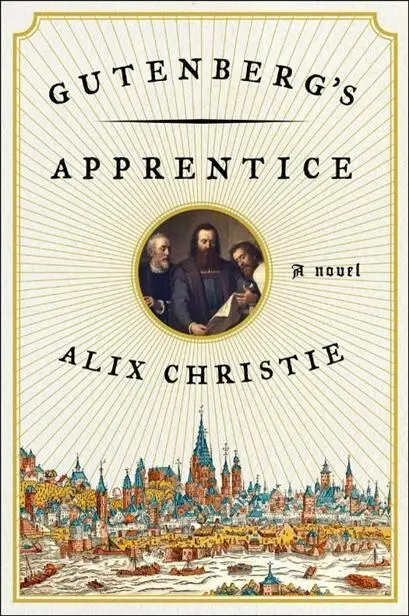
- Название:Gutenberg's Apprentice
- Автор:
- Издательство:Harper
- Жанр:
- Год:2014
- ISBN:нет данных
- Рейтинг книги:5 / 5. Голосов: 1
-
Избранное:Добавить в избранное
- Отзывы:
-
Ваша оценка:
Gutenberg's Apprentice: краткое содержание, описание и аннотация
Предлагаем к чтению аннотацию, описание, краткое содержание или предисловие (зависит от того, что написал сам автор книги «Gutenberg's Apprentice»). Если вы не нашли необходимую информацию о книге — напишите в комментариях, мы постараемся отыскать её.
Youthful, ambitious Peter Schoeffer is on the verge of professional success as a scribe in Paris when his foster father, wealthy merchant and bookseller Johann Fust, summons him home to corrupt, feud-plagued Mainz to meet “a most amazing man.”
Johann Gutenberg, a driven and caustic inventor, has devised a revolutionary — and to some, blasphemous — method of bookmaking: a machine he calls a printing press. Fust is financing Gutenberg’s workshop and he orders Peter, his adopted son, to become Gutenberg’s apprentice. Resentful at having to abandon a prestigious career as a scribe, Peter begins his education in the “darkest art.”
As his skill grows, so, too, does his admiration for Gutenberg and his dedication to their daring venture: copies of the Holy Bible. But mechanical difficulties and the crushing power of the Catholic Church threaten their work. As outside forces align against them, Peter finds himself torn between two father figures: the generous Fust, who saved him from poverty after his mother died; and the brilliant, mercurial Gutenberg, who inspires Peter to achieve his own mastery.
Caught between the genius and the merchant, the old ways and the new, Peter and the men he admires must work together to prevail against overwhelming obstacles — a battle that will change history. . and irrevocably transform them.
Gutenberg's Apprentice — читать онлайн бесплатно полную книгу (весь текст) целиком
Ниже представлен текст книги, разбитый по страницам. Система сохранения места последней прочитанной страницы, позволяет с удобством читать онлайн бесплатно книгу «Gutenberg's Apprentice», без необходимости каждый раз заново искать на чём Вы остановились. Поставьте закладку, и сможете в любой момент перейти на страницу, на которой закончили чтение.
Интервал:
Закладка:
Peter and Fust did not look alike, nor even think alike, his foster son reflected as he brought the wine to his lips. Yet how much had he given him, this solid, balding, kindly man. Peter had to honor this, no matter how his new awareness burned inside. A simple truth, but one that pounded hard within him. The scribe had made his mark: he was essential now. The workshop could not run without him. Fust and Gutenberg both knew it, too. No other man could carve those letters as he did, nor set them into graceful lines. It was remarkable, the lightness that this brought. How marvelous to be so needed, and how freeing.
CHAPTER 3: ALCHEMY
May 1452
THERE WAS NO END then to the roaring of the forge. The ores went into it in shovels and came out transformed. In cataracts the molten metal poured into the iron pots and mixed, and in thin streams sought out their molds. How long? they asked themselves, bent sweating from dawn to dusk. For every score of letters that came gleaming from the casting box, another hour went by in planing and in filing until they stood at the same height. When would they have enough? Peter asked the master, but the man just waved his hand.
“Keep on,” he said, and Peter thought of Pharaoh hardening his heart. Each plague the Lord sent down to free His chosen people from Pharaoh’s grip just tightened it, so stubborn was that slave master. Deliver us, O Lord , he prayed, stiff fingers guiding every punch into the clay. Bring us into the good and spacious land, the land that floweth with milk and honey.
His father returned and went on swiftly westward toward Bourges and after that to Paris. Somebody had to raise the gold they poured into that forge. The Duke of Burgundy by then had moved his court to Flanders, but there were markets still for pigments and for precious stones across the Loire and Île-de-France. The family saw his three big wagons off, the merchant perched up on the dashboard with his driver holding the long reins. Little Hans was like an eel on Peter’s shoulders, writhing as his elder brother gripped his legs. The boy was blue-eyed, golden, like his father; Peter dared to hope his father’s dreams no longer rested solely on the firstborn foster child. He and Grede and Tina watched the dust of their departure from the wall above the Martin’s Gate. The wagons disappeared in a great cloud along the thin brown line that ran between the abbeys, heading south and turning westward only after they had passed the line of hills. Behind the watchers, on the hill inside the city wall, white shards of Roman ruins poked out of the loam — just like the teeth of giants, Peter teased. Little Hans and Tina looked alarmed. He thought of this again a few days later as he took the long way from the workshop to the Guildhall — how the fallen of the past remain, their traces a reminder that all peoples perish.
His uncle Jakob had requested that he stop to see him, on some business, Peter had assumed. He climbed into the clear air high above the Kästrich, breathing deeply to expel the poisons from the forge. He walked along the wall and dropped at last onto the lane above the livestock market, looking at the city spread beneath him, sparkling like the waters of the Rhine.
The day was warm and bright; the double towers of the Altmünster were to his left, above their green fields sliced by a bright stream; below and to his right stood the red sandstone bulk of the cathedral. To either side poked up a score of spires, and just before him, in a cascade of blue slate, spread out the warren of the Jewish quarter. He plunged directly down a narrow lane. The Guildhall was two houses joined and tucked away among the heathen, as was only right: as hidden and remote from Elder power — Mint, cathedral, the archbishop’s court — as it was possible to be.
Peter dodged the hawkers clutching at him, crying out their wares, and turned into the Betzelstrasse and the hall called Mompasilier. The name was bastardized, a Rhinish hash of monplaisir . French for “my pleasure”: tavern, haven — coven even, some might say — for members of the city’s guilds. Peter had never liked the way they looked at him in there. He never had belonged — it struck him as he put his hand on the claw that served as doorknob. Not to a single guild, not even really to this city, until now. Until he hewed to Gutenberg, he’d hewed his whole life long just to himself and God.
His uncle had one corner of a private room reserved for Brudermeisters of the guilds. He raised a hand and waved Peter toward his table. Ale was drawn, delivered in two foaming tankards. Thirstily, Peter raised his: the brewers always sent their best to Mompasilier.
“I thought you might have heard about this order for indulgences.” His uncle was not one to waste his breath. As soon as Peter sat, his ice-cool eyes had probed his face and hands.
“No, sir.”
“Two thousand more, I am informed.” Jakob leaned toward him. “To pump the people even drier.” His fingers tightened on his beer stein. The city council frowned on the proliferation of these letters of indulgence. The letters in themselves were not the problem; all faithful people had the right to speed their way from purgatory if they could. But now the clergy seemed to crank them out at every chance, and this pumped more scarce guilders out of Mainz. Peter shook his head: he hadn’t heard.
His uncle held his hands so that the light would catch the massive seal on his guildmaster’s ring, it seemed to Peter, striking fear into the hearts of those whose lives were governed by those two crossed hammers.
“Your man Cusanus has requested them for Frankfurt.” Jakob’s eyes went left and right to verify that no one heard. “You’re not… involved, by chance… in making them, in that excuse that Gensfleisch calls a workshop?”
“I don’t know what you mean. We’re making mirrors.”
“Come now.” Jakob smiled. “He could produce a thousand chits with all that metal, I am sure.”
How like the man to pounce before his father’s trail was even cold. Of course Jakob did know; they paid his guild their dues. Then Peter started, as the meaning of his uncle’s words sank in. He had not thought of it before — the prospect of their art abused, its glory twisted to the traffic of the church.
How had it not occurred to him? He had thought only that the clergy would abhor the very notion of some trumped-up yokels printing off God’s Word. He hadn’t even seen that it was just as likely that Archbishop Dietrich would perceive their press as a new way to serve his economic interests. For metal letters could be used in any order, set and printed to decree whatever new insanity either side in that sad war desired. Peter leaned toward Jakob. “No one else knows. Outside of you — and Biermann.”
The mention of the tinsmiths’ leader irked his uncle; in the hierarchy of the trades, the goldsmiths had no truck with common smiths. It did not matter. Peter cast his mind back to that visit he and Gutenberg had made to Eltville-on-the-Rhine. The master claimed that Rosenberg, Archbishop Dietrich himself, had long since put the press out of their minds, but Peter wouldn’t be so sure.
“I wouldn’t put it past the cheat,” said Jakob, meaning Gutenberg.
“The answer’s no.” Peter sat back and raised his mug. “We’ve work enough to do.”
“Work’s fine, when it is done within the rules.”
Peter did not answer.
“I told Johann; I’ll say the same to you. If he’s protected by the guild, he will abide by the guild rules.”
“That’s a matter for my father and my master.”
“Your master .” Jakob’s face contorted. “The only thing he’s mastered is the art of fleecing Mainz. The man’s a snake, I say.”
Читать дальшеИнтервал:
Закладка:
Похожие книги на «Gutenberg's Apprentice»
Представляем Вашему вниманию похожие книги на «Gutenberg's Apprentice» списком для выбора. Мы отобрали схожую по названию и смыслу литературу в надежде предоставить читателям больше вариантов отыскать новые, интересные, ещё непрочитанные произведения.




Обсуждение, отзывы о книге «Gutenberg's Apprentice» и просто собственные мнения читателей. Оставьте ваши комментарии, напишите, что Вы думаете о произведении, его смысле или главных героях. Укажите что конкретно понравилось, а что нет, и почему Вы так считаете.