Alix Christie - Gutenberg's Apprentice
Здесь есть возможность читать онлайн «Alix Christie - Gutenberg's Apprentice» весь текст электронной книги совершенно бесплатно (целиком полную версию без сокращений). В некоторых случаях можно слушать аудио, скачать через торрент в формате fb2 и присутствует краткое содержание. Год выпуска: 2014, Издательство: Harper, Жанр: Историческая проза, на английском языке. Описание произведения, (предисловие) а так же отзывы посетителей доступны на портале библиотеки ЛибКат.
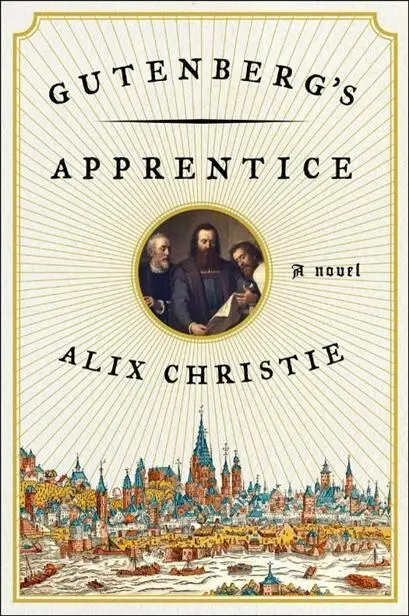
- Название:Gutenberg's Apprentice
- Автор:
- Издательство:Harper
- Жанр:
- Год:2014
- ISBN:нет данных
- Рейтинг книги:5 / 5. Голосов: 1
-
Избранное:Добавить в избранное
- Отзывы:
-
Ваша оценка:
Gutenberg's Apprentice: краткое содержание, описание и аннотация
Предлагаем к чтению аннотацию, описание, краткое содержание или предисловие (зависит от того, что написал сам автор книги «Gutenberg's Apprentice»). Если вы не нашли необходимую информацию о книге — напишите в комментариях, мы постараемся отыскать её.
Youthful, ambitious Peter Schoeffer is on the verge of professional success as a scribe in Paris when his foster father, wealthy merchant and bookseller Johann Fust, summons him home to corrupt, feud-plagued Mainz to meet “a most amazing man.”
Johann Gutenberg, a driven and caustic inventor, has devised a revolutionary — and to some, blasphemous — method of bookmaking: a machine he calls a printing press. Fust is financing Gutenberg’s workshop and he orders Peter, his adopted son, to become Gutenberg’s apprentice. Resentful at having to abandon a prestigious career as a scribe, Peter begins his education in the “darkest art.”
As his skill grows, so, too, does his admiration for Gutenberg and his dedication to their daring venture: copies of the Holy Bible. But mechanical difficulties and the crushing power of the Catholic Church threaten their work. As outside forces align against them, Peter finds himself torn between two father figures: the generous Fust, who saved him from poverty after his mother died; and the brilliant, mercurial Gutenberg, who inspires Peter to achieve his own mastery.
Caught between the genius and the merchant, the old ways and the new, Peter and the men he admires must work together to prevail against overwhelming obstacles — a battle that will change history. . and irrevocably transform them.
Gutenberg's Apprentice — читать онлайн бесплатно полную книгу (весь текст) целиком
Ниже представлен текст книги, разбитый по страницам. Система сохранения места последней прочитанной страницы, позволяет с удобством читать онлайн бесплатно книгу «Gutenberg's Apprentice», без необходимости каждый раз заново искать на чём Вы остановились. Поставьте закладку, и сможете в любой момент перейти на страницу, на которой закончили чтение.
Интервал:
Закладка:
A new contract was drawn up, witnessed by the pastor of St. Christopher’s, one Heinrich Günther. It did not nullify their first deal of two years before, but simply altered its conditions. Johann Gutenberg still brought the know-how; Johann Fust still brought the gold, and held the workshop as collateral. Except that now new capital was to be raised, a second round, to get this fledgling business off the ground.
Peter’s father too invoked the old adage: Once burned, twice shy. Why should he bear all of the risk while Gutenberg reaped the reward? No longer would he simply play the part of banker. He took an equal share in this, their common and uncommon venture. Fust pledged eight hundred guilders more, and they agreed to split, after expenses, the profits that accrued from what they called, a bit obscurely, to foil spies, das Werk der B ü cher . The work of the books.
They’d rented the Hof zum Humbrecht from a goldsmith who had moved to Frankfurt. But he still had relations, looping strands of kin all over Mainz. The city was a web of eyes and ears, not just the metalworkers but the butchers, bakers, saddlers, and sawyers, and the keepers of the taverns serving members of those four-and-thirty guilds. Prayer alone would not keep their secret safe.
It was the third time in the master’s life he’d had to hide the work he did behind a smokescreen. In Strassburg he had hid away in an outlying farm, and he had done the same in 1448, when he returned to Mainz. Nobody even guessed for months that he was back, so well dug in was he among the fields by St. Viktor’s. But this time it was different, he said. They had to hide there in plain sight.
He brought the metal dies out to where Peter and his father stood, surveying the new press. “You’d better tell the guild,” he said to Fust, “that your new forge is set on making mirrors.” He wiped the stamps with a clean rag and glanced at Hans and grinned.
“Mirrors,” Fust said, slow to comprehend.
“Pilgrim mirrors. Hundreds of them, thousands.”
These were to cover up the purpose of the lead and tin, the bismuth and antimony, that entered through the cellar door. The Humbrechthof was flanked on one side by a shoemaker whose shingle hung just at the angle of the Quintinstrasse and the Cobblers’ Lane, and on the other by a house whose sole inhabitant was one old man whose relatives just waited for his death to pounce. For all the time they labored there, the printers came and went like rats along the alley behind the row of houses that ended in a cul-de-sac not fifty paces from the market square.
“The tinsmiths will cry foul,” said Peter.
“Not if you have a word with your upstanding brother.” Gutenberg looked hard at Fust. The merchant pursed his lips, eyes flicking back and forth between his partner and the dies.
“Two guilds,” he said. “The smiths and then the gold- and silversmiths, both wanting dues.”
The master raised his outspread hands, as if to ask if they had any choice. He looked acerbically at Fust. “You know as well as I that even silence has a price.”
To that almighty Book each man brought his specific knowledge, which he tipped into creation’s forge. If Gutenberg could grasp and shape the larger whole, then Peter and his father brought more focused skills. Which mines were best for tin and lead, and at what price, which farm the cleanest linseed, which buyers might take paper, and which vellum: all this Fust could provide. Which version of the text to use, which form and shape upon the page: to Peter’s great amazement, Gutenberg deferred to his own expertise in this. And it was that confidence, that unexpected faith in his own skill, that finally brought him back into himself. This was Peter’s place, his path: to hold these alabaster sheets once more between his hands and make of them a meaning.
The Bible had to be a lectern book, of course: large enough for monks to read in the refectory, yet still austere and within any abbot’s means. Reform meant modesty in every way. For buyers they were counting on those abbeys in the Bursfeld congregation, seventy at least. To start, though, they required a model they could copy. The master snorted at the tattered pocket Bible the Franciscans used that Peter had brought back from Paris. Nor was he impressed by Fust’s more ornate books of hours. They had to get their mitts, he said, on one of proper size. To Fust’s look of horror he responded with a barking laugh, “No, not to buy! I mean to steal one with my eyes.”
Instantly the volumes at St. Jakob’s sprang to Peter’s mind. “Brack has the testaments,” he said.
The master tapped his finger at his forehead. “As well announce our business by the crier.”
One might have thought it easy to put hands on a monumental Bible in a place like Mainz. She did not lack for churches or chapels. Yet in those days the only full texts of the Bible were in cloisters, not on pulpits. Here and there a parish had received one as a gift, but these were locked up in their sacristies. Fust’s uncles were both ranking clergy at St. Stephan’s; he would pretend some bookish errand. Peter meanwhile would approach the priest at St. Quintin’s. Before two days were out, though, Gutenberg had beaten both of them. He sauntered in with a huge parcel underneath one arm: the parish Bible of St. Christopher’s, as fat and bulbous as a little dog. “I’ve got the deacon, too, to help correct the pages.”
Fust blanched. “Nobody else.”
“It can’t be helped.”
There was a moment when their eyes locked and the air between them crackled. Then all three bent above that hard brown leather mound.
The master placed a horny thumbnail on a ruby line that marked the ending of one chapter. “A hundred, hundred twenty,” he said, his look somber. “A job enough to print the black.”
They debated for some time how to produce it. Fust said the buyers should receive the plain black printed sheets directly from the press, folded and collected into quires. They then could have them decorated as they pleased, as they would do with any product of the scribes. They’d hire someone to write the running titles on each page, and pen implicits and explicits and the other ruby lines that marked the sections of the text. In his experience, a duke preferred a different kind of painting to a merchant or to an abbot; each would hire a painter to illuminate the margins, and a binder who would sew and then encase the quires.
“You think of dukes?” the master asked.
Fust smiled. “Why not?” He paused then, looked at Gutenberg through narrowed eyes. “Everything depends upon the quality — and price.”
Gutenberg exhaled. His right hand rose, raked back his hair. “A bloody monster,” he said softly. “Twelve hundred pages, at the least — a hundred thousand pulls upon the bar.”
“If it can sell for less…” Fust did not finish.
Balefully, the printer stared down at that hidebound creature. “We’ll have to go like hell,” he said, “or else this beast will have the best of us.”
He taught Peter in that second winter that the art of making was the art of movement. In his relentless mind, all things were reduced to their pure motion. By his ripe age, he’d say, one ought to hope he’d learned a thing or two. The business of any business is stripping away — the cleaner and simpler the better, he would mutter, standing over Peter’s shoulder, watching as he carved and cast. Set your tools for every prospect and prepare: then clean the track and go like Satan’s hounds. “The men are not the vital thing — although I know it’s harsh.”
Though it seemed madness at the time, the master ordered them to add more characters to those they had already made. Scores more: in total they would need nearly 300 different letterforms. Each combination they could possibly conceive, five kinds of a , a half dozen u ’s, exactly like those variations used by scribes. It had to look exactly like a Bible written out by hand, Fust said, or they would have no prayer of buyers. This way, as well, they’d have the letter that they needed at their fingertips each time. And then they’d have to cast scores more of every character, so they could set up three full pages at a time; each Bible page was twice the size of any missal.
Читать дальшеИнтервал:
Закладка:
Похожие книги на «Gutenberg's Apprentice»
Представляем Вашему вниманию похожие книги на «Gutenberg's Apprentice» списком для выбора. Мы отобрали схожую по названию и смыслу литературу в надежде предоставить читателям больше вариантов отыскать новые, интересные, ещё непрочитанные произведения.







Обсуждение, отзывы о книге «Gutenberg's Apprentice» и просто собственные мнения читателей. Оставьте ваши комментарии, напишите, что Вы думаете о произведении, его смысле или главных героях. Укажите что конкретно понравилось, а что нет, и почему Вы так считаете.