Alix Christie - Gutenberg's Apprentice
Здесь есть возможность читать онлайн «Alix Christie - Gutenberg's Apprentice» весь текст электронной книги совершенно бесплатно (целиком полную версию без сокращений). В некоторых случаях можно слушать аудио, скачать через торрент в формате fb2 и присутствует краткое содержание. Год выпуска: 2014, Издательство: Harper, Жанр: Историческая проза, на английском языке. Описание произведения, (предисловие) а так же отзывы посетителей доступны на портале библиотеки ЛибКат.
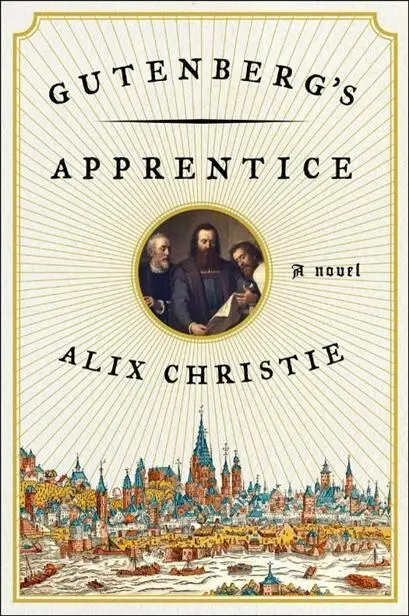
- Название:Gutenberg's Apprentice
- Автор:
- Издательство:Harper
- Жанр:
- Год:2014
- ISBN:нет данных
- Рейтинг книги:5 / 5. Голосов: 1
-
Избранное:Добавить в избранное
- Отзывы:
-
Ваша оценка:
Gutenberg's Apprentice: краткое содержание, описание и аннотация
Предлагаем к чтению аннотацию, описание, краткое содержание или предисловие (зависит от того, что написал сам автор книги «Gutenberg's Apprentice»). Если вы не нашли необходимую информацию о книге — напишите в комментариях, мы постараемся отыскать её.
Youthful, ambitious Peter Schoeffer is on the verge of professional success as a scribe in Paris when his foster father, wealthy merchant and bookseller Johann Fust, summons him home to corrupt, feud-plagued Mainz to meet “a most amazing man.”
Johann Gutenberg, a driven and caustic inventor, has devised a revolutionary — and to some, blasphemous — method of bookmaking: a machine he calls a printing press. Fust is financing Gutenberg’s workshop and he orders Peter, his adopted son, to become Gutenberg’s apprentice. Resentful at having to abandon a prestigious career as a scribe, Peter begins his education in the “darkest art.”
As his skill grows, so, too, does his admiration for Gutenberg and his dedication to their daring venture: copies of the Holy Bible. But mechanical difficulties and the crushing power of the Catholic Church threaten their work. As outside forces align against them, Peter finds himself torn between two father figures: the generous Fust, who saved him from poverty after his mother died; and the brilliant, mercurial Gutenberg, who inspires Peter to achieve his own mastery.
Caught between the genius and the merchant, the old ways and the new, Peter and the men he admires must work together to prevail against overwhelming obstacles — a battle that will change history. . and irrevocably transform them.
Gutenberg's Apprentice — читать онлайн бесплатно полную книгу (весь текст) целиком
Ниже представлен текст книги, разбитый по страницам. Система сохранения места последней прочитанной страницы, позволяет с удобством читать онлайн бесплатно книгу «Gutenberg's Apprentice», без необходимости каждый раз заново искать на чём Вы остановились. Поставьте закладку, и сможете в любой момент перейти на страницу, на которой закончили чтение.
Интервал:
Закладка:
To help them set them into lines, the master dreamed up little trays of wood for them to hold in their left palms, while their right fingers roamed the typecase to search out the letter. He had them switch from sand to clay inside the casting box, once he had seen how many letters they would need. Though clay too held for just one casting, it was far faster to prepare than sand.
They set the start of Saint Jerome’s prologue to the Bible in that dark, tight face that Peter had designed for their aborted missal. They laid it out in double columns in the strict proportions of the golden section: five thumbs across, eight down. The type made forty lines in two black towers down the page, with room between for vines, the curling tails of great initials. Gutenberg and Fust were more than pleased.
Then Peter did the reckoning. The first page they had set had taken fifteen hours.
“Thus can we judge,” the master said, “the weeks and months—”
“—and years—”
“—ahead.”
Quailing, Peter counted it once more. Sixty-six quires this Holy Book would make, approximately fourteen hundred pages.
“A quire a fortnight,” said the master, twisting at his beard.
Fust was more gimlet-eyed. “More like a quire each moon.”
Twelve quires a year were five years and a half. Dear Lord.
Protect us, in Thy wisdom; keep us from all harm.
Grede came once to the new workshop to “inspect all this commotion,” as she put it. It must have been late winter; Peter remembers her in furs. Her husband guided her around the letter cases, one hand planted firmly at her back. She brought to mind an otter, with the sleekness of her muskrat cape, her winter cap of fox. She moved as smoothly too, her fingers roving over parchment, pigments, pots of varnishes and resins. The men were struck entirely dumb. The master barely touched her outstretched hand, as if it burned. He made an awkward bow, retreated stiffly to his elevated table. Peter laughed inside, to see the way a woman could reduce their swagger to the rictus of such smiles.
She marveled at each piece of joinery, the punches and the letters that cascaded from the casting box. “Ingenious,” she murmured, staring fascinated at the press. She walked around it, eyeing it from every side. Konrad had built it sturdier this time, with tapered handles on the weighty carriage to preserve the pressman’s hands. It looked a little like a palanquin, she said, or else a bier. “Praise God, pray not,” Fust said and crossed himself. Death writhed beneath the gates and crept inside the city that whole year. In early Lent the plague had reappeared in livid spots and rattling coughs among the farmers first, then striking indiscriminately, highborn or low, not caring if its victims pushed a cart or rode a carriage. Veils covered the few faces on the streets; they shrank in doorways every time a stretcher passed, borne to the hospice of the Holy Ghost, returning laden with another corpse bound for the Kästrich graveyard. If fear of Gutenberg did not suffice to hold the men inside the shop at night, the stench and groans and terror of contagion did.
Grede ran her hands across the stacks of hides; she flicked and tested both the sizing and the weight of the new vellum. Even married, she was still a furrier’s daughter. For years she’d mended tears in manuscripts that Fust procured with tiny stitches to erase the blemishes. Now she raised one skin up to the light and tsk ed. The master watched, lips twitching, as she turned to Peter. “They ought to tan the man who did this. Another rubbing, don’t you think?” Behind her Peter saw the master frown and turn away. Gutenberg could never take a criticism from a man, much less a woman. Yet Grede was right. The calfskin could have used another pass.
No sooner had she gathered up her skirts and left than Keffer gave a hoot. “A young and juicy wife has brother Fust!”
“Retract your tongue, you clod.” Hans flung a hand toward the forge and screwed the magnifier back into his eye. The big smith was still grinning as he strolled away.
“Frau Fust, might I remind you, is a lady.” Gutenberg moved like a panther when he had a mind to. “As such we’ll have no leering and no lust — and by the saints, no bloody contact.” He looked at Peter then, thin lips drawn in a jaundiced smile. “Except for Peter, the poor sod. He hasn’t got the choice.”
Hans rolled his eyes but did not comment.
“You never had a mother, sir?” said Peter, smiling.
“We all slopped out of Eve. You know the good that brought.”
“Humanity, perhaps?” He said it teasingly.
Gutenberg gave a loud snort. “Woman!” he said. “‘More bitter than death, who is the hunter’s snare.’ Ecclesiastes.”
“‘Strength and beauty are her clothing, and she shall laugh in the latter day.’” Peter crossed his arms. “Proverbs.”
On even Ruppel’s stony face he caught a faint trace of amusement.
“Eve, Pandora, Magdalene. Go read your Greeks and scripture.” The master’s face was puckered as if he’d eaten something sour. “You mark my words, young man: a woman will destroy the best a man can be.”
He turned and walked, chin up, toward his desk. Peter watched that haughty, ramrod back. What had poor woman done, to be so calumnied? Strange way he had of showing Christian love. Peter thought of Grede, and Fust’s first wife, Elisabeth, and Céline who sold her father’s paintings by the Seine — each just as quick of hand and eye as any man. The early guilds were filled with women — weavers, painters, carvers, even. Everywhere — from Bruges to Louvain, Venice, Paris. What had she done, to man and more particularly to Gutenberg, to make her such an object of his hate? Peter glanced at Hans. Another mystery that one day, after several pints, he would extract from the old man.
CHAPTER 2: COMPOSITION
March — May 1452
IT WAS DARK when Peter stepped into the workshop every morning, dark each evening when he left. He wondered sometimes if the day had ever even been. While Keffer and the master cast, he and Hans practiced setting type. Each typecase was a slanted wooden labyrinth he had to look at first to find the letter he required. But bit by bit the lay of those three hundred pockets graved their places in his mind. The pages they were using as their manuscript were clipped onto a stand before his eyes. He and Hans would sound the letters as they groped, and Peter’s heart was glad at that low mumbling hum that he had missed from the scriptorium.
There was an art to it, he found to his surprise; it was not rote, as he had once believed. His right hand held each option in its grasp, as with his pen. He chose which of the different forms to use, which ligature to shorten or expand a word. Each line required a certain spacing to achieve a perfect weight: he’d set some lines, then have them proofed, then move a space, exchange a letterform, and proof and look again. It troubled him, at first, to think that in this way he might achieve a perfect line. Was man not flawed, by definition? And who was Peter to imagine they might reach for more? And yet the lines, when he composed them, were magnificently balanced. This, too, in his own mind, a proof of God’s intention, and the holy mission they fulfilled.
Above all he found unexpected joy in working hand in hand among those craftsmen. He’d never worked that way before: for all that scribes worked side by side, their lines were singularly theirs. But in the Humbrechthof, he found himself a link in a much larger chain. He’d carry his full tray to the composing stone, and hold the lines as Keffer tied the forme . Then Keffer in his turn would heft it toward Ruppel at the press; they’d ink it, pull the proof, and pass it back to Peter. They did not banter much; there was no need. There was a pleasure and a rhythm in the work itself that took the place of words.
Читать дальшеИнтервал:
Закладка:
Похожие книги на «Gutenberg's Apprentice»
Представляем Вашему вниманию похожие книги на «Gutenberg's Apprentice» списком для выбора. Мы отобрали схожую по названию и смыслу литературу в надежде предоставить читателям больше вариантов отыскать новые, интересные, ещё непрочитанные произведения.










Обсуждение, отзывы о книге «Gutenberg's Apprentice» и просто собственные мнения читателей. Оставьте ваши комментарии, напишите, что Вы думаете о произведении, его смысле или главных героях. Укажите что конкретно понравилось, а что нет, и почему Вы так считаете.