Alix Christie - Gutenberg's Apprentice
Здесь есть возможность читать онлайн «Alix Christie - Gutenberg's Apprentice» весь текст электронной книги совершенно бесплатно (целиком полную версию без сокращений). В некоторых случаях можно слушать аудио, скачать через торрент в формате fb2 и присутствует краткое содержание. Год выпуска: 2014, Издательство: Harper, Жанр: Историческая проза, на английском языке. Описание произведения, (предисловие) а так же отзывы посетителей доступны на портале библиотеки ЛибКат.
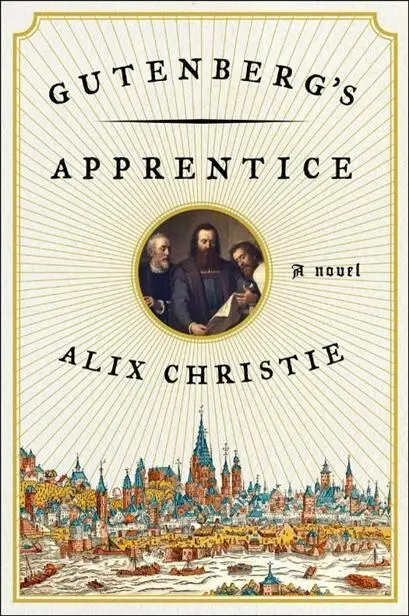
- Название:Gutenberg's Apprentice
- Автор:
- Издательство:Harper
- Жанр:
- Год:2014
- ISBN:нет данных
- Рейтинг книги:5 / 5. Голосов: 1
-
Избранное:Добавить в избранное
- Отзывы:
-
Ваша оценка:
Gutenberg's Apprentice: краткое содержание, описание и аннотация
Предлагаем к чтению аннотацию, описание, краткое содержание или предисловие (зависит от того, что написал сам автор книги «Gutenberg's Apprentice»). Если вы не нашли необходимую информацию о книге — напишите в комментариях, мы постараемся отыскать её.
Youthful, ambitious Peter Schoeffer is on the verge of professional success as a scribe in Paris when his foster father, wealthy merchant and bookseller Johann Fust, summons him home to corrupt, feud-plagued Mainz to meet “a most amazing man.”
Johann Gutenberg, a driven and caustic inventor, has devised a revolutionary — and to some, blasphemous — method of bookmaking: a machine he calls a printing press. Fust is financing Gutenberg’s workshop and he orders Peter, his adopted son, to become Gutenberg’s apprentice. Resentful at having to abandon a prestigious career as a scribe, Peter begins his education in the “darkest art.”
As his skill grows, so, too, does his admiration for Gutenberg and his dedication to their daring venture: copies of the Holy Bible. But mechanical difficulties and the crushing power of the Catholic Church threaten their work. As outside forces align against them, Peter finds himself torn between two father figures: the generous Fust, who saved him from poverty after his mother died; and the brilliant, mercurial Gutenberg, who inspires Peter to achieve his own mastery.
Caught between the genius and the merchant, the old ways and the new, Peter and the men he admires must work together to prevail against overwhelming obstacles — a battle that will change history. . and irrevocably transform them.
Gutenberg's Apprentice — читать онлайн бесплатно полную книгу (весь текст) целиком
Ниже представлен текст книги, разбитый по страницам. Система сохранения места последней прочитанной страницы, позволяет с удобством читать онлайн бесплатно книгу «Gutenberg's Apprentice», без необходимости каждый раз заново искать на чём Вы остановились. Поставьте закладку, и сможете в любой момент перейти на страницу, на которой закончили чтение.
Интервал:
Закладка:
It struck him only afterward that this was Gutenberg’s most lasting gift. The man had faith — and fire and ruthless expectation — that they would bring to it the best they had. This faith was harsh, demanding, unrelenting, and it pushed them far beyond themselves. He worked beside them much of that first year, no better and no worse, their work implicitly a piece with his own brilliance. If afterward they were appalled at how he viewed them, there was a kind of fairness in that cold assessment: all men were equal before Gutenberg, and God.
Peter did not know then just how precious were those weeks and months. It felt as though they tossed a rope ahead and hauled the whole thing sweating forward. Sometimes he fancied he could see the very operation in the smolder of the master’s eyes: fixed on some distant spot, Gutenberg would cast his thought out far before him, straining toward the spot where it would land. For once Peter dared to hope that his own stubborn striving too might finally be recognized — not mocked, as it so often had been in his life.
That hope was answered suddenly one day in early May. He was sitting, staring at the shape of those two columns on the page. He thought he knew the skills he had, his limits — when to his amazement he was gifted with a vision that exceeded, and by far, his own mind’s reach.
The frayed edge of both those right-hand margins had disturbed him from the start. They were uneven: some lines ended short and others were too long, and broken by a hyphen. A sloppy, ragged edge was the result. He was staring, irritated, at it when suddenly he saw: in one swift stroke the hand of God just pushed the birdlike scratches of the punctuation to the right, leaving a crisp and perfect margin. Peter saw how easy it would be. A miracle, indeed — of pure mechanics.
Excitedly he went to Ruppel. Build me a wider type-stick, man, he said, an m ’s width broader than our column. Ruppel scratched his head, but did it. Peter set a dozen lines in something like a frenzy, lining each precisely up to end at the same spot. When necessary he dropped a hyphen or a stop into the extra space beyond the margin. He took the tray back to the press and waited for the inking and the grinding and the proof. And then he knew.
It was perfect. Absolutely perfect: more exquisite than the dream of any scribe. The block was sharp, perfectly squared: the punctuation floated softly in the margin, brushing like the lashes of a bashful bride.
Until that day, his father had just seen the press as a much faster set of hands. The master, for his part, was driven by a vision of that never-ending replication, making many from the one. That evening, when he showed them both, they grasped that this was much, much more.
“No scribe can rival this, for evenness and strength,” said Peter.
Gutenberg was staring fascinated at the page. “I guess the geese will be relieved,” he cracked, “to keep their quills.”
Fust placed the printed sheet beside a manuscript he’d recently commissioned. “What need for clerici , indeed.” Their letter was much darker than the written words; the text block was much sharper, more defined. Peter’s father pursed his lips, then dropped his finger on one red-inked line. “Why can’t we do the red as well, then? And put the rubricator out of work?”
Peter looked at Gutenberg. By then they had a way of speaking without words. Two craftsmen, silently assessing a technique: If the lines are movable, changeable. Gutenberg was nodding, dark eyes ratcheting between the printed and the written sheets. If we can add, subtract, the elements at will. He put a hand upon the merchant’s shoulder as his mouth began to widen in a grin. “By God. Why not?”
“If you can put a line in, you can take it out,” said Peter slowly. “We could print it later with a different ink.”
He pictured it, the miracle of all those lines that scribes would letter in bright red to mark a difference from the text: Here starts the book of Job; Here ends the prologue of the Four Evangelists . Those lines just lifted out — removed, invisibly, so that they wouldn’t print in black. And then — he tried to see how it would work — each line dropped back, alone, a solitary thing that they would somehow ink in red.
“Just run it by itself.” The master looked with glinting eyes at his apprentice. “A second pass on the same sheet.” He grinned and shook his hoary head. “You’re seeing now the way I see.”
A startled laugh burst out of Fust. “We can remove the hand of man!” His eyes were wide. “Replace the hand of man!”
Gutenberg looked up toward a point on the dark beams. “The symmetries of metal, now of space.” His smile was wide. “The Lord alone knows where it will end.”
By Easter half the type was fashioned, and they’d made good progress in the cutting of the skins. One evening not long after, Fust asked his son to see him once the household had retired. His father stood outside in the small courtyard, drinking in the breath of spring. His mood was ebullient: his merchant’s sap rose every year with the greening of the buds and the thawing of the Alpen passes. Peter took the cup he offered and asked where he was headed first.
“To Basel, I should think.” For silks and dyes brought through the Bosphorus from the Levant.
“Don’t worry overmuch about the shop,” said Peter. “In point of fact”—he tipped his cup—“I owe you an apology. It’s everything you ever said. Forgive me for not seeing it before.”
Fust touched his goblet to his son’s. “For which I’m more than glad.” He settled back. For a long moment he just looked at Peter, blue eyes gleaming.
“And so…,” he said, a half smile on his lips, “we come to the next step.”
The man was nothing if not logical. The sanguine man lived by the things that he could touch and count. The job was found; next came the bride. He’d be remiss as his adoptive father, Fust said, not to broker Peter an outstanding match.
“For some poor scribbler?” Peter kept it light. “For that is all I look like now.”
“We’ve got the time.” Fust clasped his hands across his girth. “A year, or eighteen months — then we can safely let this news disperse.”
The Elder houses all would flock then, he was sure. He mentioned names of daughter this and daughter that: Fürstenburg and Gelthus, Echenzeller. Dowries, yes, but more than that, a place at all the highest tables.
“And once you thought that I should be a priest.” Peter ribbed him gently. Time was, he would have bridled at his father’s heavy hand, but in between had come this Book, and with it now, an even deeper trust that God would clear his path.
“A waste, to join the clergy.” Fust cocked his head, appraising him. “When you think how far you’ll rise with these skills.”
Ah, yes. How Fust desired, had always yearned, to rise. It was the curse of all those born too low, yet still endowed with brains to chafe against their chains. Fust had a list, his son had long believed, of all that Peter, as the eldest, should achieve. As big a business as his father’s, and as fine a house, the honor Fust himself had gained as a Companion of the Mint, a member of the M ü nzerhausgenossenschaft . The man had all of this. What more must Peter do, to raise him even higher? Already Fust had risen, in some ways, higher than his own patrician partner.
Peter wondered how much Gutenberg resented being barred from that old club where his forefathers had sat, minting coins and guaranteeing all the weights and measures. Things were much looser now than in his youth: the proof was that they had admitted Fust.
“In any case, I’d mull it over,” Fust said, pouring more wine.
Читать дальшеИнтервал:
Закладка:
Похожие книги на «Gutenberg's Apprentice»
Представляем Вашему вниманию похожие книги на «Gutenberg's Apprentice» списком для выбора. Мы отобрали схожую по названию и смыслу литературу в надежде предоставить читателям больше вариантов отыскать новые, интересные, ещё непрочитанные произведения.




Обсуждение, отзывы о книге «Gutenberg's Apprentice» и просто собственные мнения читателей. Оставьте ваши комментарии, напишите, что Вы думаете о произведении, его смысле или главных героях. Укажите что конкретно понравилось, а что нет, и почему Вы так считаете.