Alix Christie - Gutenberg's Apprentice
Здесь есть возможность читать онлайн «Alix Christie - Gutenberg's Apprentice» весь текст электронной книги совершенно бесплатно (целиком полную версию без сокращений). В некоторых случаях можно слушать аудио, скачать через торрент в формате fb2 и присутствует краткое содержание. Год выпуска: 2014, Издательство: Harper, Жанр: Историческая проза, на английском языке. Описание произведения, (предисловие) а так же отзывы посетителей доступны на портале библиотеки ЛибКат.
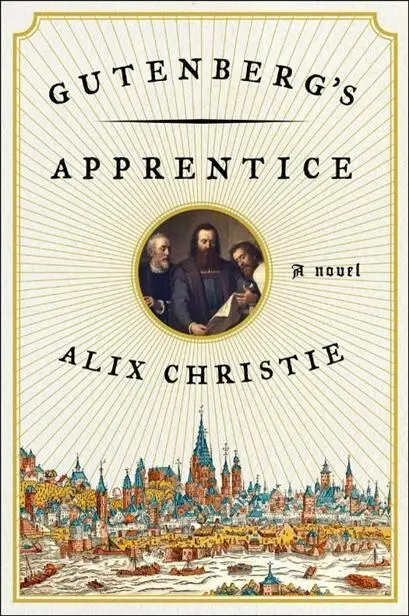
- Название:Gutenberg's Apprentice
- Автор:
- Издательство:Harper
- Жанр:
- Год:2014
- ISBN:нет данных
- Рейтинг книги:5 / 5. Голосов: 1
-
Избранное:Добавить в избранное
- Отзывы:
-
Ваша оценка:
Gutenberg's Apprentice: краткое содержание, описание и аннотация
Предлагаем к чтению аннотацию, описание, краткое содержание или предисловие (зависит от того, что написал сам автор книги «Gutenberg's Apprentice»). Если вы не нашли необходимую информацию о книге — напишите в комментариях, мы постараемся отыскать её.
Youthful, ambitious Peter Schoeffer is on the verge of professional success as a scribe in Paris when his foster father, wealthy merchant and bookseller Johann Fust, summons him home to corrupt, feud-plagued Mainz to meet “a most amazing man.”
Johann Gutenberg, a driven and caustic inventor, has devised a revolutionary — and to some, blasphemous — method of bookmaking: a machine he calls a printing press. Fust is financing Gutenberg’s workshop and he orders Peter, his adopted son, to become Gutenberg’s apprentice. Resentful at having to abandon a prestigious career as a scribe, Peter begins his education in the “darkest art.”
As his skill grows, so, too, does his admiration for Gutenberg and his dedication to their daring venture: copies of the Holy Bible. But mechanical difficulties and the crushing power of the Catholic Church threaten their work. As outside forces align against them, Peter finds himself torn between two father figures: the generous Fust, who saved him from poverty after his mother died; and the brilliant, mercurial Gutenberg, who inspires Peter to achieve his own mastery.
Caught between the genius and the merchant, the old ways and the new, Peter and the men he admires must work together to prevail against overwhelming obstacles — a battle that will change history. . and irrevocably transform them.
Gutenberg's Apprentice — читать онлайн бесплатно полную книгу (весь текст) целиком
Ниже представлен текст книги, разбитый по страницам. Система сохранения места последней прочитанной страницы, позволяет с удобством читать онлайн бесплатно книгу «Gutenberg's Apprentice», без необходимости каждый раз заново искать на чём Вы остановились. Поставьте закладку, и сможете в любой момент перейти на страницу, на которой закончили чтение.
Интервал:
Закладка:
“But the whole Latin world.” The master closed his mouth and folded his long hands beneath his nose. “A massive market.”
“The Bible,” Fust echoed, thunderstruck. A flock of hopes and fears went spinning through each heart.
The master’s eyes had kindled into blazing light. “Undoubtedly they think they own it. But it springs from a higher source.”
Amazement filled them then — and yet at the same time an utter calm. Peter rose, his mouth half open. He could feel, quite instantly, the way it fell upon them like a blessing — so purely, in so straight and bright a beam, that each could only cross himself, and bow his head and offer up his thanks to God.
In principio creavit Deus caelum et terram.
These were the words that brought a new world into being.
Peter set them flush against a nothingness; hard against a nonexistent margin he arranged them, floating like the world itself in the great void.
In the beginning God created heaven, and earth.
If the pope, the cardinal, the prior, could not give Gutenberg a text to print, then they would choose and print their own.
This, then, was their true beginning: bitter winter, creeping blue-toed to the ashes, blowing heat out of the humped-up coals. Peter set those first words purely for himself, in the frozen heart of the year when the reaper stalks, culling the weak and sick.
He hung them like a lodestar just above the forge, to remind them of the spark that springs from the Creator, running kindling down the ages straight to us. He set that sentence flush against His boundless grace and inked it with the black of space. And then he pressed its darkened lips on skin and hung it just above his eyes, and knew that this, too, was a kind of genesis.
EXODUS
CHAPTER 1: CALCULATION
February 1452
THE PICTURE Peter carries in his head is that of Moses, dark hair streaming as he parts the waters, urging on the tribes. Gutenberg resembled him remarkably that hopeful spring. The master stood apart, his arms outstretched, scooping toward them every kind of good this monumental Bible would require. Peter had to laugh at the way he windmilled his long arms, directing the whole stream into the chute that fed the workshop. “You look just like an abbot at his busy hive.”
“You could do worse than watch Cistercians.” Gutenberg pulled at his beard and smiled.
There was no question of remaining in the Hof zum Gutenberg. They grasped the magnitude this time. Conservatively reckoning, the Bible ran a thousand pages, if not more — five times as long as their aborted missal, forty times the size of the Donatus. That Fust and Gutenberg even entertained the thought revealed how much their backs were to the wall.
They were inspired, enraptured certainly — convinced of their invincibility, thought Peter afterward. This was pure Gutenberg, of course. But on the other hand they didn’t have much choice. The Bible was the only book they could hope to sell in quantity that did not need approval from the church, so long as they adhered to the accepted version. Yet from the start it was a risk in every way — not least the certainty that Dietrich would look askance at laymen operating outside his control. If any of the clergy were to learn of it, they had no doubt Dietrich would swoop in and shut them down.
Their crew then numbered only four — Peter, Hans, Keffer, and Ruppel — and yet the premises the partners looked at were all cavernous and freezing: a granary, more stables, sculleries, the ground floor of a house in town. They settled on the last, a massive dwelling girded by a thick high wall a street away along the Cobblers’ Lane. The press would have to stay behind: it was impossible, the master said, to take it all apart and lug it piece by piece along the street. There was no darkness deep enough to trust, no way to stop prying ears and eyes.
“Once burned, twice shy.” He winked at Hans. “The last time I was fool enough to let my tools out of my sight, we came much closer than a Christian should to robbing graves.” Peter glanced up, amazed. What darkness did he hide? The apprentice tucked that scrap away and vowed to worm it out of Hans.
They left the wood press standing where it was and moved the rest one moonless night across the churchyard of St. Christopher’s, through a gate left almost imperceptibly ajar. The master’s pastor, clearly, was informed. From that black chink between two walls it was no more than a cat’s spring across the street that climbed to St. Quintin’s, into a gloomy courtyard, then to the low door of the Hof zum Humbrecht, its upper stories disappearing in the blackness of the night.
Four steps dropped to the battered earth of a ground floor. Joists the width and girth of a small horse held up the cobwebbed rafters stretching deep into the subfloor of the house. The clay gave off a smell of roots and piss and rats. Chest by bench by bucket, tray by case, they hauled the workshop in. They didn’t smuggle only casting boxes, inks and ores and heavy crates of metal type. They had a giant bellows, too, rigged to a treadle, which any fool would know was meant to fan a forge.
Hans and Keffer fit the forge pipe in the chimney stones; Peter and big Ruppel set two casting stations up, and pried the shutters open to scour out the stench. The place was huge and had a space for every need: the longer, narrow halls for drying; the cavern with the forge where they would cast and run the press; a separate room where they could sit and put their letters into lines. The shapes below were echoes of the rooms in which the men would live just overhead. The master sent for Konrad, back in Strassburg, to build a new press; he would not hire some local cretin who might blab. While waiting they removed the walls that separated room from room in that dim underworld. When it was done, no corner remained safe from his keen eyes, the ceiling held by a stripped forest of dark beams. “The key is speed,” the master said, “efficiency, by God. No wasted step or motion.” It seemed to Peter as he watched him pacing, barking orders left and right, that Gutenberg saw everything from a great height, his raptor eyes pinned to the slightest movement on the ground.
He sent across the city, then the river and the forests and the mountains, for materials. Paper from a mill in Piedmont, vellum out of Swabia, to supplement the stack they had. Ruppel went with him to the Wood Gate to inspect the hardwoods: maple and beech for benches, cases, tables. He commanded coal and candles, ores and oxides. He was a muleteer, he cracked, a blooming drover. Whip-cracker, jack of all trades: polisher of stones, mixer of metal, deviser of devices, maker of machines.
Peter pitched in with his hammer like the rest. Gone was the little brownish lump from writing on his middle finger and the trace of burn on his left hand. He built the letter cases at a slant, then hefted his own letters, thick and heavy as old bones, and laid them in each wooden pocket. Each evening he would stand a moment looking at this massive thing take shape. The naked beams, the half-wrought shop, loomed like the outlines of strange buildings to his eye: half memory-palace, half the vision of God’s City that Saint Augustine described.
The partners worked together in those months as they had never done before, and never would again. In the cave of Peter’s recollection he and Gutenberg and Fust are figures by a constant fire, stooped and sketching, talking and gesticulating at all hours. What had been left of Fust’s eight hundred guilders quickly disappeared into the workshop’s maw; they would need more, much more. They’d make at least a hundred copies of the book; whatever they could get as a deposit from each buyer would bring something in, but even so they wouldn’t see real revenue for several years. They came to a new business understanding, based not on faith but more on risk and its reward — and most of all on cunning. Neither partner harbored much illusion after all that wasted time; each knew precisely where the other stood. It was the firmest ground on which to strike a deal, Fust told his son: either both would win together, or else both would lose.
Читать дальшеИнтервал:
Закладка:
Похожие книги на «Gutenberg's Apprentice»
Представляем Вашему вниманию похожие книги на «Gutenberg's Apprentice» списком для выбора. Мы отобрали схожую по названию и смыслу литературу в надежде предоставить читателям больше вариантов отыскать новые, интересные, ещё непрочитанные произведения.








Обсуждение, отзывы о книге «Gutenberg's Apprentice» и просто собственные мнения читателей. Оставьте ваши комментарии, напишите, что Вы думаете о произведении, его смысле или главных героях. Укажите что конкретно понравилось, а что нет, и почему Вы так считаете.