Alix Christie - Gutenberg's Apprentice
Здесь есть возможность читать онлайн «Alix Christie - Gutenberg's Apprentice» весь текст электронной книги совершенно бесплатно (целиком полную версию без сокращений). В некоторых случаях можно слушать аудио, скачать через торрент в формате fb2 и присутствует краткое содержание. Год выпуска: 2014, Издательство: Harper, Жанр: Историческая проза, на английском языке. Описание произведения, (предисловие) а так же отзывы посетителей доступны на портале библиотеки ЛибКат.
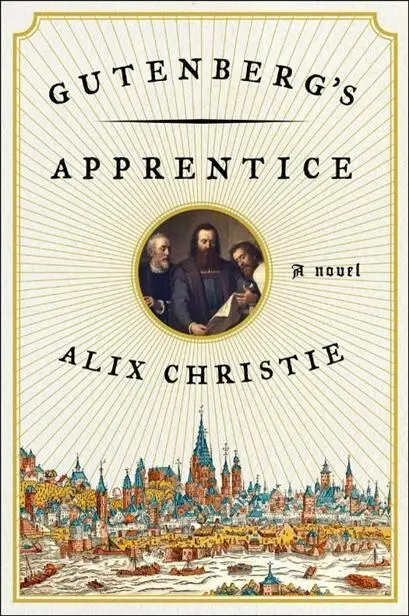
- Название:Gutenberg's Apprentice
- Автор:
- Издательство:Harper
- Жанр:
- Год:2014
- ISBN:нет данных
- Рейтинг книги:5 / 5. Голосов: 1
-
Избранное:Добавить в избранное
- Отзывы:
-
Ваша оценка:
Gutenberg's Apprentice: краткое содержание, описание и аннотация
Предлагаем к чтению аннотацию, описание, краткое содержание или предисловие (зависит от того, что написал сам автор книги «Gutenberg's Apprentice»). Если вы не нашли необходимую информацию о книге — напишите в комментариях, мы постараемся отыскать её.
Youthful, ambitious Peter Schoeffer is on the verge of professional success as a scribe in Paris when his foster father, wealthy merchant and bookseller Johann Fust, summons him home to corrupt, feud-plagued Mainz to meet “a most amazing man.”
Johann Gutenberg, a driven and caustic inventor, has devised a revolutionary — and to some, blasphemous — method of bookmaking: a machine he calls a printing press. Fust is financing Gutenberg’s workshop and he orders Peter, his adopted son, to become Gutenberg’s apprentice. Resentful at having to abandon a prestigious career as a scribe, Peter begins his education in the “darkest art.”
As his skill grows, so, too, does his admiration for Gutenberg and his dedication to their daring venture: copies of the Holy Bible. But mechanical difficulties and the crushing power of the Catholic Church threaten their work. As outside forces align against them, Peter finds himself torn between two father figures: the generous Fust, who saved him from poverty after his mother died; and the brilliant, mercurial Gutenberg, who inspires Peter to achieve his own mastery.
Caught between the genius and the merchant, the old ways and the new, Peter and the men he admires must work together to prevail against overwhelming obstacles — a battle that will change history. . and irrevocably transform them.
Gutenberg's Apprentice — читать онлайн бесплатно полную книгу (весь текст) целиком
Ниже представлен текст книги, разбитый по страницам. Система сохранения места последней прочитанной страницы, позволяет с удобством читать онлайн бесплатно книгу «Gutenberg's Apprentice», без необходимости каждый раз заново искать на чём Вы остановились. Поставьте закладку, и сможете в любой момент перейти на страницу, на которой закончили чтение.
Интервал:
Закладка:
“One of my greater victories,” Brack said, his hands held deep within his great black habit. “I managed to hold on to most of the harvest this year.”
Brack had come to Mainz from Bursfeld: that was all Peter knew. The reforming wing had sent him to root out monks who siphoned off donations to the common good, restore the common life, the strict ascetic rule. St. Jakob’s abbot, one von Bubenheim, did not appear to have survived the purge. Yet even so it did not look as if Heinrich Brack had made much progress. Peter’s heart had sunk as soon as he set eyes upon the prior’s shelves. He’d pictured more and finer books, codices blind-stamped and stacked in gracious rows, the way they’d been at Saint-Victor. These were dog-eared, though, and scattered in haphazard piles. The prior saw him looking, and he smiled.
“There’s not much here, alas, to tempt a scribe. Though I have done my best to supplement the manuscripts I found.” A novice tiptoed in and poured the wine. “I had to call for many more,” the prior said, “to help me with my work.”
“Ah yes,” the master said. “Your work.”
Brack wiped his cheeks with both his hands, as if to rid them of a weariness. He left them folded just beneath his nose. “It has not gone as I foresaw.” In his eyes, a flash of anger, swiftly mastered. “The cardinal is much beseeched.”
“How soon will he decide?”
Brack sighed. “I wish that I could tell you.” He rose and paced. His habit swung around him as he walked; his voice was thin and hard. “The truth is, many lack the stomach for a real reform.” The master waited, crouched upon the edge of his hard chair. “My text is written, and it was approved. Or so I was led to believe.”
“Our Peter here is anxious to begin,” said Gutenberg. “We hoped you’d part with a few pages — something to convince them, made with our new script.”
Brack looked sharply at the brother who stood sentry, made a sign. Without a word the novice turned and left, pulling tight the door.
“There’s nothing that would please me more. But it would not be… politic for excerpts to appear just now.”
“My shop is hardly public.” The master’s voice was tight. “And no one can imagine how it looks until they see with their own eyes.”
Had Rosenberg told Brack exactly how the master planned to make those books? Had he not guessed, at least, that he would not just send the text to monks for copying, as he had always done before? Peter did not know. Gutenberg had given him permission, though, to set a sample — the Our Father — in their new, amazing type. He bent to take it from his pouch, but Prior Brack restrained him with a lifted hand.
“The moment will come. It must. There is no question that we will prevail.” His voice was soft, but had a cutting edge. “There is no room for failure. Reform is all that can save the church now from herself.” He looked at both of them, his dark eyes sober. “The voices of dissent grow ever louder, and with cause. Cusanus is quite mindful.”
On one side, Peter thought, the fattened forces of the status quo, chief among them Archbishop Dietrich — and on the other, the gathering momentum for reform led by Cusanus, Pope Nicholas V’s avenging angel.
“Why, then?” Gutenberg pitched forward. “Why can’t he just approve it?”
Slowly Brack sat down. “You know as well as I do, Meister, our keen interest in your technique.” So he did know, thought Peter. The master straightened, lifted by a sense of pride and purpose. Peter felt a stirring in his heart of hope, faint but unmistakable. This Brack, this Cardinal Cusanus: in the whole world they could not ask for greater champions. There was no match more perfect, suddenly the young scribe saw: the Divine Office of the Mass, rewritten for a cleansed and reborn church, sown wider through this miracle of printing that God in His great wisdom had bestowed on Mainz.
“That is good news,” the master drily said. “Even better would be the order to proceed.”
“What I say cannot go past these walls.” The prior waited for their nods. “There are, as I said, some difficulties. The archbishop has approved my text. But it requires adoption by the Bursfeld conference.” He pursed his lips. “Not all my brethren apparently concur. A faction has proposed a rival text, which hardly merits to be called reformed.”
Gutenberg did not move a muscle. “When,” he said, “will they decide?”
The prior’s eyes were on the farthest wall. “The great battles are eternal,” he murmured, as if speaking to some unseen congregation. “And all foretold. Did not God send His own son to sweep the moneylenders from the Temple?” He sighed then, and returned to them. “You know the church. Everything takes time. Experts must be consulted, opinions issued, reports made. Then there is opportunity for rebuttal.”
“I know the ways of the Holy See.” There was a glitter in the master’s eye. “To my misfortune.”
“I have every faith I will prevail. But I can see too that for you this delay is not desirable.”
There was a long and awkward silence. Gutenberg was folded deep into himself. Brack, too, lapsed back into his own thoughts. There seemed no point, and yet — Peter reached and pulled the proof out of his bag. He smoothed the lines he’d sketched and he and Hans had carved and cast and proofed.
Brack lifted it, and held it to the light. “Fantastic,” he murmured, eyebrows lifted into sharp, dark arches.
“Keep it,” said the master as they rose to go. “For all the good that it will do me.”
“Not desirable! Witless cowl.” They were barely out the gate before his dam gave way. “ Not desirable! Bloody monks. Mooning away in their crumbling halls.” He went on in this vein, wrapped moodily in his cloak, loosing a string of invective that subsided only slowly as they wound their way back down.
The sun was sinking behind them, above the abbey’s shell. The dying rays bathed their backs and the hillside and the river in a reddish glow. Peter saw his master age right there before him: saw his skin slacken, his keen eyes grow rusty and dull. It might have been no more than a trick of the light, but still it moved him. He begged him not to waste his mind with worry.
“It is not I who waste my mind, but those too blind to see.” Gutenberg’s voice was low and bitter.
“Have faith. We will prevail.”
“Faith! I’ve had this faith my whole life long. You see where it has brought me.” Gutenberg looked back up at the Jakobsberg. “Tight-mouthed scribbler never even breathed a word.”
Peter put a hand out on his shoulder and tried to make things light. “What else did you expect from a monk?”
“Vow of bloody silence.” The master growled it, but at least he laughed.
They came to a turning where orchards rose off to the right and the road to the city turned the other way. Without warning the master scrambled up the bank among the trees. “Rest for the wicked,” he said, and made as if to sit. He stumbled; Peter took his arm and loosed his cloak for him to sit on. Gutenberg batted it away. “Dirt is good enough for me.”
Peter felt he saw a man, then, stripped to his very essence: his gift, his greatness, offered in full knowledge of its value, and rebuffed. Johann Gutenberg stared out across the valley of the Rhine, his face drawn, seeing nothing.
“It’s but a moment’s setback,” Peter said. “Your partner won’t give up so easily.”
“I’ve had many partners, and just as many setbacks.” He gave Peter a queer, almost pitying smile. “I wouldn’t stand here begging, would I, had I ever met with great success?”
“I thought that was your meaning. When you spoke of the Holy See.”
Читать дальшеИнтервал:
Закладка:
Похожие книги на «Gutenberg's Apprentice»
Представляем Вашему вниманию похожие книги на «Gutenberg's Apprentice» списком для выбора. Мы отобрали схожую по названию и смыслу литературу в надежде предоставить читателям больше вариантов отыскать новые, интересные, ещё непрочитанные произведения.









Обсуждение, отзывы о книге «Gutenberg's Apprentice» и просто собственные мнения читателей. Оставьте ваши комментарии, напишите, что Вы думаете о произведении, его смысле или главных героях. Укажите что конкретно понравилось, а что нет, и почему Вы так считаете.