Alix Christie - Gutenberg's Apprentice
Здесь есть возможность читать онлайн «Alix Christie - Gutenberg's Apprentice» весь текст электронной книги совершенно бесплатно (целиком полную версию без сокращений). В некоторых случаях можно слушать аудио, скачать через торрент в формате fb2 и присутствует краткое содержание. Год выпуска: 2014, Издательство: Harper, Жанр: Историческая проза, на английском языке. Описание произведения, (предисловие) а так же отзывы посетителей доступны на портале библиотеки ЛибКат.
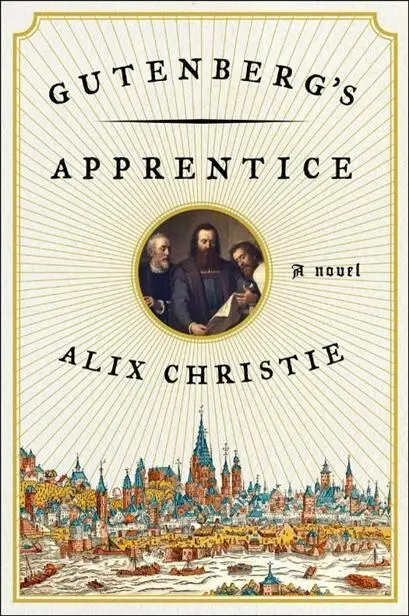
- Название:Gutenberg's Apprentice
- Автор:
- Издательство:Harper
- Жанр:
- Год:2014
- ISBN:нет данных
- Рейтинг книги:5 / 5. Голосов: 1
-
Избранное:Добавить в избранное
- Отзывы:
-
Ваша оценка:
Gutenberg's Apprentice: краткое содержание, описание и аннотация
Предлагаем к чтению аннотацию, описание, краткое содержание или предисловие (зависит от того, что написал сам автор книги «Gutenberg's Apprentice»). Если вы не нашли необходимую информацию о книге — напишите в комментариях, мы постараемся отыскать её.
Youthful, ambitious Peter Schoeffer is on the verge of professional success as a scribe in Paris when his foster father, wealthy merchant and bookseller Johann Fust, summons him home to corrupt, feud-plagued Mainz to meet “a most amazing man.”
Johann Gutenberg, a driven and caustic inventor, has devised a revolutionary — and to some, blasphemous — method of bookmaking: a machine he calls a printing press. Fust is financing Gutenberg’s workshop and he orders Peter, his adopted son, to become Gutenberg’s apprentice. Resentful at having to abandon a prestigious career as a scribe, Peter begins his education in the “darkest art.”
As his skill grows, so, too, does his admiration for Gutenberg and his dedication to their daring venture: copies of the Holy Bible. But mechanical difficulties and the crushing power of the Catholic Church threaten their work. As outside forces align against them, Peter finds himself torn between two father figures: the generous Fust, who saved him from poverty after his mother died; and the brilliant, mercurial Gutenberg, who inspires Peter to achieve his own mastery.
Caught between the genius and the merchant, the old ways and the new, Peter and the men he admires must work together to prevail against overwhelming obstacles — a battle that will change history. . and irrevocably transform them.
Gutenberg's Apprentice — читать онлайн бесплатно полную книгу (весь текст) целиком
Ниже представлен текст книги, разбитый по страницам. Система сохранения места последней прочитанной страницы, позволяет с удобством читать онлайн бесплатно книгу «Gutenberg's Apprentice», без необходимости каждый раз заново искать на чём Вы остановились. Поставьте закладку, и сможете в любой момент перейти на страницу, на которой закончили чтение.
Интервал:
Закладка:
“We had a good ride there, by God. We didn’t hide away like here.” The master was admitted everywhere: not just into the noble houses but the craftsmen’s lodges. He’d been respected and praised, much more than in the city of his birth. He didn’t give a rat’s ass for the Mainzers’ clannishness, their snobbishness.
Which did make you wonder, Peter said, why he’d come back.
“Inheritance. This house.” Hans looked balefully at the bleak, soot-streaked walls of their confinement. “His mother left it to him and to his late brother, Friele.” Besides, those foaming Armagnacs had Strassburg in their sights — it was a panic, Hans said, knowing that the mercenary army was a day or two away after having raped and pillaged half Alsace. The master paid his share to buttress the defenses, but he didn’t wait around. “We hot-footed it, believe you me.” The old smith grinned. “To him this house in Mainz was providence.”
Lent came late that year, halfway through March. It was a lucky thing, for otherwise the Main would have been frozen and the merchants forced to travel overland to Frankfurt for Lenten Fair. Fust sailed away, but Gutenberg remained, although they knew the Elders claimed the payments on their bonds two times a year, at autumn and at Lenten Fair. He must have sent a proxy, Peter thought, as he went to the Schreibhaus to see Petrus Heilant. The Elders still collected interest on the loans they’d made to Frankfurt, Speyer, Worms — though only half on every guilder that Mainz owed. This was the deal that Dietrich had exacted in exchange for lifting off the ban: he’d bailed the city out in part — and in return had kept immunity from tax.
The staleness of the air inside the clergy’s meetinghouse disgusted Peter more and more. Or maybe it was just the act of begging that disturbed him every time he stooped to enter the low portal. Heilant was blandly reassuring that a break would come in time, but precious little seemed to come from this. In the depths of that cold penitential season, Peter felt the hope begin to leach out of his bones.
He told himself each letter punch was one more link he broke in the thick chain that anchored him to Mainz. He’d add one to the pile; another shattered link would drop. He’d asked for his own workshop key so he could work at night. If he could pick the pace up, he might finish by midsummer and be off.
One evening a few weeks after Easter he was working late, taking advantage of the light. Spring had come at last, and with it the sweet lengthening of days. The men had gone upstairs, the master back across the courtyard. Gutenberg appeared to find it unremarkable that Peter chose to work on his own time. He must have thought that his apprentice drove himself the way he did — or so his brief, distracted nods conveyed.
Peter lit two candles to chase any shadow from the metal in the vise. He lost himself in concentration. Some time later — one hour, two — he heard a door close, quick steps, then the workshop door heave open. The light had gone, he saw as he looked up. The master crossed toward the workbench and started rummaging among the tools. He took a blade and then came over to where Peter labored.
“Night work.” He snorted. “The guild would stop it, if they ever got their nose in.”
Peter nodded, looked back down.
“It isn’t any of their bloody business.” The master’s face was waxy in the dimness; he held a book clamped underneath one elbow.
“No.” Peter looked back up, surprised. Gutenberg had been a guildsman, ex officio; Hans had said so.
“Time and tide waiteth not.” The master stood there, lost in thought. And then he shook himself and lifted a finished punch that lay at Peter’s elbow. “What, six weeks? Thereabouts?”
The end at last was in their sight. Again Peter nodded.
“Ligatures tomorrow, then,” said Gutenberg, half to himself.
The main alphabets were done; the master had ordered Konrad to build trays to hold the letters, certain pockets made larger for the characters they’d need in great abundance. There was a rigor to that logic even Peter could admire. There were no rules when Gutenberg set out: he’d cobbled everything from what he knew of smithy, weavery, scriptorium. He’d had them knock together slanted racks to hold those letter cases, wooden trays to hold the finished lines and pages. It was the brilliance of that mind to see a thing — a person too — in pieces, Peter thought. Efficiency and speed, he always said: no step or motion should be wasted.
“Brack will have the text to set in a few days.” The master set the punch back down and fingered his long beard.
Peter stretched his aching hands. “He knows how you will do it?”
“More or less.” The smile was sly.
“You must know him then, to trust him.”
“I know them all, to my everlasting sorrow.” Gutenberg smiled cagily. “Far better, luckily, than they know me.”
“I understood that you had studied, too, in Erfurt.”
“An age ago.” He shrugged. “Half the city did; the other half just wanted to be priests.”
Peter allowed himself a smile. “I found the same among the scribes.”
“All angling for the teat.” Gutenberg made a face. “Though there are some worth heeding.” He pulled out the book he was holding. “This one knows ten times more of metal than the guild.”
Peter looked down at the curling hide.
“I thought you ought to read it.”
The inside leaves were soft as suede, and spattered from long use.
“ On Divers Arts . By Theophilus. You only need book three.” Gutenberg leaned over him and started flipping through the pages. “Everything I know I got from Hans — and this.”
Chapter heads flashed past: Workshop. Forge. Bellows. Chisels. Punches. Chalice-making. Soldering. Repoussé. Refining Copper, Silver, Brass. Strange lessons for a scribe. Peter murmured his thanks.
“I’ll need it back.” The master turned. “But you can copy out the pages for yourself.”
By Pentecost they’d cast enough of the new letters to begin to fit them into words. Afterward it seemed to Peter that the timing was remarkable. The day before, the parishes had celebrated the arrival of the Holy Ghost, that rushing wind that swept on Christ’s disciples, searing all their foreheads with bright flame. It would be blasphemy to think that what seized the scribe that day was any way akin. And yet, and yet… at twenty-five, he did feel grazed — by a brief spark, the most fleeting of breezes.
They’d had only their smoke proofs until then; they did not know how well the types would really print. It was the master who suggested that Peter take the new black ink and choose the lines to set and pull as a first proof. This ink was also Gutenberg’s invention: darker than the plant-based ink used by scribes. He boiled linseed oil to varnish, added lampblack and a pinch of carbonate of lead. This made a sticky, tarlike paste that could be slathered on the letters and then smoothed to an even film.
It startled Peter, hearing the master say that he was owed the honor of composing those first lines. But then Gutenberg did understand paternity — the pride of bringing forth a thing entirely new. Peter tipped his cap to him by setting words from Theophilus, Benedictine craftsman:
Therefore, act now, prudent man, .. by whose labor and zeal so many burnt offerings are being shown to God. Henceforth be fired with greater ingenuity: with all the striving of your mind hasten to complete whatever is still lacking in the house of the Lord.
Keffer showed him how to tie the lines into a block he called a forme and slide the whole thing on a tray. Peter carried the full slab aloft as though it were an offering, and set it gingerly upon the bed of Konrad’s press. He took the leather balls that they had dubbed “dog’s tongues” in either fist and smeared each with the inky paste, then rolled them on the stone to spread the ink that he applied onto the type with care.
Читать дальшеИнтервал:
Закладка:
Похожие книги на «Gutenberg's Apprentice»
Представляем Вашему вниманию похожие книги на «Gutenberg's Apprentice» списком для выбора. Мы отобрали схожую по названию и смыслу литературу в надежде предоставить читателям больше вариантов отыскать новые, интересные, ещё непрочитанные произведения.









Обсуждение, отзывы о книге «Gutenberg's Apprentice» и просто собственные мнения читателей. Оставьте ваши комментарии, напишите, что Вы думаете о произведении, его смысле или главных героях. Укажите что конкретно понравилось, а что нет, и почему Вы так считаете.