Alix Christie - Gutenberg's Apprentice
Здесь есть возможность читать онлайн «Alix Christie - Gutenberg's Apprentice» весь текст электронной книги совершенно бесплатно (целиком полную версию без сокращений). В некоторых случаях можно слушать аудио, скачать через торрент в формате fb2 и присутствует краткое содержание. Год выпуска: 2014, Издательство: Harper, Жанр: Историческая проза, на английском языке. Описание произведения, (предисловие) а так же отзывы посетителей доступны на портале библиотеки ЛибКат.
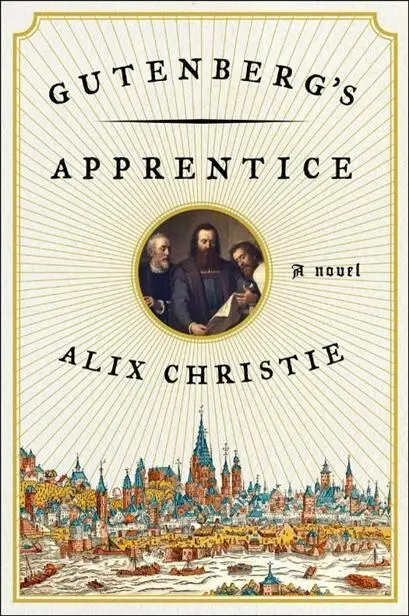
- Название:Gutenberg's Apprentice
- Автор:
- Издательство:Harper
- Жанр:
- Год:2014
- ISBN:нет данных
- Рейтинг книги:5 / 5. Голосов: 1
-
Избранное:Добавить в избранное
- Отзывы:
-
Ваша оценка:
Gutenberg's Apprentice: краткое содержание, описание и аннотация
Предлагаем к чтению аннотацию, описание, краткое содержание или предисловие (зависит от того, что написал сам автор книги «Gutenberg's Apprentice»). Если вы не нашли необходимую информацию о книге — напишите в комментариях, мы постараемся отыскать её.
Youthful, ambitious Peter Schoeffer is on the verge of professional success as a scribe in Paris when his foster father, wealthy merchant and bookseller Johann Fust, summons him home to corrupt, feud-plagued Mainz to meet “a most amazing man.”
Johann Gutenberg, a driven and caustic inventor, has devised a revolutionary — and to some, blasphemous — method of bookmaking: a machine he calls a printing press. Fust is financing Gutenberg’s workshop and he orders Peter, his adopted son, to become Gutenberg’s apprentice. Resentful at having to abandon a prestigious career as a scribe, Peter begins his education in the “darkest art.”
As his skill grows, so, too, does his admiration for Gutenberg and his dedication to their daring venture: copies of the Holy Bible. But mechanical difficulties and the crushing power of the Catholic Church threaten their work. As outside forces align against them, Peter finds himself torn between two father figures: the generous Fust, who saved him from poverty after his mother died; and the brilliant, mercurial Gutenberg, who inspires Peter to achieve his own mastery.
Caught between the genius and the merchant, the old ways and the new, Peter and the men he admires must work together to prevail against overwhelming obstacles — a battle that will change history. . and irrevocably transform them.
Gutenberg's Apprentice — читать онлайн бесплатно полную книгу (весь текст) целиком
Ниже представлен текст книги, разбитый по страницам. Система сохранения места последней прочитанной страницы, позволяет с удобством читать онлайн бесплатно книгу «Gutenberg's Apprentice», без необходимости каждый раз заново искать на чём Вы остановились. Поставьте закладку, и сможете в любой момент перейти на страницу, на которой закончили чтение.
Интервал:
Закладка:
CHAPTER 8: MAINZ
January — May 1451
HE’D WORKED the calculus of duty in his head. Peter owed an alphabet of lead, no more. What they would do with this new letter mattered little to him as he pictured the great chancelleries in which he’d find a place. There was no further talk from Fust of marriage contracts; Peter guessed his father knew that he might bolt if pushed. Gutenberg meanwhile procured a missal book that he dismembered, fanning out the pages on his desk. Sacks of ore appeared, a bale of paper half as tall as Hans. Konrad hammered a new casting box, and Peter took a spot beneath the window frame and started tracing.
For all that he despised this art as crude, it was not in his nature to draw badly. The paper that he used was of pure linen, free of imperfections, to avoid the slightest wobble in the lines that he would transfer onto metal punches. The alphabet he planned must be as fine as any he had drawn, to sing the psalms and say the words of the apostles. He traced and retraced each line, swash, and spur, and spaced the letters widely on the large white sheet. Each time the bell struck one more hour he rose and stretched his arms and thawed his fingers at the forge. Hans, peering over his right shoulder, bellyached that all those fine connecting lines would drive them blind. The master and his father hovered too, until Peter brusquely said he couldn’t concentrate with them both breathing down his neck.
It took him three full weeks to draw the letters to his satisfaction. He made them larger, blacker, tighter than the letters of the grammar: written closely, they resembled a thick mat of woven thorns. He could not do it any faster. He understood by then that every single one would be the progenitor of all the hundreds, even thousands, they would cast precisely in its image. He drew full letters in two sizes, majuscules and minuscules, ligatures, abbreviations; each size required two hundred different hunks of type. Hans and Keffer looked like cattle stunned before the kill when they considered how long it would take to carve and cast those alphabets.
“I’ll pray for you,” said Peter with a little smile, touching one stiff finger to the cap he wore to keep the hair out of his eyes. When he was done, he left the finished sheets for Gutenberg in a clean pile.
He didn’t want to care, and yet he did. He came in the next day both wary and expectant. The master was already sitting at his desk.
“I might have known you’d bankrupt us,” he started. The flame lit only half his face; he wore a pair of lenses on the bridge of his long nose. “You’d have us slave a year, I guess, to cut these?” The words were as caustic as ever, yet there was something different in his tone. He lifted up one sheet and scrutinized it, and turned to Peter standing there. Gutenberg’s apprentice saw the flicker of a smile. “It’s strong, though. Black. And still with a slight feeling of the hand.”
“It is compressed, compared to many.”
“So then it saves on parchment.” The master grinned and handed all the pages back.
Hans showed Peter how to forge the brass in rods they clipped and hammered to a square-tipped shaft. They made hundreds of these golden wands, which they then carved. Peter watched the old smith hunker at the bench, the shaft clamped in a vise, a little square of paper with the first of all those letters in his hand. Hans let a drop of flax oil fall onto the paper, watched it go translucent as the ink began to shine, then flipped it. The letter was as perfectly reversed as if they viewed it in a mirror. He laid the letter on the metal tip and rubbed it softly with his finger: the inky shape lay on the brass now in reverse, and ready to be carved.
The goldsmith fingered through his chisels for a tiny blade no thicker than an awl. “Pray for us,” he said, with a bare smile, and screwed a glass into his eye. It was an old, familiar sight: the craftsman bent, absorbed, his eyes and fingers joined in one exacting act, the world shrunk to a space no larger than his touch and breath.
When it was Peter’s turn to try, he stretched his neck and arms and emptied out his mind. He grasped the chisel — like the quill, it was a pure extension of his hand. The metal peeled like shavings of cold butter from his blade. He tapped, and watched it flake, moved down a hair and tapped again and blew the shining shards away. Hans said that metal had a grain, like wood; you had to learn to know the way it gave. The letter was the simplest stroke, an l . Peter tapped and flaked and blew. Deeper, Hans said. Straighter. There. An hour, then two. And then the slanted cap atop the stroke, the angled basin of its heel. Hans handed him a brush, an even smaller awl. Peter felt a stinging in his eyes; he wiped the sweat off, bent back down.
Scribes often noted in the edges of their manuscripts the ways they suffered in the handiwork of God. A sharp complaint, secreted in a margin: Thin ink, may night fall soon. I’ve finished now. For Christ’s sake, bring me drink . Writing caved the ribs and torqued the back and fogged the eyes. Once in Saint-Victor’s library in Paris Peter had discovered a whole string of notes from the same scribe: This parchment is certainly hairy , he had carped, this lamp gives a bad light . And yet until he bent for hours above that shaft of metal, Peter never really understood his closing thought: Just as the sailor yearns for port, the writer longs for the last line.
At last he straightened, stretched his aching neck, and reached the finished punch toward Hans. The smith turned toward a candle, held the tip above the flame, rotating it until the whole was covered in a film of soot. “Smoke proof,” he grunted, pressing it onto the paper. And then they saw where it was wrong, where right; they placed the punch back in the vise, and sliced minutely at it one more time.
The work of the apprentice is the taming of all impulse: in place of pride, humility; impatience mastered, then subdued. It took Peter back to his first weeks at the scriptorium, where Anselm started by removing feathers, vellum, leather pouches, ornament of every kind. He stripped the pupils down to one thin reed, a lump of lampblack, one plain sheet. To learn the silencing of will, of the murky self: to strip their bodies and their minds to the essential. Apprenticeship, he said, was patience, and a deep, abiding faith: again, again, and yet again, until the hand was firm, the soul scoured clean. For only then would they be purely Adam’s flesh, a conduit, a channel.
Hans told him that he had “the feel.” The way that he touched Peter’s elbow, took his proofs out to the light, and traced his horny nails around each contour was a sign of his regard. He grumbled out of habit when the “scribbler” wasn’t satisfied. “Feinschmeckery,” he’d mutter. Fussbudgetry. Yet Peter noticed how he started taking just that bit more care at his own carving, holding his own work to that same “fancy” standard.
As fast as they were finished with each punch, the others took them to make molds and started casting: not just Keffer and Konrad but the master as well. Through that dark Lenten season Gutenberg too rolled up his sleeves. It wasn’t, Peter thought, that he was suddenly awash with fellow feeling. The truth was that the man could not sit still.
It weighed on Peter, nonetheless, the fact that the master hadn’t even had the grace to compliment his draftsmanship. He said as much to Hans. The goldsmith looked into a middle distance. “Never had to,” he answered with a crooked smile. “Everybody comes to him regardless — like bees to nectar, trout to flies.” Gutenberg in Strassburg: those had been the times! Everybody wanted something from him, and he pulled them to him with his tinkering, his strange ideas, just like iron filings. Important people seemed to think he had the next big thing secreted in his sleeve. They damn near threw their money at him: there was a bishop’s nephew and a paper miller, some patricians with large holdings, paying court. His first machine convinced them: a wheel for polishing that he had dreamed up to smooth those pilgrim’s stones. They backed him handsomely when first he fit those stones into the frames that Hans had stamped to make the bloody mirrors.
Читать дальшеИнтервал:
Закладка:
Похожие книги на «Gutenberg's Apprentice»
Представляем Вашему вниманию похожие книги на «Gutenberg's Apprentice» списком для выбора. Мы отобрали схожую по названию и смыслу литературу в надежде предоставить читателям больше вариантов отыскать новые, интересные, ещё непрочитанные произведения.


Обсуждение, отзывы о книге «Gutenberg's Apprentice» и просто собственные мнения читателей. Оставьте ваши комментарии, напишите, что Вы думаете о произведении, его смысле или главных героях. Укажите что конкретно понравилось, а что нет, и почему Вы так считаете.