Alix Christie - Gutenberg's Apprentice
Здесь есть возможность читать онлайн «Alix Christie - Gutenberg's Apprentice» весь текст электронной книги совершенно бесплатно (целиком полную версию без сокращений). В некоторых случаях можно слушать аудио, скачать через торрент в формате fb2 и присутствует краткое содержание. Год выпуска: 2014, Издательство: Harper, Жанр: Историческая проза, на английском языке. Описание произведения, (предисловие) а так же отзывы посетителей доступны на портале библиотеки ЛибКат.
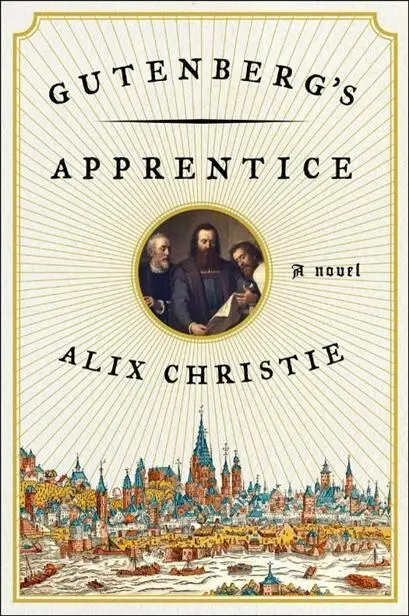
- Название:Gutenberg's Apprentice
- Автор:
- Издательство:Harper
- Жанр:
- Год:2014
- ISBN:нет данных
- Рейтинг книги:5 / 5. Голосов: 1
-
Избранное:Добавить в избранное
- Отзывы:
-
Ваша оценка:
Gutenberg's Apprentice: краткое содержание, описание и аннотация
Предлагаем к чтению аннотацию, описание, краткое содержание или предисловие (зависит от того, что написал сам автор книги «Gutenberg's Apprentice»). Если вы не нашли необходимую информацию о книге — напишите в комментариях, мы постараемся отыскать её.
Youthful, ambitious Peter Schoeffer is on the verge of professional success as a scribe in Paris when his foster father, wealthy merchant and bookseller Johann Fust, summons him home to corrupt, feud-plagued Mainz to meet “a most amazing man.”
Johann Gutenberg, a driven and caustic inventor, has devised a revolutionary — and to some, blasphemous — method of bookmaking: a machine he calls a printing press. Fust is financing Gutenberg’s workshop and he orders Peter, his adopted son, to become Gutenberg’s apprentice. Resentful at having to abandon a prestigious career as a scribe, Peter begins his education in the “darkest art.”
As his skill grows, so, too, does his admiration for Gutenberg and his dedication to their daring venture: copies of the Holy Bible. But mechanical difficulties and the crushing power of the Catholic Church threaten their work. As outside forces align against them, Peter finds himself torn between two father figures: the generous Fust, who saved him from poverty after his mother died; and the brilliant, mercurial Gutenberg, who inspires Peter to achieve his own mastery.
Caught between the genius and the merchant, the old ways and the new, Peter and the men he admires must work together to prevail against overwhelming obstacles — a battle that will change history. . and irrevocably transform them.
Gutenberg's Apprentice — читать онлайн бесплатно полную книгу (весь текст) целиком
Ниже представлен текст книги, разбитый по страницам. Система сохранения места последней прочитанной страницы, позволяет с удобством читать онлайн бесплатно книгу «Gutenberg's Apprentice», без необходимости каждый раз заново искать на чём Вы остановились. Поставьте закладку, и сможете в любой момент перейти на страницу, на которой закончили чтение.
Интервал:
Закладка:
“It is some trick with wood, they say,” said Rosenberg, and Peter felt his chest seize.
“Wood!” The master laughed. “I leave the whittling to lesser men. No sir, it is not wood.”
“But still — some trick, not with the hand?” Rosenberg was frowning, holding out that grammar toward the master as if it had the clap.
Gutenberg took it and raised it up. He squared his shoulders and turned to the archbishop. “A new invention, by your leave. A great technique born in the golden city of the Mainz archdiocese.” He held the grammar up as if it were a chalice until the archbishop reached out his hand.
“With this technique, Your Grace, I can make many copies of a book, each one identical.” Dietrich took the little volume and laid it open on his knees. “This is a grammar — as you see.”
Gutenberg glanced at Peter and mouthed silently, The leaf . Peter dug into his pouch and produced the Donatus page. “If I might approach?” the master asked, and Dietrich nodded.
Gutenberg stepped on the dais, raised the printed leaf, and laid it next to the same page, bound now into a book. “As you can see, there is not a single difference you’ll detect — and most of all no slips or errors, as we encounter all too frequently from scribes.”
Dietrich peered; his pale and bulging eyes moved slowly back and forth. “So it would seem.” His face remained impassive, but Peter thought he saw a look of shock, or at the very least surprise, in those veiled eyes. The archbishop beckoned Rosenberg, and Gutenberg resumed his seat.
They sat on tenterhooks as those two whispered, Rosenberg intent, explaining something. The consultation seemed to stretch from minutes into hours, or maybe it was just the slowing down of time in that long moment in which Peter understood. They all knew — every one of them — while he and the whole crew had been locked down. The master had kept shooting off his mouth, while they’d been sworn to silence. Gutenberg sat there with his head high, and Peter felt a blaze of fury on behalf of Fust. His father had a fortune riding on this secret, which apparently was not as secret as he thought. Doubtless Gutenberg had waved the little book at half the Elder clans in Mainz in search of funds, Peter thought, before he’d seduced Fust.
Finally the master started fidgeting. He did not like to wait. His mouth worked until he said beneath his breath, “The psalm.” In the rustling that ensued as Peter drew it out, the archbishop and his vicar both looked up.
“I hoped”—the master smiled, a little sheepishly, and stood, the psalm secreted in his hands behind his back—“that with my new technique I might be of some service to you too.”
He spread the double sheet on which the scribe had written out the canticles of Moses and Isaiah, in sharp black letters with two blazing gold and red initials. “It seems to me,” he smiled, “the pope would be well pleased with this technique. A little gift made in this way in your archdiocese — a fine pontifical in gauge of your respect and love, and by the way, a nice distraction from the tithe.”
Dietrich opened his pink mouth and smiled. “You never cease to surprise me, Johann.”
“I learned my lessons well.” As all men knew, the pope required a tenth part tithe from every diocese to fund his Jubilee. The rumor was that Dietrich refused, along with the archbishops of Cologne and Trier.
“And for the love I bore your godfather”—the archbishop smiled—“I might agree.” He waved at Rosenberg to take the sheet. “But there’s another task we must consider first.”
The master tensed and waited.
“You’ve heard perhaps that there are new monks at St. Jakob’s.” Dietrich sat back, tenting his white hands. “There is a push among the Benedictines for reform.” There was no movement in the room beyond the scratching of the scribe as they all waited for him to make his meaning clear. “Reform, of course, is something everyone supports.” He smiled blandly. “And so we ought to do our best to help this new congregation.” He signaled Rosenberg to carry on.
“His Grace has authorized a revised missal, which some among the Benedictines feel essential,” the vicar started. “A new and standard text based on a strict interpretation of the Rule, replacing all the variations that have sown disorder.” Shrewdly Rosenberg looked down at Gutenberg. “It seems to us that this — technique — falls like a gift, for if it makes a single text identical in every copy, then each one is entirely free from error.”
The master licked his lips. He stood a moment, stunned, it seemed to Peter. What whirred in the mechanics of his mind? Dietrich leaned his great black bulk toward them.
“A missal,” said the master, pulling at his beard.
“This tool of yours could be — extremely useful,” said the vicar. “So long as it does not…” His voice trailed off.
“So long as we are all assured it does God’s work.” Archbishop Dietrich smiled, pretending that he waited. There was no possibility, of course, that his desire would be denied.
“The Word of God, Your Grace.” The master dipped his head. “You do me a great honor.” The words were obsequious, though underneath it Peter knew that he was calculating madly.
“One thing, though, I must beg, Your Grace.” Gutenberg looked briefly left and right, as if to fix his words into the minds of both the soldier and the priest. “I must insist on secrecy. I cannot work without it — for if word of this gets out, it is stolen from me in a moment.”
Dietrich nodded, bobbing that huge face, made large as if to counterbalance the great miter of his office. “It will be so.” He turned to Rosenberg. “You need not keep these things.” The vicar bowed, and handed book and sheet back to the printer.
“You will need money, I suppose,” said the archbishop.
“Always,” said the master. They exchanged a smile.
Dietrich turned then to his knave and raised the jewel-handled knife. The boy lifted up a pear — a pear, and in December! An instant later the archbishop raised his eyes, as if surprised to find them both still there.
“Go with God,” he said, and lifted up the knife in a slow, lofty gesture. Peter recognized it with a shudder. It was the same dismissive gesture that he used when lifting up his shepherd’s crosier on the rare occasions that he deigned to visit Mainz.
They exited the castle warren through some gardens and an iron gate that opened to the little town of Eltville-on-the-Rhine. Gutenberg stalked swiftly, his closed face not betraying what he thought. Nor did he say a word to Peter that whole day about the thing that had transpired. The scribe was mute, an appendage, a slave the master put back in its place when it had served its purpose. Yet all the while the shock of it was lodged inside him, blocking any other thought. The Word of God reduced to that crude, soulless type — the handbook of the Mass, this precious volume filled with sermon and with song, stamped like some tawdry trinket onto hide. A grammar was one thing — a holy book a sacrilege, a horror in God’s eyes.
Mammon ruled, Peter thought darkly. This day as every day, Johann Gutenberg had business to transact. The man had fingers in all kinds of pies; they saw his niece, his nephew, and a pastor. He’d spent some early years in Eltville, it was clear — most likely every time the Elder clans decamped from Mainz, refusing to submit to taxes from the guilds.
The sun was sinking when the boat to bear them back arrived. Despite libations at each visit, Peter was not warmed. They climbed on, and the master joined the captain in his shelter at the aft. Peter huddled on a bench up front. Spent horses were unhitched, and fresh ones tethered to the long, stout lines that ran between the towpath and the ship. The vessel struggled hard against the current as the dray team strained, the horses’ heads bowed nearly to the ground, before it heaved and started back the long, slow haul upstream.
Читать дальшеИнтервал:
Закладка:
Похожие книги на «Gutenberg's Apprentice»
Представляем Вашему вниманию похожие книги на «Gutenberg's Apprentice» списком для выбора. Мы отобрали схожую по названию и смыслу литературу в надежде предоставить читателям больше вариантов отыскать новые, интересные, ещё непрочитанные произведения.











Обсуждение, отзывы о книге «Gutenberg's Apprentice» и просто собственные мнения читателей. Оставьте ваши комментарии, напишите, что Вы думаете о произведении, его смысле или главных героях. Укажите что конкретно понравилось, а что нет, и почему Вы так считаете.