Alix Christie - Gutenberg's Apprentice
Здесь есть возможность читать онлайн «Alix Christie - Gutenberg's Apprentice» весь текст электронной книги совершенно бесплатно (целиком полную версию без сокращений). В некоторых случаях можно слушать аудио, скачать через торрент в формате fb2 и присутствует краткое содержание. Год выпуска: 2014, Издательство: Harper, Жанр: Историческая проза, на английском языке. Описание произведения, (предисловие) а так же отзывы посетителей доступны на портале библиотеки ЛибКат.
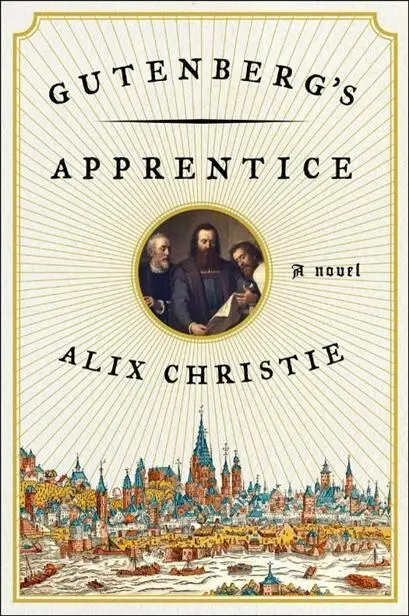
- Название:Gutenberg's Apprentice
- Автор:
- Издательство:Harper
- Жанр:
- Год:2014
- ISBN:нет данных
- Рейтинг книги:5 / 5. Голосов: 1
-
Избранное:Добавить в избранное
- Отзывы:
-
Ваша оценка:
Gutenberg's Apprentice: краткое содержание, описание и аннотация
Предлагаем к чтению аннотацию, описание, краткое содержание или предисловие (зависит от того, что написал сам автор книги «Gutenberg's Apprentice»). Если вы не нашли необходимую информацию о книге — напишите в комментариях, мы постараемся отыскать её.
Youthful, ambitious Peter Schoeffer is on the verge of professional success as a scribe in Paris when his foster father, wealthy merchant and bookseller Johann Fust, summons him home to corrupt, feud-plagued Mainz to meet “a most amazing man.”
Johann Gutenberg, a driven and caustic inventor, has devised a revolutionary — and to some, blasphemous — method of bookmaking: a machine he calls a printing press. Fust is financing Gutenberg’s workshop and he orders Peter, his adopted son, to become Gutenberg’s apprentice. Resentful at having to abandon a prestigious career as a scribe, Peter begins his education in the “darkest art.”
As his skill grows, so, too, does his admiration for Gutenberg and his dedication to their daring venture: copies of the Holy Bible. But mechanical difficulties and the crushing power of the Catholic Church threaten their work. As outside forces align against them, Peter finds himself torn between two father figures: the generous Fust, who saved him from poverty after his mother died; and the brilliant, mercurial Gutenberg, who inspires Peter to achieve his own mastery.
Caught between the genius and the merchant, the old ways and the new, Peter and the men he admires must work together to prevail against overwhelming obstacles — a battle that will change history. . and irrevocably transform them.
Gutenberg's Apprentice — читать онлайн бесплатно полную книгу (весь текст) целиком
Ниже представлен текст книги, разбитый по страницам. Система сохранения места последней прочитанной страницы, позволяет с удобством читать онлайн бесплатно книгу «Gutenberg's Apprentice», без необходимости каждый раз заново искать на чём Вы остановились. Поставьте закладку, и сможете в любой момент перейти на страницу, на которой закончили чтение.
Интервал:
Закладка:
The passengers stood waiting while the boat maneuvered to the wharf before the Wood Gate. Gutenberg had dug a splendid suit out of some moldy chest: a triple-layered gray beret that dropped half to his shoulders and breeches of the same dark gray, with slits that showed brief flashes of maroon. He laughed when Peter bowed and mimed his awe.
“Oh yes.” The master showed his teeth. “We must put on a show.” He swept onto the boat, handed off his cloak, and strode up to the captain, who he seemed to know. A yeasty, fruity smell rose up from hops and oats and wine stored in the hold. They went up to the prow, the Rhine stretched out invitingly before them, a pewter band beneath the cold gray winter sky. The railing was at their chests, the wind full in their faces. If he but let her, Peter thought, the river would convey him to the sea, which he had never seen. One day he’d take it there, he told himself, quite giddy with release.
They both leaned forward as the boat pushed off, arms draped across the rail. The master smiled, his long beard spangled with the spray. “I’ve half a mind to just keep going and not stop until we reach the Dutchmen.”
His mood was strange. He seemed both coiled within himself and yet elated. Guardedly his young apprentice watched and tried to judge how much he dared to ask. The archbishop’s castle was beyond the bend at Wiesbaden. Peter pictured the vast river winding, saw it as a shining snake across the land, as God himself must see it from on high. “How long a ride?” he asked, the answer tossed back by the wind: “About two hours.” Gutenberg gripped harder at the railing as the boat began to toss, and Peter couldn’t help but notice a large golden ring he’d never worn before. The master caught his glance.
“I am a wanderer, like all my kin,” he said, and held it up. The Gensfleisch family seal was that of a lone figure like a humpbacked beggar with a walking stick. It wore a pointy cap and held aloft a cup for alms, and underneath the cape, a lump that might have been a basket.
“Saint Christopher?” asked Peter.
Gutenberg gave a queer smile. “Perhaps. I’ve always thought it apt. Not the traveler, so much as some poor fool who spends his life in begging.” He pulled his collar up then. “I should like to have that cape.”
When Peter fetched his wrap for him, he muttered, “Thank you,” much to his apprentice’s surprise. This gave Peter courage to inquire who they might meet and what he should know about their business there.
Gutenberg regarded him with his deep, gold-flecked eyes. “A man who thinks he runs the world.” He expelled a little mirthful spurt. “For what that’s worth.”
Peter waited — he was a master now in the fine art of waiting. Gutenberg looked swiftly right and left, and then he bent, as if imparting some great secret. “You have to think of Dietrich as a mappa mundi : all the world below, and at the top his fat round head.” His eyes were wicked. “The rest of them appendages to exercise his will. His right arm is his soldier, the knight Erlenbach. His left is Rosenberg, the vicar general, who tends what’s left of his black soul.” His teeth glinted as he grinned. The legs were chancellor and chief clerk, he went on, warming to his little game. Beneath these all the countless earls and margraves clinging to his heels. But this was nothing to the terra incognita spreading out from his vast bulk — the forces that he alternately schemed against or plotted with or fought tooth and nail: the other German dukes, princes, and archbishops, and above all, the pope in Rome.
“You know him well,” said Peter with a little smile.
“I used to go there fairly often long ago.” Gutenberg turned back downstream, his face in profile sharply chiseled, with that long, aristocratic nose.
The Martinsburg, when it came into view, looked almost dainty through the screen of trees. As they came closer, Peter saw that it was fortified, its tower twice as tall and broad as Mainz’s Iron Gate. Atop its turrets fluttered Dietrich’s arms: the six-spoked wheel of Mainz and then the house of Erbach, two white stars, one red. The fortress could not be approached directly from the river, ringed as it was by sharply pointed stones. They slipped instead into a side canal and disembarked onto a jetty like a tongue extended from the wall. “Keep your mouth shut,” the master hissed as they were led inside. “Just kiss his hand and then fall back.”
Peter had expected gold and jewels — pomp, excess. Such was the picture of this monster in the mind’s eye of the city’s guilds. He was astonished instead to find the great man in his morning dress, all pink from bathing, wearing only a black robe, his scarlet collar nearly hidden by his neck and jowls. He sat on a golden chair, that much was true, flanked by a man-at-arms and a priest in dark red robes. A silver tray of fruit lay at his right, beside a kneeling knave whose sole employ appeared to be advancing bits of food toward his mouth.
“How kind to take the time to see us, dear Johann.” Languidly Archbishop Dietrich lifted up a fleshy hand. His eyes were heavy like a tortoise’s.
“Your Grace.” The master bent his knee and kissed the rings upon that hand. Then it was Peter’s turn; he heard the master say, “Peter Schoeffer, lord, a clericus of Gernsheim and of Mainz, a scribe in my employ.”
Peter backed away. “Warm greetings, Father,” Gutenberg was saying to the priest who must be Rosenberg: black brows beneath a bright white fringe that circled his black skullcap, penetrating, deep-set eyes. The knight, a hard, thin elder warrior all in leather, looked right through them both; to the side sat a secretary with a writing tray. The archdiocese had scores of scribes, but none so high as this, thought Peter with a spurt of hope. Two velvet stools appeared behind them, and they sat.
Even afterward he barely could describe the room, so closely did he bend his ears to hear. He vaguely saw that it was large and paned with squares of painted blue Venetian glass on doors that gave out on a garden. What other decoration there might be, he did not see. They had been turned and twisted through the tower hallways to arrive in this bright chamber. Now as they waited Dietrich dipped his fingers in a silver salver, dried them on a linen towel, and, leaning forward, placed them on his knees.
“Your metalwork, I see, does not extend to razors.” His own chin was white and smooth, a promontory jutting from a sagging sea of skin. His blue eyes opened, huge and oddly vacant.
Gutenberg sighed loudly. “My lord, you know I’m an old sinner. The razor, I confess, is the least of my faults.”
Dietrich’s cheek twitched. “You do consort with troublemakers, it appears.”
Raising both his hands, the master supplicated brilliantly. “Forgive me, Grace, if you can understand. I’m quite unable to find craftsmen from the noble classes.”
Dietrich had a pair of full and drooping lips that parted only slightly when he slipped a morsel in, or when, as now, he truly smiled. “Indeed. Yet we have need of smiths”—his eyes lapped briefly over Peter—“as well as scribes.”
The humor snuffed out then, just like a candle, from Dietrich’s eyes. “You have a way with craftsmen, it would seem.” He turned toward Rosenberg. The vicar general bowed and pulled a volume from his sleeve.
“It’s said that you made this,” the vicar said, black eyes upon the master’s face as he began to turn the leaves.
The master rose, stretched out a hand. “I might have known I could not keep so marvelous a thing from you,” he said, inclining himself slightly toward Dietrich. It was a mime he played, thought Peter — Lord let him play it well. He felt an unaccustomed pressure on his shoulders, seated on that stool below the dais, his head right at the level of the henchman’s hilt.
Читать дальшеИнтервал:
Закладка:
Похожие книги на «Gutenberg's Apprentice»
Представляем Вашему вниманию похожие книги на «Gutenberg's Apprentice» списком для выбора. Мы отобрали схожую по названию и смыслу литературу в надежде предоставить читателям больше вариантов отыскать новые, интересные, ещё непрочитанные произведения.











Обсуждение, отзывы о книге «Gutenberg's Apprentice» и просто собственные мнения читателей. Оставьте ваши комментарии, напишите, что Вы думаете о произведении, его смысле или главных героях. Укажите что конкретно понравилось, а что нет, и почему Вы так считаете.