Alix Christie - Gutenberg's Apprentice
Здесь есть возможность читать онлайн «Alix Christie - Gutenberg's Apprentice» весь текст электронной книги совершенно бесплатно (целиком полную версию без сокращений). В некоторых случаях можно слушать аудио, скачать через торрент в формате fb2 и присутствует краткое содержание. Год выпуска: 2014, Издательство: Harper, Жанр: Историческая проза, на английском языке. Описание произведения, (предисловие) а так же отзывы посетителей доступны на портале библиотеки ЛибКат.
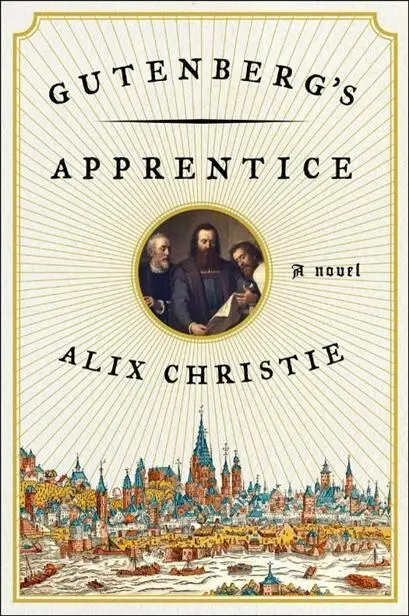
- Название:Gutenberg's Apprentice
- Автор:
- Издательство:Harper
- Жанр:
- Год:2014
- ISBN:нет данных
- Рейтинг книги:5 / 5. Голосов: 1
-
Избранное:Добавить в избранное
- Отзывы:
-
Ваша оценка:
Gutenberg's Apprentice: краткое содержание, описание и аннотация
Предлагаем к чтению аннотацию, описание, краткое содержание или предисловие (зависит от того, что написал сам автор книги «Gutenberg's Apprentice»). Если вы не нашли необходимую информацию о книге — напишите в комментариях, мы постараемся отыскать её.
Youthful, ambitious Peter Schoeffer is on the verge of professional success as a scribe in Paris when his foster father, wealthy merchant and bookseller Johann Fust, summons him home to corrupt, feud-plagued Mainz to meet “a most amazing man.”
Johann Gutenberg, a driven and caustic inventor, has devised a revolutionary — and to some, blasphemous — method of bookmaking: a machine he calls a printing press. Fust is financing Gutenberg’s workshop and he orders Peter, his adopted son, to become Gutenberg’s apprentice. Resentful at having to abandon a prestigious career as a scribe, Peter begins his education in the “darkest art.”
As his skill grows, so, too, does his admiration for Gutenberg and his dedication to their daring venture: copies of the Holy Bible. But mechanical difficulties and the crushing power of the Catholic Church threaten their work. As outside forces align against them, Peter finds himself torn between two father figures: the generous Fust, who saved him from poverty after his mother died; and the brilliant, mercurial Gutenberg, who inspires Peter to achieve his own mastery.
Caught between the genius and the merchant, the old ways and the new, Peter and the men he admires must work together to prevail against overwhelming obstacles — a battle that will change history. . and irrevocably transform them.
Gutenberg's Apprentice — читать онлайн бесплатно полную книгу (весь текст) целиком
Ниже представлен текст книги, разбитый по страницам. Система сохранения места последней прочитанной страницы, позволяет с удобством читать онлайн бесплатно книгу «Gutenberg's Apprentice», без необходимости каждый раз заново искать на чём Вы остановились. Поставьте закладку, и сможете в любой момент перейти на страницу, на которой закончили чтение.
Интервал:
Закладка:
CHAPTER 7: MAINZ
Mid-December 1450
REFORM WAS A PRAYER that bounced across the Holy Roman Empire and the rest of Christendom that year, a hope that something in the world might change. True Christians yearned for a return to a purer, more ascetic faith, and change had been agreed on at the conclave of the cardinals four years before in Basel. The world was wormwood, pocked with greed, and none plundered more than those who had been called to serve the church. The pope himself, in ordering his Jubilee, decreed that the abuses had to stop, and lent his weight to many projects of reform among the Benedictines and the Augustinians as well as within his own house, the hierarchy of the Holy See.
It was a pious hope indeed. Peter knew it from the instant that he saw the archbishop’s knowing smile, his bland assurance that he endorsed reform. The only reform Dietrich wanted was the restoration of the abbeys’ wealth, for every monastery in the archdiocese was in his jurisdiction. For decades noble families had run them as their private fiefs and stripped them nearly clean, but this would henceforth cease — to honor God, return the monks to upright lives, the monasteries to their former economic strength, and thus increase the archbishop’s own receipts.
This missal for St. Jakob’s was a marvelous commission, Gutenberg assured his partner, then his crew — the centerpiece of a great push among the Benedictines of the Bursfeld congregation for reform. He had no doubts, and through a night of talking convinced Fust as well that this was just the book they had been waiting to produce. Fust did not like the prospect of the clergy in command of that whole printing works he underwrote, despite his own faith and his uncles’ high positions in the city’s churches. But Gutenberg was a master of manipulation, Peter thought, observing as the two of them discussed it out of earshot of the crew. The master was quite able to convince them all to lift and drink directly from that poisoned chalice.
For poisoned it most surely was. The handbook of the Mass was hellishly complex, even for the most accomplished scribe. It ran two hundred pages and was written in two, if not three, contrasting scripts: one for the priest’s words; a larger letter for the Gospel readings; and in finer books a third hand for the lyrics of the Psalms.
The partners called the crew together two days after their return from Eltville. Gutenberg was quite unrecognizable: his hair was trimmed, as was his beard; he seemed to overflow with cheer. Beside him Fust stood, chest thrust out, his cheeks and chin smooth-shaved, convinced no doubt by the sheer money to be made. Who did he take himself for? Peter asked himself. It was a strange inversion, to be sure: patrician Elder wearing whiskers, common merchant fresh of face.
The master’s hands held something at his back. “I hear there was a bet.” He pulled a volume out and grinned. “It’s neither long nor short, but just the thing.”
They craned to see the first page of the liber ordinarius , the handbook of the Holy Roman rite. “The first of many, let us pray.” Fust smiled and glanced at Peter.
“They’ll go like fishcakes at the fair.” Gutenberg looked around at the four men. Hans plucked his throat; Konrad stretched a hand out, gauging the proportions of the page. Keffer pursed his lips and looked at Peter. A little flame inside the new apprentice flickered and went out.
“Two hundred pages, worth their weight in gold,” said Gutenberg.
Every priest in every parish, every abbot in his chapel, every soul of wealth and standing, had to have the handbook to the Mass. This edition would be newly drafted by the prior of St. Jakob’s, to be used by all the monasteries of the Bursfeld congregation, he explained. But nothing said their workshop had to limit it to that.
With curving yellowed nails he started ticking off prospective buyers: seventy for Bursfeld in the dioceses of Mainz and Bamberg; forty, fifty more for churches in the cities, who’d strong-arm the wealthy of their parish to endow their pulpits with a copy. Nor was the Latin rite restricted to the Rhineland, nor to Germany and Austria and Bohemia, comprising their own Holy Roman Empire. Peter grasped at once their overarching goal: one single, uniform edition, which could be sold in every kingdom from the Narrow Sea of England to the Middle Sea that laps the Holy Land. Hundreds, thousands, of them, priced to undercut the products of the scribes.
“God’s given us the means to multiply His Word!” Gutenberg was fairly dancing with delight. “At last His own benighted clergy, too, have seen.”
Fust had a bottle in his hand; he twisted at the cork until it popped.
The pressure gave then, too, in Peter’s head: he heard the platens of a hundred presses crashing, books churned out as hot and rough as bolts bashed out by blacksmiths. Big volumes too, not puny little grammars: vast quantities of brutish, ugly, soulless tomes.
He scrutinized Fust’s face: his blue eyes shone, his cheeks were glowing. Did he feel no compunction about selling out that beauty, all the praise and grace that God invested in their hands? He glanced at Konrad, who had lately started muttering that he would like to push on home. Keffer would be glad, he guessed, of extra work. Hans — well, Hans was as loyal as a hound. Which left just Peter Schoeffer to spit in the soup.
“There is a reason books like these are done by scribes.” He reached and took it out of Konrad’s hands. “You need at least two separate scripts, at least two sizes.”
Gutenberg’s glass stopped, half raised. “Really.” He cocked an eyebrow, looked around, and drawled it mockingly. “I’m much obliged. I guess then Brack is short of scribes.”
“Heinrich Brack,” Fust put in, looking hard at Peter. “The prior of St. Jakob’s.”
“And author of our text.” The master wheeled, gave Hans a jovial whack. “His Grace is more than pleased. You should have heard old Rosenberg!” He cackled. “‘Such a means to make a perfect text, and in his Lordship’s diocese!’” He mimed a high falsetto.
“I guess he didn’t look that closely at the type then,” Peter said grimly. He saw again that cheap Donatus, open on Archbishop Dietrich’s knee.
“I guess he did.” The master’s back was up; his eyes were glinting.
“With due respect.” Peter glanced apologetically at Hans. “This letter will not do.”
“Says who?” The master’s face was twisted.
“It is too coarse.” Peter spoke as pleasantly as he was able. “Too heavy, and too square.”
“You, of course, could do much better.”
“That’s not my meaning.”
“Although…” Fust’s voice broke in, meditative and slightly probing. “It might not be a bad idea. It might just—”
Peter, stunned, could only gape.
“A finer letter, as he says, might well improve it.” Fust fished out his spectacles and reached to scan the written missal.
“A whole new face — that takes six months — to draw and cut and cast?” The master barked a laugh. “God’s body, man. It’s madness.”
Fust stroked his chin, and held his ground. “Even so. It’s worth a try.”
Konrad looked at Peter and traced a blade across his neck; Hans thrust his lips out, sighing. The master turned his back and walked a moment up and down, one hand inside his vest, the other torturing his beard. “Two hands and in two sizes,” he muttered blackly, spun, and then returned. He brought his face so close that Peter saw the tiny red threads in his eyes. “You’re not the only one who’s ever seen a missal, Master Scribe.”
“Let it be on my head,” said Fust in a loud voice. Unspoken, his real meaning: it is my money, sir, and I decide.
Читать дальшеИнтервал:
Закладка:
Похожие книги на «Gutenberg's Apprentice»
Представляем Вашему вниманию похожие книги на «Gutenberg's Apprentice» списком для выбора. Мы отобрали схожую по названию и смыслу литературу в надежде предоставить читателям больше вариантов отыскать новые, интересные, ещё непрочитанные произведения.










Обсуждение, отзывы о книге «Gutenberg's Apprentice» и просто собственные мнения читателей. Оставьте ваши комментарии, напишите, что Вы думаете о произведении, его смысле или главных героях. Укажите что конкретно понравилось, а что нет, и почему Вы так считаете.