Alix Christie - Gutenberg's Apprentice
Здесь есть возможность читать онлайн «Alix Christie - Gutenberg's Apprentice» весь текст электронной книги совершенно бесплатно (целиком полную версию без сокращений). В некоторых случаях можно слушать аудио, скачать через торрент в формате fb2 и присутствует краткое содержание. Год выпуска: 2014, Издательство: Harper, Жанр: Историческая проза, на английском языке. Описание произведения, (предисловие) а так же отзывы посетителей доступны на портале библиотеки ЛибКат.
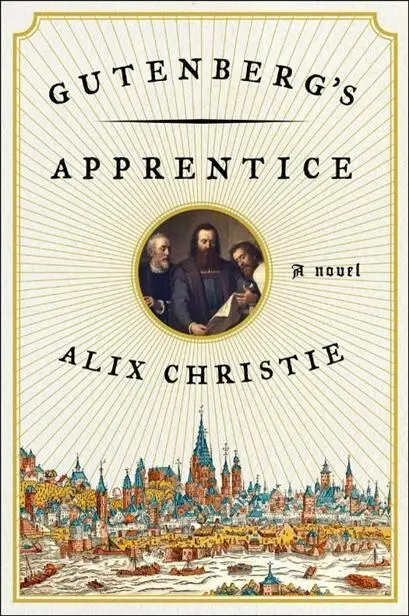
- Название:Gutenberg's Apprentice
- Автор:
- Издательство:Harper
- Жанр:
- Год:2014
- ISBN:нет данных
- Рейтинг книги:5 / 5. Голосов: 1
-
Избранное:Добавить в избранное
- Отзывы:
-
Ваша оценка:
Gutenberg's Apprentice: краткое содержание, описание и аннотация
Предлагаем к чтению аннотацию, описание, краткое содержание или предисловие (зависит от того, что написал сам автор книги «Gutenberg's Apprentice»). Если вы не нашли необходимую информацию о книге — напишите в комментариях, мы постараемся отыскать её.
Youthful, ambitious Peter Schoeffer is on the verge of professional success as a scribe in Paris when his foster father, wealthy merchant and bookseller Johann Fust, summons him home to corrupt, feud-plagued Mainz to meet “a most amazing man.”
Johann Gutenberg, a driven and caustic inventor, has devised a revolutionary — and to some, blasphemous — method of bookmaking: a machine he calls a printing press. Fust is financing Gutenberg’s workshop and he orders Peter, his adopted son, to become Gutenberg’s apprentice. Resentful at having to abandon a prestigious career as a scribe, Peter begins his education in the “darkest art.”
As his skill grows, so, too, does his admiration for Gutenberg and his dedication to their daring venture: copies of the Holy Bible. But mechanical difficulties and the crushing power of the Catholic Church threaten their work. As outside forces align against them, Peter finds himself torn between two father figures: the generous Fust, who saved him from poverty after his mother died; and the brilliant, mercurial Gutenberg, who inspires Peter to achieve his own mastery.
Caught between the genius and the merchant, the old ways and the new, Peter and the men he admires must work together to prevail against overwhelming obstacles — a battle that will change history. . and irrevocably transform them.
Gutenberg's Apprentice — читать онлайн бесплатно полную книгу (весь текст) целиком
Ниже представлен текст книги, разбитый по страницам. Система сохранения места последней прочитанной страницы, позволяет с удобством читать онлайн бесплатно книгу «Gutenberg's Apprentice», без необходимости каждый раз заново искать на чём Вы остановились. Поставьте закладку, и сможете в любой момент перейти на страницу, на которой закончили чтение.
Интервал:
Закладка:
When his servant finally brought the monk’s reply, the master seized the scroll and cracked the seal. His face alone destroyed all hope. He stormed away without a word; it fell to Fust to extract and then to share the truth.
Archbishop Dietrich had indeed endorsed the prior’s version of the liber ordinarius . That draft in fact was long since done. But — here the but —apparently there was a second and competing text; there was dissension in the ranks over the prior’s vision of reform. His Grace the cardinal, Cusanus, quite naturally would have to choose.
Fust looked hard across the crew toward his son. His rigid face spoke volumes. He’d trusted Gutenberg — they all had, to a man. For months the master had assured them that the text was coming; not once had the inventor shown the slightest doubt. “Our missal,” he had even called it. And now they stood there, pants down, holding out their hands, as Dietrich covered his backside. Gutenberg himself had left the room.
Fust saddled up and left the first week of October, more to stop him ranting, Peter knew, than out of any appetite for sales. Eight hundred guilders he had riding on this missal, nearly all of it tied up in heaps of type and stacks of vellum. Peter meanwhile racked his brain. There had to be some way to move the project on. It came to him one morning as he stared up toward St. Jakob’s from the rampart wall. They’d have to set some of the missal text in their new type, to give the monks — perhaps Cusanus, too — a taste, he told the master. Just beg a page or two, that’s all, and let them see how fine this thing will be. Gutenberg at first did not respond. His mood was fouler then than even Hans had seen it — until a few days later, when abruptly he told Peter to grab cloak and hat and climb the hill with him to see this Prior Brack.
The way to St. Jakob’s lay directly south. But they were forced to leave the city by crabbed routes around the markets and great houses. The master strode so quickly that Peter lost sight of him a time or two among the jostling passersby and carts. He would have lost him utterly, had Gutenberg not stood a head above the rest, and worn a bright red fur-trimmed cap. He slowed as they came out behind St. Martin’s to the painting workshops and the street began to flow more broadly toward the gate. Some paces on, the hatters seized upon him, crying “Fine sir! A muskrat, or an otter, that’s a better top to wear in such a season!” He laughed and dodged and doffed his own. Peter pulled his stole up tight. They passed beneath the gate and crossed a stream that chattered blithely in the cold. They were the only ones that afternoon that went not into Mainz, but out.
Ahead and to the left the hayfields shimmered in a rime of frost, stitched into blackened rows. The sky was banded in more hues of gray than all their trays of metals. The highway bore away into the mist and split: one tongue licked left down to the river, another straight ahead, the right-hand fork up toward St. Jakob’s. Geese splashed along the inlet. But save for this, there reigned a stillness so complete that it erased all haste from Peter’s soul. The master must have felt the same; he took a great breath in and turned and smiled.
They felt as much as saw the Jakobsberg, looming up above them just outside the city wall. The monastery on that sudden rise reared up so high and close that on a clear day all the monks might hail the deacon of St. Stephan’s in the city on the other side. Peter never had been up to the Benedictines’ keep. Yet he knew like any son of Mainz that to the people of the city it had ever been a threat. The townsfolk rose each generation in revolt against the wealthy abbots and the Elders, burning and destroying in resentment and despair. And just as often did those heavy, jeweled hands swing, biting, back. The bloodshed soaked the marrow of each family, guildsman or patrician, poor or rich.
Gutenberg surveyed the vine-crabbed slope down to the trench cut just beneath the city wall. “They’ll never dig it deep enough. Nor lack for fools on either side.” He straightened, making for the fork and the steep uphill climb. “You know who had it dug?” He glanced at Peter, a sly look in his eyes. “My granddad’s granddad — Wirich was his name. Common workingman of Mainz — you’d think at least the guilds would give me that.” He gave his barking laugh. “My mother’s blood flowed down from his — and cost me entry to the Mint. They drove the ingrate out, of course — although I left of my own free will.”
These grapevines once had been the abbey’s, he went on as they toiled upward. His ancestor had led the city charge that torched them all — St. Jakob, St. Albans, St. Viktor — clawing back those vineyards for the city. An empty victory, of course, for Mainz had been required to pay the restitution. “They pay it still,” he said, and shook his head.
They stopped and stood to catch their breaths before a ramp that led to a great gate. Peter looked across and down, astounded; he’d never seen the city from this high. Everything was tiny: the threadlike rigging of the ships, the toylike wagons, and the people, tiny specks on lanes like veins.
“No wonder that they see us all as pawns.” He didn’t realize, at first, that he had murmured this aloud.
The master stretched out one arm toward the hillock near the river’s edge. “Though on my father’s side, a cousin ran the school at St. Viktor’s.” He raised one eyebrow. “I guess that makes us brothers of a kind.” It surprised Peter, Gutenberg recalling his apprentice’s brief tenure in that order. The master flashed a grin. “I count on that good brotherhood to pray for my black soul when it is time.”
He cinched his belt and squared his cloak. He stood erect, pitched forward on his toes, as if he steered a moving boat. And for the first time Peter saw him, really saw him: the way he straddled those two warring worlds, beholden to no group — no clan, no guild, no class, nor, in God’s truth, to any other man. He stood outside, alone, a solitary soul.
They were expected. The gate swung open with a shudder, and they stepped inside. Peter had expected something grand, but when they entered that wide courtyard he stopped short, amazed.
The monastery was an empty shell, a propped-up and half-built facade. The building right before them was the only one intact; off to the left the abbey church, which should have been its jewel, was only half constructed. It spanned the hilltop like the long stroke of a U, joining to the central building. Its walls were newish, tall, with space for windows, but the nave stood open to the sky. Beneath his breath the master said, “It used to look much worse.” Across the courtyard there were stables, storerooms, a granary that in that season overflowed with hops; a well, a muddy pool, and several wagons. And that was it: no rows of barrel-chested peasants, not a single fatted friar, no sense of busy, serene plenty. The Benedictine abbey of St. Jakob’s, it was clear, had fallen on hard times.
The prior received them in the sacristy — at least the office seemed to serve that function. There were holy vessels, vestments on a shelf. A case of books, as well, in that large room, which looked out on the river from the second floor. Heinrich Brack was older than Peter had imagined: tall and stooped, with hair like iron filings and great pouches underneath his small, dark eyes. He made a jangling as he rose and clamped a hand on his hip to still the ring of keys.
“Dear friend.” He clasped the master’s hand. “I thank the Lord to see you well.”
“My health, sir, lies I think more in your hands.”
Peter caught the faintest ghost of a smile. The master introduced him as his scribe. The prior offered wine.
Читать дальшеИнтервал:
Закладка:
Похожие книги на «Gutenberg's Apprentice»
Представляем Вашему вниманию похожие книги на «Gutenberg's Apprentice» списком для выбора. Мы отобрали схожую по названию и смыслу литературу в надежде предоставить читателям больше вариантов отыскать новые, интересные, ещё непрочитанные произведения.











Обсуждение, отзывы о книге «Gutenberg's Apprentice» и просто собственные мнения читателей. Оставьте ваши комментарии, напишите, что Вы думаете о произведении, его смысле или главных героях. Укажите что конкретно понравилось, а что нет, и почему Вы так считаете.