Alix Christie - Gutenberg's Apprentice
Здесь есть возможность читать онлайн «Alix Christie - Gutenberg's Apprentice» весь текст электронной книги совершенно бесплатно (целиком полную версию без сокращений). В некоторых случаях можно слушать аудио, скачать через торрент в формате fb2 и присутствует краткое содержание. Год выпуска: 2014, Издательство: Harper, Жанр: Историческая проза, на английском языке. Описание произведения, (предисловие) а так же отзывы посетителей доступны на портале библиотеки ЛибКат.
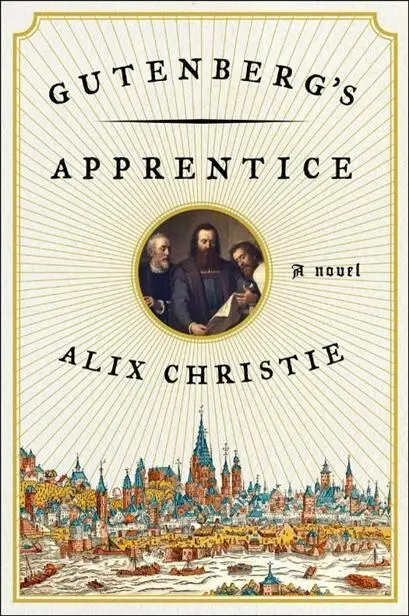
- Название:Gutenberg's Apprentice
- Автор:
- Издательство:Harper
- Жанр:
- Год:2014
- ISBN:нет данных
- Рейтинг книги:5 / 5. Голосов: 1
-
Избранное:Добавить в избранное
- Отзывы:
-
Ваша оценка:
Gutenberg's Apprentice: краткое содержание, описание и аннотация
Предлагаем к чтению аннотацию, описание, краткое содержание или предисловие (зависит от того, что написал сам автор книги «Gutenberg's Apprentice»). Если вы не нашли необходимую информацию о книге — напишите в комментариях, мы постараемся отыскать её.
Youthful, ambitious Peter Schoeffer is on the verge of professional success as a scribe in Paris when his foster father, wealthy merchant and bookseller Johann Fust, summons him home to corrupt, feud-plagued Mainz to meet “a most amazing man.”
Johann Gutenberg, a driven and caustic inventor, has devised a revolutionary — and to some, blasphemous — method of bookmaking: a machine he calls a printing press. Fust is financing Gutenberg’s workshop and he orders Peter, his adopted son, to become Gutenberg’s apprentice. Resentful at having to abandon a prestigious career as a scribe, Peter begins his education in the “darkest art.”
As his skill grows, so, too, does his admiration for Gutenberg and his dedication to their daring venture: copies of the Holy Bible. But mechanical difficulties and the crushing power of the Catholic Church threaten their work. As outside forces align against them, Peter finds himself torn between two father figures: the generous Fust, who saved him from poverty after his mother died; and the brilliant, mercurial Gutenberg, who inspires Peter to achieve his own mastery.
Caught between the genius and the merchant, the old ways and the new, Peter and the men he admires must work together to prevail against overwhelming obstacles — a battle that will change history. . and irrevocably transform them.
Gutenberg's Apprentice — читать онлайн бесплатно полную книгу (весь текст) целиком
Ниже представлен текст книги, разбитый по страницам. Система сохранения места последней прочитанной страницы, позволяет с удобством читать онлайн бесплатно книгу «Gutenberg's Apprentice», без необходимости каждый раз заново искать на чём Вы остановились. Поставьте закладку, и сможете в любой момент перейти на страницу, на которой закончили чтение.
Интервал:
Закладка:
There was a fair amount of joshing as he laid a dampened paper on the glistening lines. It took a man, not a monk, a bull and not a saint, that sort of thing. “Then lend a hand,” he said. One blond giant and one red put beefy mitts upon the bed and helped him push it underneath the hanging platen.
The lever he would pull alone. It almost was past Peter’s strength, but in that instant he was lifted up in every sense that he could name. His feet came partway off the floor, and the blood rushed to his neck as he heard first the weight drop, then a grinding sound as it made contact with the letters.
“Fiat imprimere!” the master cried, and they hauled back the bed. Peter opened up the wooden frame. Carefully he peeled off the sheet, as the others stepped back to a respectful distance.
A power surged out of those words, a strength that even Peter had not pictured. The ink was as black as heaven’s vault, the letters sharp and gripping. They wove into a trellis just as Pliny said all lines must do, to hold the meaning of the text like wires among the vines. The Word is as a fruit, he thought; the vineyard of the text is thickly twined. He stared, transfixed. In their austerity and density, the letters made a page of extraordinary beauty. His letters — his! — the very lines he’d drawn and carved, now lay proudly, blackly, making words up on the page. He felt his insides quicken with the thrill of it — and then a kind of falling.
Gutenberg was fairly hopping just behind him. Peter felt his energy and eagerness, and from the corner of his eye he saw him reaching. Peter held the page out to him, his fingers grazing the deep bite the words had taken in it.
“By God!” The master’s face was open, softened, every trace of sharpness gone. “A scribe, my eye! A bloody carving genius, more like! From here on out you sculpt my types.”
That was the moment it all changed. Peter saw it clearly at the time. There are in every life some moments that stand out, as if embossed — moments when a man can sense the hand of God. That day, for the first time, the scribe asked — first in shock, then gradually with disbelief, and bashful, dread-filled pride — if what His servant Peter did there, in the Hof zum Gutenberg, might be in fact what He intended.
This was the spark, the breeze, that entered him — the understanding, too, that all the ways he knew were coming to an end. None of the arts he’d learned could remain unchanged. None of the ways of his fathers and their fathers, the familiar rhythms of their lives, would be the same. The genie was released from the bottle. Ars impressoria , known ever after as the ars divin . Peter watched the master take the sheet and hand it off to Hans, and heard his triumphant words: “Fetch Fust.”
His fellows — Hans and Keffer and Konrad, bound now in wonder and in pride — were clustered close together with the master, staring down. Gutenberg looked up and smiled. “By the will of the most Holy Father, we have been delivered,” he said, with a look no less amazed than that of his whole crew.
“Amen,” said Hans, and, turning toward the young apprentice, raised his hands and clapped.
CHAPTER 9: MAINZ
June — September 1451
PETER’S FATHER did not hide his satisfaction with the script, and by extension with the hand that moved his own dreams that much closer. The name days of his sons fell close together in late June — Johannes, John the Baptist, and then the feast day of Saint Peter. Little Hans, at one, could only gum his polished tusk, but Peter could read easily the message in the rosewood box Fust gave him. It had compartments lined in silk the exact length of quills. He had been hasty and too commandeering, Fust conceded as he placed it into Peter’s hands. These metal types are born of writing: there will never be a time when hands are not our first, most sacred tools.
The knotted fustus of their house was inlaid on the top in repoussé of silver from the family shop. “The race is not to the swift,” Peter answered, bowing. He had been hasty too. There were many ways to spread the light of learning, after all. Then there was peace and reconciliation and feasting in the Haus zur Rosau.
Almost a year had burned away since he’d been summoned back from Paris. In the workshop all the type was done, the preparations for the printing of the missal made. The text they were to set, however, had not yet arrived. The prior of St. Jakob’s begged their patience and their faith. July passed in stupefying heat, but still his text did not appear. The crew made grammars to bring in coin and pass the time. The master started sending Lorenz to the monastery on the hill to fetch the first few pages, but every time the servant brought back the same answer.
“Patience!” Gutenberg would snort. “A vice and not a virtue in my book.”
On August 6, the Feast of the Transfiguration, Peter caught a glimpse of Petrus Heilant, his old classmate, at the portal of St. Martin’s. He had not heard from him for quite some time, but neither had Peter sought him out. The farmers and the monks and sisters from the cloisters on the land had all arrived in carts and long processions, draining through the gates toward the market square. The feast was new, reminding all the faithful that they shared in Christ’s divinity as it had been revealed upon the Mount. More like a chance to make another grab at the collection plate, his uncle Jakob had observed. The monks of St. Viktor’s stood sweating in the unforgiving sun. Heilant looked quite ill, all pink and twitching in his thick black habit. Peter caught his eye; the monk held up his hands and mimed them empty. It hit Peter then with certainty: whatever post there was to pluck, Heilant sure as Satan would have snatched it first. Peter smiled and turned away, humbled yet relieved by his own slipshod calculation.
And in the shop they kept on printing those sad grammars, cursing as the heat intensified. The parchment curled before they got it near the press; the ink just melted to a slop that left the letters thin and blotched. Konrad by then had gone back home to Strassburg, leaving Hans bereft. Ruppel, the new man who ran the press, was taciturn, which did not help. Keffer muttered curses when the master ordered them to work at odd, inhuman hours to beat the heat: before the dawn and through the night, eyes gritty and their weary bones begging for their beds.
All through August Gutenberg just stalked, twisting at that sorry rope he called a beard. If in the spring he had been civil, even friendly, now the crew were just as stupid as they’d been before: cockups and dogsbodies, laggards, useless whelps. The prior didn’t fare much better. “Light a fire beneath your bloody habit,” he would mutter as he reviewed the sketches and the calculations for the missal Peter had prepared.
His apprentice reckoned they’d spent more than half Fust’s gold already. Four or five hundred guilders had gone out on paper, vellum, lampblack, resin, ores and wood and candles, not to mention food and housing for the men. Everything stood ready for St. Jakob’s missal: a hundred sets of royal sheets were trimmed, the letters made. The harvest moon rose and waxed and waned, but still they had received no text to set. Fust and Gutenberg vanished into the master’s study with the ledger, emerging after sounds of argument with mouths turned down. “Another month,” said Gutenberg; “Not a day more,” growled Fust.
Out in the city there were signs of the great mustering to come. Mainz was next to be instructed in the pope’s great mission of reform. His special envoy, Nicholas of Cusa, known as Cardinal Cusanus, had called a diocesan meeting to explain the edicts that the cardinals had passed in Basel. Even in the Hof zum Gutenberg they heard the rustle of the clergy coming. They swooped in like winged beetles, brown and black, the leaders of the seventeen thousand priests in the archdiocese — from Freiburg in the west to Thuringia and Franken in the east and south as far as Baden. At least the visit might shake loose the text from Prior Brack, Fust said. Gutenberg thought just the same: he seized a pen and wrote a note and sent Lorenz back up the hill. For hours he waited on his stool, his eyebrows twitching like a cat parked at a wainscot.
Читать дальшеИнтервал:
Закладка:
Похожие книги на «Gutenberg's Apprentice»
Представляем Вашему вниманию похожие книги на «Gutenberg's Apprentice» списком для выбора. Мы отобрали схожую по названию и смыслу литературу в надежде предоставить читателям больше вариантов отыскать новые, интересные, ещё непрочитанные произведения.











Обсуждение, отзывы о книге «Gutenberg's Apprentice» и просто собственные мнения читателей. Оставьте ваши комментарии, напишите, что Вы думаете о произведении, его смысле или главных героях. Укажите что конкретно понравилось, а что нет, и почему Вы так считаете.