Alix Christie - Gutenberg's Apprentice
Здесь есть возможность читать онлайн «Alix Christie - Gutenberg's Apprentice» весь текст электронной книги совершенно бесплатно (целиком полную версию без сокращений). В некоторых случаях можно слушать аудио, скачать через торрент в формате fb2 и присутствует краткое содержание. Год выпуска: 2014, Издательство: Harper, Жанр: Историческая проза, на английском языке. Описание произведения, (предисловие) а так же отзывы посетителей доступны на портале библиотеки ЛибКат.
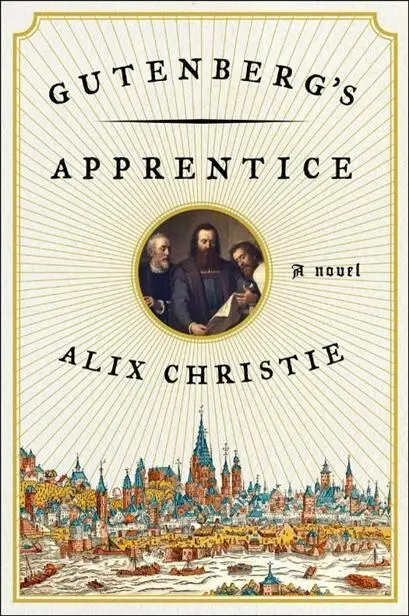
- Название:Gutenberg's Apprentice
- Автор:
- Издательство:Harper
- Жанр:
- Год:2014
- ISBN:нет данных
- Рейтинг книги:5 / 5. Голосов: 1
-
Избранное:Добавить в избранное
- Отзывы:
-
Ваша оценка:
Gutenberg's Apprentice: краткое содержание, описание и аннотация
Предлагаем к чтению аннотацию, описание, краткое содержание или предисловие (зависит от того, что написал сам автор книги «Gutenberg's Apprentice»). Если вы не нашли необходимую информацию о книге — напишите в комментариях, мы постараемся отыскать её.
Youthful, ambitious Peter Schoeffer is on the verge of professional success as a scribe in Paris when his foster father, wealthy merchant and bookseller Johann Fust, summons him home to corrupt, feud-plagued Mainz to meet “a most amazing man.”
Johann Gutenberg, a driven and caustic inventor, has devised a revolutionary — and to some, blasphemous — method of bookmaking: a machine he calls a printing press. Fust is financing Gutenberg’s workshop and he orders Peter, his adopted son, to become Gutenberg’s apprentice. Resentful at having to abandon a prestigious career as a scribe, Peter begins his education in the “darkest art.”
As his skill grows, so, too, does his admiration for Gutenberg and his dedication to their daring venture: copies of the Holy Bible. But mechanical difficulties and the crushing power of the Catholic Church threaten their work. As outside forces align against them, Peter finds himself torn between two father figures: the generous Fust, who saved him from poverty after his mother died; and the brilliant, mercurial Gutenberg, who inspires Peter to achieve his own mastery.
Caught between the genius and the merchant, the old ways and the new, Peter and the men he admires must work together to prevail against overwhelming obstacles — a battle that will change history. . and irrevocably transform them.
Gutenberg's Apprentice — читать онлайн бесплатно полную книгу (весь текст) целиком
Ниже представлен текст книги, разбитый по страницам. Система сохранения места последней прочитанной страницы, позволяет с удобством читать онлайн бесплатно книгу «Gutenberg's Apprentice», без необходимости каждый раз заново искать на чём Вы остановились. Поставьте закладку, и сможете в любой момент перейти на страницу, на которой закончили чтение.
Интервал:
Закладка:
The master’s eyes went back across the river. “They burned me once before with those damn mirrors.” Peter nodded. “We sank a fortune in that pilgrimage to Aachen. Once every seven years.” Gutenberg ran a hand across his face. “But Rome, it seems, can only count to three.” He looked back at Peter. “We made thousands of the things. Then they postponed it — due to plague, they claimed. I got out with a lawsuit and my shirt; I guess the others sold the rest. Only through the grace of God was I not ruined.”
The mass movements of pilgrims, like the great Crusades, ebbed and flowed on some vast tide — as if their destinies were charted by caprice as much as by all-knowing God. And yet, thought Peter, there had been design. Had not that failure served to turn the master to this new, more fruitful work?
“It was then you started on your letters.”
“Though that, too, was a fair disaster at the start.”
Peter had thought so often of that single question — of the one, transforming moment in the master’s life — in the long hours spent carving at his stool. He’d never have a better chance. “What impulse was it,” he asked quietly, “that steered your hand?”
The master’s hand rose absently; he pulled his lips between his finger and his thumb. “I was a young man,” he said finally. “Not so different from you. Thrown out of my own city, forced to find my way.” His eyes closed briefly, and he said: “It came to me while I was walking in the orchard at St. Arbogast’s. I was obsessed, you see, with the idea of making the many from the one.”
His eyes flew open. “Did He not say: ‘Be fruitful and multiply’?” His smile was slightly wistful. “I was walking in the garden, thinking about Eden. I dreamed those years of making things that could be endlessly repeated: over and over the same. I was barred by my mother’s blood from striking coins as a Companion of the Mint — yet still I must have heard those mallets striking in my mind.
“I knew then that was how I’d make my mark.” He looked keenly at Peter, who nodded, trying not to break the spell. Never had the master spoken so freely or so personally to him. “There was the matter of money too. I had barely a pot to piss in, for all my rank.” His smile was wry, and more in keeping with his customary self.
He leaned toward Peter and dropped his voice, though there was no one near for leagues around. “After the mirrors I knew it would have to be something every soul would need. Nothing precious — just something necessary, and reasonably cheap. I thought of all manner of things — prayers stamped in tin, handbells ringed in verses. Ask Hans. We spent hours spinning every idiotic fancy. But all depended somehow on the church — and that, in my mood then, was sheer anathema.” He raised an eyebrow, added drily: “Would I had kept to that belief.
“That’s when I hit on the Donatus. I kept asking myself: What did we all have to have, or do? What needs has any man, besides those needs we share with beasts? And then I knew: he has to read. All lettered men had learned that text. I saw it clearly, in an instant: I would make that grammar, in the thousands, for the masses.”
Peter felt a twinge of disappointment. What had he hoped? That God himself had touched his hand? In truth, he had.
“The Lord works in strange ways.” Gutenberg was staring at him. “I’ve known for decades that my life would never be like other men’s.” In those dark and kindling eyes Peter saw an unaccustomed depth of human feeling and compassion. “And yet it is a burden too — this strange compulsion. As I think you know.”
He continued to regard Peter steadily, as if he saw in him some thing that Peter could not see himself. He felt a heat suffuse his cheeks. That was the moment that the master chose to go. He gathered himself; for once he let his apprentice help him to his feet.
“When you get to my age, Peter,” he said as they turned toward Mainz, “you do begin to wonder. If it really is a gift from God — and not a curse sent up from hell.”
CHAPTER 10: MAINZ
October — December 1451
IT AUGURED WELL that Cardinal Cusanus rode into Mainz upon a donkey. At least the master said so. The great reformer entered every city on his journey just as Christ had done, on a humble ass, dressed in a plain red habit: the symbolism was not lost upon the waiting crowd. The workshop crew lay down their tools and went to watch. A human crush received the delegation, three souls deep, with shining faces and waving arms. The cardinal had come, to free them from corruption and venality, tossing his blessings not in Latin but in their native tongue. For Nicholas of Cusa, born plain Nikolaus von Kues, was one of theirs: a Rhinelander, stern and upright.
The clergy stood in dark and splendid rows along the cloisters of Archbishop Dietrich’s Little Court, fur-collared, hung with crimson stoles, the autumn sunlight winking from their jewels. Peter spied Petrus Heilant jammed among the canon regulars of St. Viktor’s. There was a grim set to the scribe’s slack jowls and to the jaws of all his fellows, at the thought that they might lose all they had managed to obtain. Well then, thought Peter, smiling to himself: let the bloodletting start.
It all came down to money, as Jakob and Johann Fust always said. More trade was done inside the church than at the Frankfurt fair. How loudly all those clergymen proclaimed their poverty, his father said, bitterly complaining of extortion at the hands of Rome. Fust’s uncles, in their pulpits, screeched in that same choir. And yet the working folk knew otherwise: the world was eaten from within, the abbeys stripped by noble monks and nuns who clawed the riches to themselves, the city clergy fat and bold, resisting tithes to Rome, then issuing indulgences and pocketing the proceeds. Nicolas the Fifth had sent his envoy to root out that rot and curb their greed.
Archbishop Dietrich had not deigned to show his face. It sickened Peter. How few of them were humble and devoted to the Word. He searched among the crowd for Prior Brack, but could not see him. The Benedictine seemed an ascetic man, unmoved by worldly pomp and power. Scoured by that same dry wind that had cleansed Saint Benedict, the founder of their order, whom God a thousand years before had ordered to preserve His Word. It was this same wind Peter felt, with growing strength, guiding his hand. He watched the bright red beam of Cardinal Cusanus move with purpose through the throng and knew there’d never be a place for him among those grasping prelates, in their cloisters and their chancelleries, estranged from God’s true flock.
The people stretched their arms and clamored. Gutenberg turned toward him, raised his hands, and mimed a prayer. Deliver us, approve the book — and while you’re at it, sweep the stables clean. Only later did they realize that in the sweeping and the breaking that Cusanus undertook, the minor battle of St. Jakob’s missal was the last thing on his mind.
Three weeks remained until the formal meeting of the synod. The cardinal took residence at Guldenshaff’s, around the corner from the workshop, passing his days down at the Charterhouse in writing and in meditation. Peter found it an exquisite torture knowing that he breathed that self-same air and walked those self-same streets: as great a star as Germany had given to the world, a common man who’d risen to the pope’s right hand.
Cusanus was a scholar, though a boatwright’s son from Kues on the Mosel. He saw the Lord’s hand in all matters, large and small: the movements of the stars, the workings of the earth, even the properties of elements, including metals. Peter found himself rereading all his writings. Cusanus preached each man’s capacity to feel God’s touch, regardless of his birth, his wealth, even his creed. Man was himself a pilgrim mirror, catching and reflecting back the rays of God’s own essence. He could not know, of course, his own Creator, as an owl could never look into the sun. Yet he alone received the gift to fashion his own world with mind and hand — and with that gift he might approach that divine spark through small creations of his own.
Читать дальшеИнтервал:
Закладка:
Похожие книги на «Gutenberg's Apprentice»
Представляем Вашему вниманию похожие книги на «Gutenberg's Apprentice» списком для выбора. Мы отобрали схожую по названию и смыслу литературу в надежде предоставить читателям больше вариантов отыскать новые, интересные, ещё непрочитанные произведения.









Обсуждение, отзывы о книге «Gutenberg's Apprentice» и просто собственные мнения читателей. Оставьте ваши комментарии, напишите, что Вы думаете о произведении, его смысле или главных героях. Укажите что конкретно понравилось, а что нет, и почему Вы так считаете.