Alix Christie - Gutenberg's Apprentice
Здесь есть возможность читать онлайн «Alix Christie - Gutenberg's Apprentice» весь текст электронной книги совершенно бесплатно (целиком полную версию без сокращений). В некоторых случаях можно слушать аудио, скачать через торрент в формате fb2 и присутствует краткое содержание. Год выпуска: 2014, Издательство: Harper, Жанр: Историческая проза, на английском языке. Описание произведения, (предисловие) а так же отзывы посетителей доступны на портале библиотеки ЛибКат.
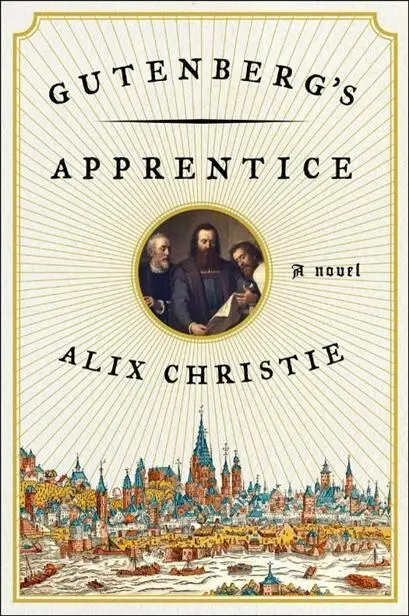
- Название:Gutenberg's Apprentice
- Автор:
- Издательство:Harper
- Жанр:
- Год:2014
- ISBN:нет данных
- Рейтинг книги:5 / 5. Голосов: 1
-
Избранное:Добавить в избранное
- Отзывы:
-
Ваша оценка:
Gutenberg's Apprentice: краткое содержание, описание и аннотация
Предлагаем к чтению аннотацию, описание, краткое содержание или предисловие (зависит от того, что написал сам автор книги «Gutenberg's Apprentice»). Если вы не нашли необходимую информацию о книге — напишите в комментариях, мы постараемся отыскать её.
Youthful, ambitious Peter Schoeffer is on the verge of professional success as a scribe in Paris when his foster father, wealthy merchant and bookseller Johann Fust, summons him home to corrupt, feud-plagued Mainz to meet “a most amazing man.”
Johann Gutenberg, a driven and caustic inventor, has devised a revolutionary — and to some, blasphemous — method of bookmaking: a machine he calls a printing press. Fust is financing Gutenberg’s workshop and he orders Peter, his adopted son, to become Gutenberg’s apprentice. Resentful at having to abandon a prestigious career as a scribe, Peter begins his education in the “darkest art.”
As his skill grows, so, too, does his admiration for Gutenberg and his dedication to their daring venture: copies of the Holy Bible. But mechanical difficulties and the crushing power of the Catholic Church threaten their work. As outside forces align against them, Peter finds himself torn between two father figures: the generous Fust, who saved him from poverty after his mother died; and the brilliant, mercurial Gutenberg, who inspires Peter to achieve his own mastery.
Caught between the genius and the merchant, the old ways and the new, Peter and the men he admires must work together to prevail against overwhelming obstacles — a battle that will change history. . and irrevocably transform them.
Gutenberg's Apprentice — читать онлайн бесплатно полную книгу (весь текст) целиком
Ниже представлен текст книги, разбитый по страницам. Система сохранения места последней прочитанной страницы, позволяет с удобством читать онлайн бесплатно книгу «Gutenberg's Apprentice», без необходимости каждый раз заново искать на чём Вы остановились. Поставьте закладку, и сможете в любой момент перейти на страницу, на которой закончили чтение.
Интервал:
Закладка:
Peter knew this spark — he’d felt it in the making of his metal letters. But such ideas angered the established clergy, convinced that they were God’s exclusive representatives on earth.
Most mornings through those long, excruciating weeks he waited, poised in the small doorway that gave out onto the Cobbler’s Lane, hoping for a glimpse of that tall crimson figure dashing past. Of all the men who walked the earth, it seemed to Peter, Nicholas Cusanus would perceive their letters for the miracle they were. Cusanus laid great stress on learning, and predicted ever-swelling shelves of books — as if he knew what God had granted Gutenberg. Peter kept a printed sheet of the Our Father rolled up in a pocket, praying for a sign that he should show it. But no sign came: he could not break his vow of silence.
They all felt great relief when finally the synod started. Master Gutenberg attended daily, as if going to some cheap entertainment. Each evening he regaled them with the scene. Dietrich in his golden robes “like Pharaoh” had appeared at last, surrounded by his staff; across from him “your cardinal,” the master cracked at Peter, “encircled by his band of crows.” The archbishop was livid from the start, but he couldn’t let it show. King Friedrich, “that Hapsburg whelp that Dietrich put upon the throne,” had ordered the archbishop to Ferrara for his coronation as the kaiser in that very week. But Dietrich wasn’t leaving the archbishopric of Mainz, not while that upstart cardinal swept through with sharpened knife. The master laughed again. The proclamation of the orders for reform took up the whole first day, and chilled and darkened the archbishop’s people like a sudden, brutal downpour.
The master kept his finger on the pulse of it, and on the margins tried to wheedle those of rank to speed the cardinal’s decision on their missal. The rest of that long meeting, though, was much too tiresome for words. There was haggling over tithes and taxes, who got which commission or the naming rights for vacant parishes, a grim and bloody battle over who could issue letters of indulgence. Cusanus took this latter deadly seriously, and accused the bishops of a tawdry traffic in redemption that besmirched the pope. A letter of indulgence was a sacred grant made by His Holiness, and its integrity must be respected. He calumnied them as well for trafficking in relics, and for promulgating more new holy days that only meant more offerings in their own salvers. Only when the session dealt with blood and women did things liven up, the master said, grinning. There’d be no rites around some sainted smear that just as easily could be a gutted goat—“or even, God forbid, the mess of Eve.
“You ought to see the way they clutch themselves, those monks, to hear their concubinage condemned,” he added, chortling. “It seems they take their members for their vows, and go so far as to propitiate them in their abbeys!”
And then as loudly as it started, it was over. The clergy beat their great black wings and raised the dust with their departure — just like the merchants at the Frankfurt fair, leaving nothing but their rubbish and soiled sheets. By then it was December. Cardinal Cusanus left their city on the seventh day of that last month in the year of our Lord 1451, bound for parleys between England, France, and Luxembourg — the matter of the missal of St. Jakob’s clearly unimportant in those state affairs.
The days were at their darkest of the year. Johann Fust wore that same darkness on his brow. They had been commissioned to produce a book that clearly would not be forthcoming. Everything he had invested was tied up in useless piles of paper, wood, and metal. Halfway through the month, he called Gutenberg and Peter to decide what they should do.
Fust’s back was to the fire. His arms were crossed and his head hung heavy to one side. Gutenberg sat slumped on the wood settle, face in shadow, with Peter between them at the battered table. The type was made. The crew was trained. They were like actors in a passion play, just waiting for the tarp to rise. For a very long time there was no sound beyond the popping of the flames. Down the street at the great houses, merriments abounded: madrigals and jugglers and feasts. Yet in the Hof zum Gutenberg all was somber and still.
The master stirred first, speaking as if continuing a conversation begun some time before. “But to proceed would be folly.”
“As it was folly to trust a text that was not final.”
Johann Fust breathed heavily and settled in a chair. Disappointment etched the corners of his mouth. He had believed — had relied heavily — on the judgment of Johann Gutenberg. “Is there no way,” he asked, “to gauge Cusanus’s interest?”
“His interest is the same as ours. At least, I thought our work could serve his ends.”
Gutenberg sat caved in, hardly moving. To Peter he looked just as he had looked up on the mount below the Jakobsberg, a man who turned in ever-tighter circles, proffering a gift that others spurned. The master roused himself and started speaking bitterly. “Apparently he’s influenced by Hagen.” Fust frowned. “The leader of their bloody congregation. They think that Prior Brack has gone too far.”
“You never said a word about another version.” The tone of Fust’s voice was accusing.
“How in the hell was I to know?” The master scowled, and curled more deeply in himself.
“Cusanus will support that text, then, and not ours.”
“No doubt.”
They lapsed back into silence.
“No point in trying to print the other, I suppose,” said Fust.
“Forget the cursed missal.” The master’s growl was almost animal.
If Brack’s text wasn’t chosen, Peter thought, the monks would never know how they had planned to make it. Those who prevailed would copy out the winning text by hand, as they had done for centuries before. And in the Hof zum Gutenberg the three of them would still be sitting looking at each other as they sat here now — the money sunk into ten thousand hunks of lead for which they had no use, no project.
“Is there not…” Fust broke off and raised his eyes toward the heavens. “Did the cardinal not say he wanted something else? A psalter, maybe, or a breviary?”
Gutenberg looked up then too, as if the answer were inscribed in the thick beams. The Bursfeld Benedictines had petitioned Rome for years for the permission to enact reforms. He’d told the whole crew so when he’d proposed that missal, months before.
“The standard texts,” he said. “To wipe out variation, incorrect interpretation.”
“There must be something else, then, we can standardize.”
The fire sputtered as they strained their minds.
“They’re meant to unify all practices,” the master said.
“Each mired in some arcane dispute.”
The master sighed and nodded. He hauled himself up to his feet and leaned against the chimney, staring into the fire. “It has to be something they can’t claim. Like the Donatus. Something in the domain of the public, not the church.”
Fust stroked his chin. The walls pulled in, and it seemed hotter as they bent their minds in thought — as if they stoked them, as a furnace sucks the air in to intensify the flames. “Something over which no church or prince can exercise control.” Peter’s father spoke in a low and meditative voice. “What else did he tell them to review?”
Johann Fust asked it; Johann Gutenberg replied.
“The Holy Gospels.”
They stared at one another in shocked silence.
“Each abbot was to do his best to get a copy of the Holy Book, as free from error as the hand of man can make it.”
And still they only looked at one another. Gutenberg for once was shorn of words.
“It would not just be used by those two dioceses,” his father said.
Читать дальшеИнтервал:
Закладка:
Похожие книги на «Gutenberg's Apprentice»
Представляем Вашему вниманию похожие книги на «Gutenberg's Apprentice» списком для выбора. Мы отобрали схожую по названию и смыслу литературу в надежде предоставить читателям больше вариантов отыскать новые, интересные, ещё непрочитанные произведения.









Обсуждение, отзывы о книге «Gutenberg's Apprentice» и просто собственные мнения читателей. Оставьте ваши комментарии, напишите, что Вы думаете о произведении, его смысле или главных героях. Укажите что конкретно понравилось, а что нет, и почему Вы так считаете.