Alix Christie - Gutenberg's Apprentice
Здесь есть возможность читать онлайн «Alix Christie - Gutenberg's Apprentice» весь текст электронной книги совершенно бесплатно (целиком полную версию без сокращений). В некоторых случаях можно слушать аудио, скачать через торрент в формате fb2 и присутствует краткое содержание. Год выпуска: 2014, Издательство: Harper, Жанр: Историческая проза, на английском языке. Описание произведения, (предисловие) а так же отзывы посетителей доступны на портале библиотеки ЛибКат.
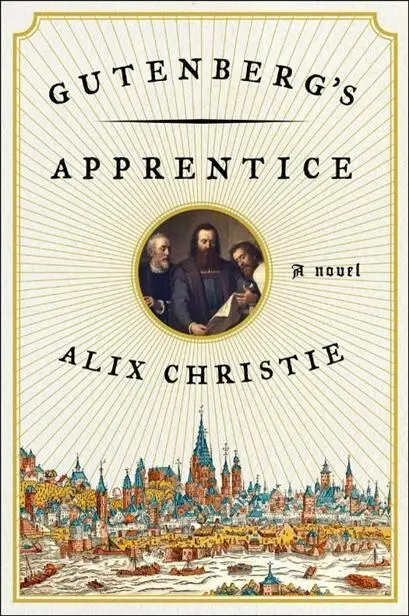
- Название:Gutenberg's Apprentice
- Автор:
- Издательство:Harper
- Жанр:
- Год:2014
- ISBN:нет данных
- Рейтинг книги:5 / 5. Голосов: 1
-
Избранное:Добавить в избранное
- Отзывы:
-
Ваша оценка:
Gutenberg's Apprentice: краткое содержание, описание и аннотация
Предлагаем к чтению аннотацию, описание, краткое содержание или предисловие (зависит от того, что написал сам автор книги «Gutenberg's Apprentice»). Если вы не нашли необходимую информацию о книге — напишите в комментариях, мы постараемся отыскать её.
Youthful, ambitious Peter Schoeffer is on the verge of professional success as a scribe in Paris when his foster father, wealthy merchant and bookseller Johann Fust, summons him home to corrupt, feud-plagued Mainz to meet “a most amazing man.”
Johann Gutenberg, a driven and caustic inventor, has devised a revolutionary — and to some, blasphemous — method of bookmaking: a machine he calls a printing press. Fust is financing Gutenberg’s workshop and he orders Peter, his adopted son, to become Gutenberg’s apprentice. Resentful at having to abandon a prestigious career as a scribe, Peter begins his education in the “darkest art.”
As his skill grows, so, too, does his admiration for Gutenberg and his dedication to their daring venture: copies of the Holy Bible. But mechanical difficulties and the crushing power of the Catholic Church threaten their work. As outside forces align against them, Peter finds himself torn between two father figures: the generous Fust, who saved him from poverty after his mother died; and the brilliant, mercurial Gutenberg, who inspires Peter to achieve his own mastery.
Caught between the genius and the merchant, the old ways and the new, Peter and the men he admires must work together to prevail against overwhelming obstacles — a battle that will change history. . and irrevocably transform them.
Gutenberg's Apprentice — читать онлайн бесплатно полную книгу (весь текст) целиком
Ниже представлен текст книги, разбитый по страницам. Система сохранения места последней прочитанной страницы, позволяет с удобством читать онлайн бесплатно книгу «Gutenberg's Apprentice», без необходимости каждый раз заново искать на чём Вы остановились. Поставьте закладку, и сможете в любой момент перейти на страницу, на которой закончили чтение.
Интервал:
Закладка:
Then they went upstairs, and the compositors bent back to work. Inside a minute they heard voices rising, accusations bouncing off the floorboards. “Sabotage,” they heard, and “folly.” And then the master’s testy voice: “For God’s sake, let it be, Johann.”
“Finally met his match.” Hans cocked his head and grinned.
Peter thought of Anna, she of the Iron Door. Those brothers back in Strassburg, with their mirrors and their plague. The hapless clerk of Mainz whom Gutenberg had seized some twenty years before. He’d always pushed against the rules — and anybody fool enough to try to block his path.
Fust’s face was set when he descended. Peter stepped out, on the pretense of some work he had to place on the composing stone. He understood, as they threw charges, countercharges, at each other on the stairs, that Fust refused, point-blank, to free up any member of “his” crew for this new work.
That night Fust told his son, as well, that he’d demanded an accounting of the workshop’s income and expenses for the past two years. He’d paid the sums he’d pledged; there was no earthly reason they should fall short now. Where had the money gone? He’d like to know. If Gutenberg persisted in this folly, he’d pay himself for any ink and paper that he used. The point was, none of it could interfere, in any wise, with their last push to finish up the Bible.
“He claims,” said Fust, his blue eyes sharp, “that you’ll be done inside six months.”
The man would promise anything.
It was early Advent, a whole lifetime until Easter and midsummer. Each setter still had five or six quires left to do, each one of which might take a month. And over all that time, the workshop would be vulnerable. Peter had to keep them safe, he realized. He had to save their secret somehow.
He too could plan a subterfuge.
He ordered Keffer to produce two hundred pilgrim mirrors, using Hans’s old mold. And then he reached up to the master’s shelf for those old sample sheets, the canticles he’d set and printed for the pope’s pontifical. Within a week or two they would be starting with the printing of the Psalms. It would be easy to print off some extra sheets, as if they truly made that book of papal prayers that Gutenberg had once proposed.
Peter did not tell the master. Nor was Gutenberg around to see the metal poured to make those pilgrim badges. Barred by Fust from using workers from their common shop, he went back to the first press he had made, still standing in his stable. He’d make the bloody prophecy himself, he growled — or find some willing hands to do it. While Keffer poured the mirrors, Peter kept the Bible pages flowing. The stories that those pages told that final winter were of portent and of lamentation: the books of Daniel and of Jeremiah and of Job.
The torments that God poured upon his faithful servant preyed on Peter’s mind. Job’s suffering and isolation were extraordinary, epic — yet they struck a chord in his own soul. Over and over the phrase recurred to him like an old song — what Job’s poor servant said, returning with each tale of woe: “And I alone have escaped to tell thee.”
CHAPTER 6: APPARITIONS
[37.5 quires of 65]
December 1453
THE BOOKS OF PROPHECY began appearing one by one, like random snowflakes through the Adventide. None paid them any notice at the start. Books usually appeared this way, a copy here, a copy there — until the copies started clustering, drifting into noticeable little piles.
The first to wonder in his father’s hearing were the traders on the Kaufhaus floor. The wives of Salman and Kumoff had each bought a pamphlet from an urchin near St. Martin’s. This in itself might have passed unremarked. But what was strange was how alike they were, said Kumoff — like peas in pods — and more than that, the boy had more, and there were others, they had heard, for sale inside the Schreibhaus.
“I told him scribes were just as hard up now as anybody else,” Fust said. Peter reached to take the copy that his father held.
“How many, at what price?” he asked.
“Five shillings each. God knows how many, though. A score? A hundred? More?”
The prophecy made fourteen pages. If Gutenberg had scared up a whole ream of paper, he could make several hundred, Peter reckoned, using Keffer and Ruppel, pulled after hours to do the work back at the Hof zum Gutenberg. He hadn’t had the heart to block them when the men had begged to earn the little extra that the master offered.
“He’d better watch how many he puts out,” Fust said, chewing his lip.
Yet he’d not easily resist temptation — not if he thought that he could dredge up twenty, thirty guilders. “He might have shown us,” Peter said, and opened the slim poem.
“He didn’t dare.”
Small wonder: the thing was nasty and cheap, type badly inked and letters lurching on their feet. Whoever set it had not even tried to justify the lines. He’d used their first poor type, in its last gasp, not for a Latin schoolbook, but auf Deutsch : the v ’s stood in for all those w ’s no Latin book required.
“A waste of rag.”
“Apparently they’re selling.”
Peter tossed it on the desk. “He’ll draw attention to us, far too soon.”
Feet drumming on the stairs stopped up their mouths; there was a sharp knock at the door. As Fust was saying, “Enter,” Jakob’s head appeared. His eyes went right to Peter. “Well, well,” he said, stepping inside. “Look what the cat dragged in.”
“And you,” said Peter, rising and reaching out a hand. “You’re looking well.”
“More than I might say of you.” Jakob embraced him, then stepped back, searching his nephew with his eyes. “You work him to the death, Johann. He’s skin and bones.”
“No worse or better than the rest of us.” His brother gestured to a chair.
They all were thinner, harder, Peter thought: not only in the workshop but in all of Mainz, thanks to the sultan and his war.
Jakob did not take the chair. His eyes remained on Peter’s face; his hand slipped to a pouch beneath his cloak. “This better not be why.” He drew a pamphlet out and threw it on the desk, his nostrils flaring when he saw its doppelgänger.
“That’s not the reason the guilds shelter you.” He looked at Fust. “A year.” His face was hard. “A whole damned year we hold our tongues — for this? I give my word that it will help us, I protect that thieving goat, and this is what I get? Some drivel from a witch?”
Fust wiped one hand across his face. “Sit,” he said again. His voice was weary.
Bull-like, Jakob swung his head. “Who made it? You?”
“Gutenberg,” said Johann Fust. “Though I did warn him.”
“Not at the Humbrechthof,” said Peter, swiftly.
“I don’t care where.” Jakob’s eyes were like the Alpen ice. “I owe him nothing — nothing, do you understand? I always said he’d double-cross you, take what he could get and screw us all. I hope to hell you see it now.” He ground the words.
“Six months.” Peter leaned urgently toward him. “Just six more months, that’s all I need. Then we can free the press, and Mainz will get what it is owed.”
Hate distorted Jakob’s sunken cheeks. “‘What Mainz is owed.’” He sneered. “A pretty promise, presses that can spit out gold. When will we get them, eh? When Erlenbach has dragged them off to Eltville, I suppose?” He brought his fist down on the desk. “God damn you and your promises, Johann.”
“I gave my word.” Fust’s voice was cold. “I do not break it, Jakob.”
“And yet you let him lead you by the nose.”
Fust said nothing; there was nothing he could say. He faced his brother, the sinews rigid in his neck.
Читать дальшеИнтервал:
Закладка:
Похожие книги на «Gutenberg's Apprentice»
Представляем Вашему вниманию похожие книги на «Gutenberg's Apprentice» списком для выбора. Мы отобрали схожую по названию и смыслу литературу в надежде предоставить читателям больше вариантов отыскать новые, интересные, ещё непрочитанные произведения.






Обсуждение, отзывы о книге «Gutenberg's Apprentice» и просто собственные мнения читателей. Оставьте ваши комментарии, напишите, что Вы думаете о произведении, его смысле или главных героях. Укажите что конкретно понравилось, а что нет, и почему Вы так считаете.