Alix Christie - Gutenberg's Apprentice
Здесь есть возможность читать онлайн «Alix Christie - Gutenberg's Apprentice» весь текст электронной книги совершенно бесплатно (целиком полную версию без сокращений). В некоторых случаях можно слушать аудио, скачать через торрент в формате fb2 и присутствует краткое содержание. Год выпуска: 2014, Издательство: Harper, Жанр: Историческая проза, на английском языке. Описание произведения, (предисловие) а так же отзывы посетителей доступны на портале библиотеки ЛибКат.
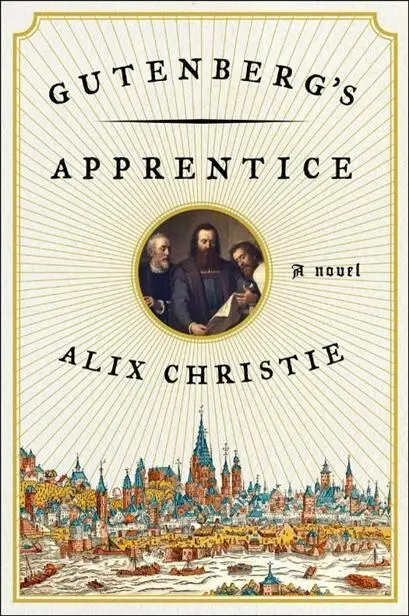
- Название:Gutenberg's Apprentice
- Автор:
- Издательство:Harper
- Жанр:
- Год:2014
- ISBN:нет данных
- Рейтинг книги:5 / 5. Голосов: 1
-
Избранное:Добавить в избранное
- Отзывы:
-
Ваша оценка:
Gutenberg's Apprentice: краткое содержание, описание и аннотация
Предлагаем к чтению аннотацию, описание, краткое содержание или предисловие (зависит от того, что написал сам автор книги «Gutenberg's Apprentice»). Если вы не нашли необходимую информацию о книге — напишите в комментариях, мы постараемся отыскать её.
Youthful, ambitious Peter Schoeffer is on the verge of professional success as a scribe in Paris when his foster father, wealthy merchant and bookseller Johann Fust, summons him home to corrupt, feud-plagued Mainz to meet “a most amazing man.”
Johann Gutenberg, a driven and caustic inventor, has devised a revolutionary — and to some, blasphemous — method of bookmaking: a machine he calls a printing press. Fust is financing Gutenberg’s workshop and he orders Peter, his adopted son, to become Gutenberg’s apprentice. Resentful at having to abandon a prestigious career as a scribe, Peter begins his education in the “darkest art.”
As his skill grows, so, too, does his admiration for Gutenberg and his dedication to their daring venture: copies of the Holy Bible. But mechanical difficulties and the crushing power of the Catholic Church threaten their work. As outside forces align against them, Peter finds himself torn between two father figures: the generous Fust, who saved him from poverty after his mother died; and the brilliant, mercurial Gutenberg, who inspires Peter to achieve his own mastery.
Caught between the genius and the merchant, the old ways and the new, Peter and the men he admires must work together to prevail against overwhelming obstacles — a battle that will change history. . and irrevocably transform them.
Gutenberg's Apprentice — читать онлайн бесплатно полную книгу (весь текст) целиком
Ниже представлен текст книги, разбитый по страницам. Система сохранения места последней прочитанной страницы, позволяет с удобством читать онлайн бесплатно книгу «Gutenberg's Apprentice», без необходимости каждый раз заново искать на чём Вы остановились. Поставьте закладку, и сможете в любой момент перейти на страницу, на которой закончили чтение.
Интервал:
Закладка:
“That may be true. But — more than you perhaps, he trusted God.”
“Until you’ve heard it all, you cannot judge.”
“Then pray go on.”
CHAPTER 8: COVENANT
[49 of 65 quires]
January — April 1454
ADAY PASSED — TWO, then three. They waited for some repercussion. Then it had been a week, and still none came. Now, of course, Peter knows why. But at the time it struck him as a miracle, a proof, however halting and obscure, of God’s design.
Their Bible was protected. Peter had believed, at least, that they’d inquire about the progress of that fake pontifical. Yet as the year turned and the silence held, he put aside his questions and his fears. He thought of all the marks the Jews put on their doors the night the deadly angels passed to slaughter the firstborn Egyptians. The sign protecting them was not as visible, but it was surely there. The Word of God willed its completion, after all.
Gutenberg himself, of course, was unrepentant. “I will hear none of it,” he said to Peter when he coldly told him what the raid had cost. The master brushed away all talk of broken letters, missing reams of paper stock. He moved as if his garments shone, and none might touch them — as if the chain that bound him to the ordinary world had snapped. He stood, remote and folded in upon himself, and watched the presses crank. His chin was up, his body taut; for once he held his tongue. His mind was elsewhere, resurrected into glory: already he was planning the next book to come.
Peter watched him, torn between offense and a deep need he barely understood. The two of them were so alike in certain ways: both transported, burning with the energy of this new thing that only they could grasp. Both determined, and intent: for nearly four years they’d been hiding in plain sight. Even now they were untouchable, the young man marveled — although young men will always see transcendence, not the calculation clear to older, wiser eyes.
The fasting time had come again: the world was waiting for Crusade. In the markets and the churches, people braced. They put by what little food they could; husbands showed their wives the counting books, the hidey-holes, the keys. The market scribes and private clerks to those of wealth bent to their parchments, scratching out the inventories of their clients’ houses and their souls. Each citizen of Mainz was changed, inside that crumbling wall the city council made a last-ditch effort to repair. They were sinew, bone, and yet determined, fierce. They’d show the Lord that He had punished them in error. When work was done, the younger carpenters and masons honed their battle-axes and their swords and practiced in the marshy fields along the Bleiche.
Fust too hauled out a breastplate that had been his father’s, and his father’s before that. The fit was snug, but not as snug as it would once have been; his air of bonhomie had melted with his excess weight. If once he had deferred — to the archbishop, or the council, or his partner, Gutenberg — now he was grim, his forehead permanently pleated. “Such days as these I never hoped to see,” he’d say, and cross himself, yet at the same time he was strangely sanguine. He had delivered all his hopes, he said, into God’s hands.
Which did not mean he could not use his own. At St. Silvester’s he had learned, on his return from Frankfurt, of the archbishop’s raid. He went to Gutenberg without another word. He had his own key to the Humbrechthof; he’d rented that damned house with his own gold. He did not knock; he just appeared, like some fell warrior. That little escapade was a net loss, he said. Three reams would be repaid, five guilders per. His voice and face were devoid of expression. In Christian fairness he would credit any profit scraped from that disgusting screed.
The master looked in vain at Peter standing there. It was almost amusing, seeing how he turned to him, then looked away, lips working. “Somebody had to dig us out.”
“ You dug that pit,” said Fust. “Not I.”
“Not you?” His partner with a black look swept the room, perceived that every ear was open and attuned. They cringed a bit, half turned away — and yet the need to know connected them, sharpened their hearing.
“If you don’t pay—” The master dropped his voice so low that only those who stood the closest — Peter, Keffer, Hans — could hear. “I have to scratch around.” His arms were spread, that same old parody of supplication; a sense of injury pinched at his mouth. I hold this up; what do you do? his cruciform and bitter body seemed to say. Fust merely snorted. A bolt of anger streaked across the master’s face. “Do not forget,” he hissed, “you’re not the only fountain in this town.”
Fust scowled and ordered them to box the sheets that he was due from the first volume. He’d hired the Austrian to do the painting. Peter nodded, keeping his own face averted from them both. Please God, just four more months, he prayed.
Grede too had changed: she saw portents, omens, in each bird, each bud, each rupture of the earth as it awakened into spring. She walked, head covered, on the Sabbath afternoons, when once she had preferred to stay at home beside the winter hearth or in her summer courtyard. The creatures of the earth would know before man did, she said. She swept her eyes to the horizon, watching for the wheeling flocks that meant that spring had come, and warring time, far eastward of the Rhine.
“When you are gone,” she said, and looked straight into Peter’s eyes, “every last one of you—” She shook her head, reproving; they walked across the boards that spanned the washing stream. He carried a large basket for the cattails and the pussy willows she had come to gather.
“What then?” he asked when she did not go on.
She took a seat on the bench, knocked from a log, that looked back toward the city. Behind them was a thick hedge and the sloping hillock of the Altmünster. She dropped her scarf and closed her eyes, as if to draw some strength from the weak sun, then opened them and stared across the roof tiles. “Men never think,” she softly said, “of all they leave behind.”
He pictured all the women then, the children in descending sizes clutching at their skirts. Imagined in a flash he tried to wipe out of his mind: the market square, a crush of arms and hair, pushed in a panic toward the steps of the cathedral; the screams and blood; the ripping cloth, the pawing, thrusting; glint of daggers and sharp lances.
“They wouldn’t leave the city unprotected.” He tried to ascertain what she held hidden in her eyes. There were small creases at the corners now, like sparrow claws.
“Oh, no?” Her smile was bitter. “There are few enough of you; if there is war, he’ll have you all.”
Despite the Sunday prohibition there were youths across the Bleiche, swinging arms like windmills, bulking up their muscles with huge hammers in their fists.
“But when they do”—her dark eyes narrowed—“you’d better leave us, each of us, protected.”
He didn’t understand. “Whatever I can do.” He reached to pat her hand. Impatiently, she shook it off.
“What’s wrong with men?” Grede looked back at the boys, their grunts and shouts, then at the stream, its bright green bank, its gentle and incessant murmur. “What’s wrong with you, why can’t you feel your hearts?”
He knew then why she’d brought him to that spot. There was no smoke above the dyers’ hut this time, no summer herbs nor bending grasses, dancing feet or laughter. But all around him he could feel the ghost of Anna.
“You are a member of the guild.” Her eyes bored into him. “Yet you would still refuse her all the guild’s protection.”
Читать дальшеИнтервал:
Закладка:
Похожие книги на «Gutenberg's Apprentice»
Представляем Вашему вниманию похожие книги на «Gutenberg's Apprentice» списком для выбора. Мы отобрали схожую по названию и смыслу литературу в надежде предоставить читателям больше вариантов отыскать новые, интересные, ещё непрочитанные произведения.











Обсуждение, отзывы о книге «Gutenberg's Apprentice» и просто собственные мнения читателей. Оставьте ваши комментарии, напишите, что Вы думаете о произведении, его смысле или главных героях. Укажите что конкретно понравилось, а что нет, и почему Вы так считаете.