Alix Christie - Gutenberg's Apprentice
Здесь есть возможность читать онлайн «Alix Christie - Gutenberg's Apprentice» весь текст электронной книги совершенно бесплатно (целиком полную версию без сокращений). В некоторых случаях можно слушать аудио, скачать через торрент в формате fb2 и присутствует краткое содержание. Год выпуска: 2014, Издательство: Harper, Жанр: Историческая проза, на английском языке. Описание произведения, (предисловие) а так же отзывы посетителей доступны на портале библиотеки ЛибКат.
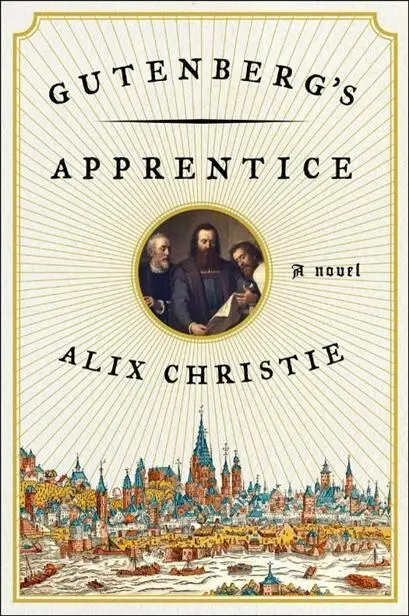
- Название:Gutenberg's Apprentice
- Автор:
- Издательство:Harper
- Жанр:
- Год:2014
- ISBN:нет данных
- Рейтинг книги:5 / 5. Голосов: 1
-
Избранное:Добавить в избранное
- Отзывы:
-
Ваша оценка:
Gutenberg's Apprentice: краткое содержание, описание и аннотация
Предлагаем к чтению аннотацию, описание, краткое содержание или предисловие (зависит от того, что написал сам автор книги «Gutenberg's Apprentice»). Если вы не нашли необходимую информацию о книге — напишите в комментариях, мы постараемся отыскать её.
Youthful, ambitious Peter Schoeffer is on the verge of professional success as a scribe in Paris when his foster father, wealthy merchant and bookseller Johann Fust, summons him home to corrupt, feud-plagued Mainz to meet “a most amazing man.”
Johann Gutenberg, a driven and caustic inventor, has devised a revolutionary — and to some, blasphemous — method of bookmaking: a machine he calls a printing press. Fust is financing Gutenberg’s workshop and he orders Peter, his adopted son, to become Gutenberg’s apprentice. Resentful at having to abandon a prestigious career as a scribe, Peter begins his education in the “darkest art.”
As his skill grows, so, too, does his admiration for Gutenberg and his dedication to their daring venture: copies of the Holy Bible. But mechanical difficulties and the crushing power of the Catholic Church threaten their work. As outside forces align against them, Peter finds himself torn between two father figures: the generous Fust, who saved him from poverty after his mother died; and the brilliant, mercurial Gutenberg, who inspires Peter to achieve his own mastery.
Caught between the genius and the merchant, the old ways and the new, Peter and the men he admires must work together to prevail against overwhelming obstacles — a battle that will change history. . and irrevocably transform them.
Gutenberg's Apprentice — читать онлайн бесплатно полную книгу (весь текст) целиком
Ниже представлен текст книги, разбитый по страницам. Система сохранения места последней прочитанной страницы, позволяет с удобством читать онлайн бесплатно книгу «Gutenberg's Apprentice», без необходимости каждый раз заново искать на чём Вы остановились. Поставьте закладку, и сможете в любой момент перейти на страницу, на которой закончили чтение.
Интервал:
Закладка:
“I refuse her nothing. She refused me first.”
“And tried and tried to reach you — or do you deny that too?”
“It isn’t your concern now — is it, Grede?”
“Will it be yours when you are dead?” She flushed in anger. “You make us wait, then leave us, then refuse to do your duty when you’re asked. For shame.” She pulled her shawl up to her chin, half turning from him.
“When we most need you,” she half whispered, “none of you are there.”
He saw her once again, her bedclothes red with blood, her mourning weeds of black.
“And I should marry her, just so she has her widow’s tithe and bread?” He almost laughed.
“How hard you are.” She looked at him as if she didn’t know him. “How hard you have become, inside that workshop.” She bit her lip, and shook her head. “I almost think that I don’t know you.”
He did not answer.
“Time was, when you wore all your feelings on your sleeve.” She looked at him with sorrow. “You loved her, don’t deny it. You love her still — you’ve just become too proud.”
Father Michael preached that day, as he preached every Sunday throughout Lent, of mankind’s fall from grace. Of Adam’s punishment for thinking he was not just greater than the creatures of the earth, but almost like to God. Peter heard, but did not heed the priest. Imago Dei , he said to himself: the Lord made mankind in His image. Someday there might be men who, with His grace and their own striving, could regain the divine spark that Adam through his greed had lost. How else were they to understand the meaning of this gift — this power given them to incarnate His Gospel?
As Easter neared, the Humbrechthof, released from fear, resounded to the music of the Psalms. By day they set those verses for the Bible, and at night he sketched a letter for the great new volume that the partners planned. A lectern psalter for the Benedictine order, said Gutenberg, lifting one sardonic eyebrow: why don’t we see if we can make the colors print this time. Fust concurred, pleased at this turn, although he held the size of the edition to those abbeys of whose sales they could be certain. Peter worked beside the master once again, fashioning a new technique to print the red and blue initials, using interlocking metal formes . But he did not, for all of that, relax his guard. Gutenberg might have moved beyond the Bible, tossing forward his inventive thought; Peter still had three quires from every setter to compose and send to press.
Nick Bechtermünze drew the setting of King David’s songs of praise. He struggled, though, to keep the pages flowing. Peter lent a hand and picked up one of those three quires. The first full psalm he set was number thirty-nine: With expectation I have waited for the Lord / And he was attentive to me . Inwardly, he smiled.
And then, as if to show just how attentive God might be, they made a beauty of those pages such as even Peter or his father never dreamed.
Each verse of David’s psalms sings praise: thus the first letter of each line is large, and red or blue. They’d have to mimic this in type, leaving a gap for every one to be hand-lettered afterward. Yet there were scores of gaps on every page, too many to fill up with wood. Hans stared a long while into space, scratching his bald pate. He started melting, tapping. The third day, with a tuck and turn, he hauled an answer from the coals. He had cast a plain square shaft the same size as a letter m , yet just a fraction shorter than their letters. When slipped between them it would make a gap, because it was too short to take the ink.
Peter proofed the trial page himself, to guarantee the gaps the metal squares made were sufficient. He drew three dozen rounded Lombards, carmine red and azure blue, then held the page up to show to Mentelin and Hans. They marveled. Gutenberg was tickled, too — as much with Hans’s ingenuity as with that startling beauty. The master cackled when he saw those spacing quads, and elbowed the old smith. “Too bad you never had a twin. I could have used you for old Sibyl.” He stuck out his tongue and made a little taunting face at Peter. He’d made a hash of that whole prophecy, and they both knew it. He might have drafted several men, but he had likely set those lines himself — he was just proud and stubborn enough to attempt it. He was no better, though, at setting than at carving; as Hans had said, he couldn’t carve to save his life.
Yet let the man who has not sinned cast the first stone.
As soon as he began to set those psalms, Peter saw that he’d miscalculated in the counting of the lines. The quire he set would come up half a column short; to his frustration, the next quire was already printed off and dried.
“Blind me,” he exclaimed, and slapped his type stick on his thigh.
Mentelin, his green eyes narrowed, leaned to see.
“Short a dozen.” Peter ground his teeth. “Blind me, curse my eyes.”
The gold-scribe counted lines beneath his breath. “Just stretch the whole thing out and short the page before. If God is with you, you can get them to align. No one will see.”
They sat there, pulling at their lips. “In any case,” said Mentelin, and turned on him his easy smile: “To err is human — to forgive, divine.”
“So I have heard.”
“And did you know,” his friend went on, his red head tilted, “that in the Muslim creed they are prohibited from striving for perfection that might rival God’s?” His eyes were calm, his freckled cheeks serene. “Their artists therefore take the greatest care to put an error in each book or painting.”
“What error?” came the master’s voice. He had an otherworldly tuning of his senses to the workshop’s sounds. For all the din, he must have heard the way that Peter slapped his type stick down; he poked his beak into the room.
“The lines are short.” Sourly, Peter shrugged.
“Whose fault is that?” There was no trace in him of anything that might be called remorse; it was appalling.
“Mine,” was all his foreman said, and they locked eyes for just the briefest instant. The master made a face, but he retreated.
Peter watched his back. The man could never say as much — he’d never, ever, admit a mistake. Since Peter crossed him in the square, he’d barely spoken to him, except for things related to the work. Peter had dared to challenge him, to call him to account. And in response, the master cut him off; by this refusal he rebuked him. Admitting nothing, coiled into himself, hard as a chunk of iron ore. Eventually he’d let it go, as he had done a dozen times before. He’d act as if it never even happened. Never alluding afterward to anything, as if the pain, the trust betrayed, did not exist.
To err was human, though.
Peter looked at Mentelin, all copper gentleness and mercy. How hard Peter had now become, his old friend Grede had said.
“And if the error is not by intent?” he asked. “Instead an accident — of pride?” He saw himself, with horror, in the master’s brittle, brutal mirror.
He too had coiled into himself — had been unwilling to admit his error.
Mentelin looked up and smiled. “We all are sinners, Peter. All of us. Me and him and you included.”
He took the lettered sample, rolled it and tied it with a ribbon. How boastful now that psalm did seem: With expectation I have waited for the Lord . As if the Lord owed him or anyone a thing. He went out in the fields to find the early lilies of the valley as the ground began to thaw. The earth was there, resurgent, always underneath their feet, a greening present they unwrapped anew each spring. He gathered up the tender waxen bells with care. He walked for hours, mind churning, seeking the right words. At last the best that he could do was this: My love, can you forgive me?
Читать дальшеИнтервал:
Закладка:
Похожие книги на «Gutenberg's Apprentice»
Представляем Вашему вниманию похожие книги на «Gutenberg's Apprentice» списком для выбора. Мы отобрали схожую по названию и смыслу литературу в надежде предоставить читателям больше вариантов отыскать новые, интересные, ещё непрочитанные произведения.


Обсуждение, отзывы о книге «Gutenberg's Apprentice» и просто собственные мнения читателей. Оставьте ваши комментарии, напишите, что Вы думаете о произведении, его смысле или главных героях. Укажите что конкретно понравилось, а что нет, и почему Вы так считаете.