Alix Christie - Gutenberg's Apprentice
Здесь есть возможность читать онлайн «Alix Christie - Gutenberg's Apprentice» весь текст электронной книги совершенно бесплатно (целиком полную версию без сокращений). В некоторых случаях можно слушать аудио, скачать через торрент в формате fb2 и присутствует краткое содержание. Год выпуска: 2014, Издательство: Harper, Жанр: Историческая проза, на английском языке. Описание произведения, (предисловие) а так же отзывы посетителей доступны на портале библиотеки ЛибКат.
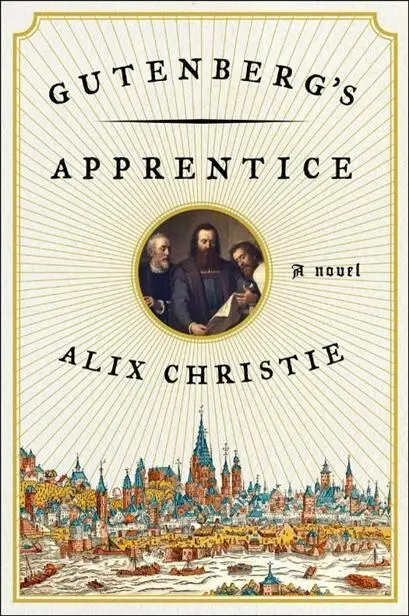
- Название:Gutenberg's Apprentice
- Автор:
- Издательство:Harper
- Жанр:
- Год:2014
- ISBN:нет данных
- Рейтинг книги:5 / 5. Голосов: 1
-
Избранное:Добавить в избранное
- Отзывы:
-
Ваша оценка:
Gutenberg's Apprentice: краткое содержание, описание и аннотация
Предлагаем к чтению аннотацию, описание, краткое содержание или предисловие (зависит от того, что написал сам автор книги «Gutenberg's Apprentice»). Если вы не нашли необходимую информацию о книге — напишите в комментариях, мы постараемся отыскать её.
Youthful, ambitious Peter Schoeffer is on the verge of professional success as a scribe in Paris when his foster father, wealthy merchant and bookseller Johann Fust, summons him home to corrupt, feud-plagued Mainz to meet “a most amazing man.”
Johann Gutenberg, a driven and caustic inventor, has devised a revolutionary — and to some, blasphemous — method of bookmaking: a machine he calls a printing press. Fust is financing Gutenberg’s workshop and he orders Peter, his adopted son, to become Gutenberg’s apprentice. Resentful at having to abandon a prestigious career as a scribe, Peter begins his education in the “darkest art.”
As his skill grows, so, too, does his admiration for Gutenberg and his dedication to their daring venture: copies of the Holy Bible. But mechanical difficulties and the crushing power of the Catholic Church threaten their work. As outside forces align against them, Peter finds himself torn between two father figures: the generous Fust, who saved him from poverty after his mother died; and the brilliant, mercurial Gutenberg, who inspires Peter to achieve his own mastery.
Caught between the genius and the merchant, the old ways and the new, Peter and the men he admires must work together to prevail against overwhelming obstacles — a battle that will change history. . and irrevocably transform them.
Gutenberg's Apprentice — читать онлайн бесплатно полную книгу (весь текст) целиком
Ниже представлен текст книги, разбитый по страницам. Система сохранения места последней прочитанной страницы, позволяет с удобством читать онлайн бесплатно книгу «Gutenberg's Apprentice», без необходимости каждый раз заново искать на чём Вы остановились. Поставьте закладку, и сможете в любой момент перейти на страницу, на которой закончили чтение.
Интервал:
Закладка:
They trooped to a reception room, where a thin figure rose from where it sat before the fire. An ancient priest, his bones just barely knit enough to bear the burden of his thick embroidered robes. So this was the “Old Peacock,” as they called him: resplendent in his crimson and yet wasted, bony hands like sticks that jutted from that costly habit. Past eighty, Peter guessed, so thin and hollow that even in the heat of summer he required a fire.
“God be with you,” came his reedy voice. He shuffled toward them, leaning on a cane. “Urgent business, I am told.”
“I’m here to see Herr Gutenberg.”
“Ah.” Up went two stringy eyebrows. “And you are?”
“Peter Schoeffer, his apprentice, Father.”
The Old Peacock looked him over, white eye-hairs bristling, loose lips quivering as he considered. “I see.” His eyes darted toward the wardens. “You wish to speak with him.”
“I do.”
“This is a house of God.” He raised one desiccated claw and waved it at them. “Your men must wait. You’ll be quite safe.”
“The times are tense,” said Peter.
The priest gave a gray smile. “No more nor less than all the years before.” He nodded at the porter, then at Peter, and turned and started slowly back to his great chair.
The room in which they held the master was another level down, through limestone arches damp with ancient mold. As soon as they descended the steep stair, they heard a muffled sound, and saw two hands reach out and haul a face between the bars. “I’ll have you tarred,” the master snarled, before he recognized the man behind the guard.
“Thank God,” he said then, fingers tightening upon the iron grate set in the wooden door. They flew off at the rattle of the key. Gutenberg sprang back, the hinges groaning as the door swung slowly inward. “You took your time.”
His eyes blinked rapidly in the new light. His hair stood out in all directions, as if he’d passed the hours in yanking at it. There was a wooden platform and a bucket, nothing else in that dank cell.
“Knock when you’re done,” the guard said as he shut the door. The master jerked, and Peter stepped inside. The darkness was a living blanket, muffling all hope.
“Are you all right?” He groped with his right hand along the stony wall. “Leave light!” he called. A beam arrived, propped in a sconce out in the hall, to cast the bench in a faint glow.
“Calumny,” the master said in a hard, hollow tone. “Calumny and criminality. I thought that you were here to get me out.” He sank onto the bench and pulled his cloak up to his nose.
“You’re fed, you’re not too cold?” The raw, cold comfortlessness of it was so shocking that Peter half forgot how they had fallen quite so low.
“Like any animal,” the master hissed, “in Dietrich’s little zoo.”
“I’ve come to see,” said Peter carefully, “if there is anything you need.”
“I need to be released. If you’re not up to that, then you can go.”
“I’m sure you know some leverage you might use. With the archbishop. Since manifestly, you’re so close.” Peter did not try to hide his bitterness.
“The fault is with those jumped-up oafs.” Gutenberg thrust his face toward him. “Your cocky uncle, and that turncoat.”
“You’re blameless then, as always.”
Gutenberg said nothing, only tightened his thin lips.
“You put it all in jeopardy.” If Peter did not speak right then, he never would. “The whole Book — and for what?”
At this the master’s eyes snapped open. His head jerked like a doll’s; he reached for Peter’s sleeve. “They didn’t get it? Didn’t find—”
“Only your press.”
The master sagged, his chin descending to his chest. “Thanks be to God.”
No thanks to you, though , Peter told himself.
Gutenberg looked up. He tried to catch his foreman’s eye. “He thinks that I colluded with the council. I!” He gave a strangled laugh. “Heard somehow I was talking to those asses, and decided I was part of the whole plot.”
“You did collude, though.” Peter said it quite deliberately. “You did collude, against the Book, and us.”
“If you think that, you are a fool.”
“I must be. If you couldn’t even find it in yourself to trust me.”
“Trust.” The master turned his face toward the wall. “What good has trust been, ever?” He shook his head, his long hair clinging to his cheekbones. “Only fools put trust in promises. I told you that before.”
“Not even your own foreman.” The pain was sharper than he’d thought.
“You are your father’s son. Your loyalties are clear.”
Peter did not answer, only sat there listening to the dripping, the master’s breath, the distant scrabbling of rats.
“I did what I had to do.” Gutenberg got to his feet. “You might not like it, but—” He shrugged. “I’ve come too far to let them get me now.” He reached and banged twice, hard, upon the wooden door.
The jailer turned the great brass key. Peter slipped out; once again the fingers wound themselves around the bars. “Just get it done,” the master hissed, and then the fingers disappeared.
They might have left him there. Peter’s father certainly was of a mind to, when he rode back to Mainz. The snakes were in their baskets and defanged, was what he said — not only Rosenberg, but Gutenberg. The thing was in a kind of balance. But what a balance, Peter thought: a mix of elements both volatile and toxic, which the slightest added grain could well combust.
If nothing changed, the city would remain the focus of the archbishop’s constant and unblinking eye. Peter did not like to think of what that eye might light upon and see.
He counted out the days that still remained. He counted the remaining pages, for they counted now in pages, not in quires. He watched as Hans and Keffer cast that new small type; when they had finished all their pages for the day, he let them set the pope’s accursed letter of indulgence.
Three days had passed. He is your partner, Peter said to Fust; Fust spoke to Jakob; Jakob spoke to Molsberg; nothing moved.
“Where are his cursed books?” his father asked at last, as if examination of the ledger could relieve the impasse. “He hasn’t shown them, damn his soul.”
“Locked in his house, no doubt.”
His father’s face was just as shuttered.
“It’s not the point, though, is it?” Peter asked.
“Not to you, perhaps.” His father’s look was distant.
“Gold. It’s all the council cares about, and Gutenberg, and Dietrich.”
“Gutenberg the first.” Fust folded both his arms and stood there in the workshop in the heat of day, and brooded.
Peter sighed and rubbed his eyes. There was a way, he said — the only way, at least, that he could see. Wearily he laid out the thin solution he had worried from his mind. What if another letter of indulgence could be found, another order, they could print? A second run of this one, or another, for some other diocese? So that the profits from this second letter — which he’d undertake to print himself — could be directly funneled to the city council? “If we can guarantee they’ll get the bishop’s cut, the council might relent, and release Rosenberg,” he said.
“Possibly,” said Fust.
“I can think of no alternative.”
“Then the archbishop gives up Gutenberg.” Fust gave him a queer smile. “And you have saved us all.”
“The only thing that matters is the Bible.”
“And the psalter.” Fust looked down onto the desk where Gutenberg had left the latest proofs. “And on and on the two of you will go,” his father said, shaking his head. His eyes were clear, all sentiment effaced. “How did you plan to do it?”
Читать дальшеИнтервал:
Закладка:
Похожие книги на «Gutenberg's Apprentice»
Представляем Вашему вниманию похожие книги на «Gutenberg's Apprentice» списком для выбора. Мы отобрали схожую по названию и смыслу литературу в надежде предоставить читателям больше вариантов отыскать новые, интересные, ещё непрочитанные произведения.


Обсуждение, отзывы о книге «Gutenberg's Apprentice» и просто собственные мнения читателей. Оставьте ваши комментарии, напишите, что Вы думаете о произведении, его смысле или главных героях. Укажите что конкретно понравилось, а что нет, и почему Вы так считаете.