Alix Christie - Gutenberg's Apprentice
Здесь есть возможность читать онлайн «Alix Christie - Gutenberg's Apprentice» весь текст электронной книги совершенно бесплатно (целиком полную версию без сокращений). В некоторых случаях можно слушать аудио, скачать через торрент в формате fb2 и присутствует краткое содержание. Год выпуска: 2014, Издательство: Harper, Жанр: Историческая проза, на английском языке. Описание произведения, (предисловие) а так же отзывы посетителей доступны на портале библиотеки ЛибКат.
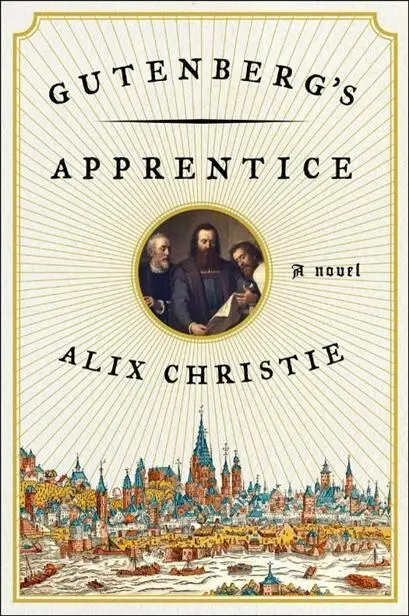
- Название:Gutenberg's Apprentice
- Автор:
- Издательство:Harper
- Жанр:
- Год:2014
- ISBN:нет данных
- Рейтинг книги:5 / 5. Голосов: 1
-
Избранное:Добавить в избранное
- Отзывы:
-
Ваша оценка:
Gutenberg's Apprentice: краткое содержание, описание и аннотация
Предлагаем к чтению аннотацию, описание, краткое содержание или предисловие (зависит от того, что написал сам автор книги «Gutenberg's Apprentice»). Если вы не нашли необходимую информацию о книге — напишите в комментариях, мы постараемся отыскать её.
Youthful, ambitious Peter Schoeffer is on the verge of professional success as a scribe in Paris when his foster father, wealthy merchant and bookseller Johann Fust, summons him home to corrupt, feud-plagued Mainz to meet “a most amazing man.”
Johann Gutenberg, a driven and caustic inventor, has devised a revolutionary — and to some, blasphemous — method of bookmaking: a machine he calls a printing press. Fust is financing Gutenberg’s workshop and he orders Peter, his adopted son, to become Gutenberg’s apprentice. Resentful at having to abandon a prestigious career as a scribe, Peter begins his education in the “darkest art.”
As his skill grows, so, too, does his admiration for Gutenberg and his dedication to their daring venture: copies of the Holy Bible. But mechanical difficulties and the crushing power of the Catholic Church threaten their work. As outside forces align against them, Peter finds himself torn between two father figures: the generous Fust, who saved him from poverty after his mother died; and the brilliant, mercurial Gutenberg, who inspires Peter to achieve his own mastery.
Caught between the genius and the merchant, the old ways and the new, Peter and the men he admires must work together to prevail against overwhelming obstacles — a battle that will change history. . and irrevocably transform them.
Gutenberg's Apprentice — читать онлайн бесплатно полную книгу (весь текст) целиком
Ниже представлен текст книги, разбитый по страницам. Система сохранения места последней прочитанной страницы, позволяет с удобством читать онлайн бесплатно книгу «Gutenberg's Apprentice», без необходимости каждый раз заново искать на чём Вы остановились. Поставьте закладку, и сможете в любой момент перейти на страницу, на которой закончили чтение.
Интервал:
Закладка:
“Father.”
“I should have known. But now I stand here — cut out, and exposed. Have you no notion of how much I owe?”
“How should I?”
Fust raised one eyebrow, answered mockingly: “I’m sure that I don’t know.”
A moment passed before he spoke again. “You tell him he’ll be freed as soon as I have seen his books.” There was an edge of something — satisfaction, vengeance — in his tone. “I’ll let you do another letter, yes — but only after he produces the damned ledger, as he pledged to months ago.”
“Two weeks,” said Peter, “three at the most. And then the Bible’s done.”
“The Bible, of all books,” his father answered, “requires the truth.”
“When it is done, and sold—”
Fust cut him off. “We’ll have to sell it two times over, just to climb out of this hole.”
Heinrich Brack was no longer the prior of St. Jakob’s monastery. Lubertus Ruthard was the abbot now, the prior Eberhard von Venlo. The former prior had no doubt these younger men, reformers all, would see the cloister through. Brack turned upon his visitor a small, contented smile. His final days now could be passed in prayer and meditation.
Indeed, said Peter, it was for prayer — and guidance — he had come.
They walked across the knoll to a small bench that had been set outside the wall, affording a fine eastward view across the Rhine. On a clear day, Brack said, he sometimes caught a glint of sunlight bouncing off St. Bartholomew’s spire some thirty miles away in Frankfurt. Quietly he set his body down; no longer did he jingle at each step with all the burdens of his office.
“In three weeks’ time, God willing,” Peter said, “Gutenberg will show our Bible there.”
“So it is done.” Brack traced a cross with his thin hand in the bright air.
Peter smiled. So Brack had known, and kept it to himself. “Almost,” he said. “If God is with us.”
“Have you some doubt?” Brack’s eyes were flinty in their pouches.
“I never did before.” Peter turned his eyes across the water. “It seemed so clear to me, the part we played. But now it all is clouded.”
The burden of so many months and years of lies and secrets felt unbearable, up there on that scoured knoll.
“It is a mighty thing for the renewal of our faith,” said Brack. “That is enough, I think.”
“And yet did Jesus not say no discord should enter in his house?”
“‘The life of man upon earth is a warfare.’” Wistfully, Brack smiled.
“Father, I would give you my confession.”
The monk laid his right hand on Peter’s head. And Peter spoke to him of all that had transpired: of subterfuge and pride and arrogance, and letters of indulgence that brought strife and not salvation. Brack’s eyes were closed, his head bent forward as he listened. In the silence afterward he nodded, eyes still closed, communing with the Lord.
“My son”—he opened up his eyes—“your sins are small. Johann Gensfleisch is a man who burns through earth and ore — and on occasion, more.”
There was a way, said Peter, they could end the feud, and save the council’s and Archbishop Dietrich’s face. He needed one more batch of letters, several thousand, at the very least. It felt to him like begging.
Brack reflected. “I think that this can be arranged.”
Peter pressed his hand in thanks.
Ruefully, the former prior smiled. “Thus, even in our own backyard do the eternal questions stand revealed.”
“Why God accepts duplicity, you mean?” Peter shook his head. “You might as well ask why He allowed the Turk to destroy Constantinople.”
“Even Satan is a part of God’s Creation — and thus a part of God.”
Then why did God not simply strike them down? he asked. Just wipe the whole world clean, as He had done before?
Their human view was partial, said the Benedictine. God alone could see the whole.
“He sees and blesses all that’s base, as well as noble?” This Peter doubted. As long as he might live, he never would accept the master’s treachery as part of the Lord’s plan.
“He gives us gifts, out of His grace.” Brack’s gaunt old face was luminous, and sage. “And then He watches us, to see how we will use them.”
“To serve the Lord, you mean, or else our private gain.” Peter did not try to hide his bitterness.
Brack smiled, and placed a hand upon his forearm. “We do not live upon this earth, my son, quite long enough to judge.”
His vision drifted over Mainz’s rooftops and her spires, the remnants of the ancient camp beneath her vineyards and her orchards. “The Romans, too, were geniuses at engineering. Inventors of such marvelous techniques. Yet they have left us nothing but some stones and rubble.”
CHAPTER 4: SPONHEIM ABBEY
March 1486
FOR THE LONGEST TIME he thought he could prevent it. Peter would hold the two of them together as they strained apart, through his sheer strength, the force of his own will.
“The thought was unacceptable to me, that the workshop might be torn apart.”
Outside Sponheim Abbey winter has redoubled its assault, as if to punish the temerity of crocuses and hope. A freezing rain beats at the windows in which Peter sees reflected one old man, his hair gone pewter, and the back of one young Benedictine less than half his age. It strikes him that he’s nearly the same age the master was, the year he died.
“This… altercation,” asks the abbot, “happened the same year the pope declared Crusade?”
The printer shakes his head. “The summer after. The princes and the clergy met incessantly for months, but could not come to terms.”
It was that letter of indulgence that destroyed the workshop, he has always felt. “It might have ended differently, but for the Turk.”
Again the abbot gives a little smile. “Yet as I’ve said, the book was done, as well as both of those confessionalia .”
“It wasn’t the letters per se — but what they represented. Lies. Deceit. That was the fundamental breach.” Methodically, Peter sets out the counts of treason.
“First Gutenberg concealed too much. But more than that — he put the Book at risk. He was prepared, as well, to fleece my father and the guilds. Ends for him always justified the means, however roughshod he might run you over.”
“And you,” the abbot says, “were caught between the hammer and the anvil.”
Mirthlessly, Peter laughs. “The insane thing is that I still hoped . I had this wild belief that all would come out right, if we could only make it to the fair.” He shakes his head. “We were so close! I thought if we could just hold on, the revenues would fill the holes — especially that gulf that since the prophecy had grown between them.” He shakes his head again and strokes his throat, a tenderness inside for his young self.
“I put my whole self on the line. I nearly killed myself, to make that second letter, carving every night those final weeks.” So cruelly had he pressed the crew and his own body that he hardly can recall that final burst. They were machines by then, churning blindly, truly.
“You didn’t use Hans’s type?” asks Trithemius, surprised.
“I didn’t want to give him even that small satisfaction.” Peter looks the abbot in the eyes. Deceit will breed deceit; in those last months when he had felt betrayed, he’d kept his secrets, too. “Besides, I had my reasons. Technical improvements I was working on, that I could use a smaller alphabet to test.”
The abbot waits, but Peter says no more. There is a kind of stiffness to the monk as he sits facing him, the printer thinks. He is polite, but something in his attitude suggests he is more critical inside. So be it: every chronicler must sift the stories he is told.
Читать дальшеИнтервал:
Закладка:
Похожие книги на «Gutenberg's Apprentice»
Представляем Вашему вниманию похожие книги на «Gutenberg's Apprentice» списком для выбора. Мы отобрали схожую по названию и смыслу литературу в надежде предоставить читателям больше вариантов отыскать новые, интересные, ещё непрочитанные произведения.


Обсуждение, отзывы о книге «Gutenberg's Apprentice» и просто собственные мнения читателей. Оставьте ваши комментарии, напишите, что Вы думаете о произведении, его смысле или главных героях. Укажите что конкретно понравилось, а что нет, и почему Вы так считаете.