T. Binyon - Pushkin
Здесь есть возможность читать онлайн «T. Binyon - Pushkin» — ознакомительный отрывок электронной книги совершенно бесплатно, а после прочтения отрывка купить полную версию. В некоторых случаях можно слушать аудио, скачать через торрент в формате fb2 и присутствует краткое содержание. Жанр: unrecognised, на английском языке. Описание произведения, (предисловие) а так же отзывы посетителей доступны на портале библиотеки ЛибКат.
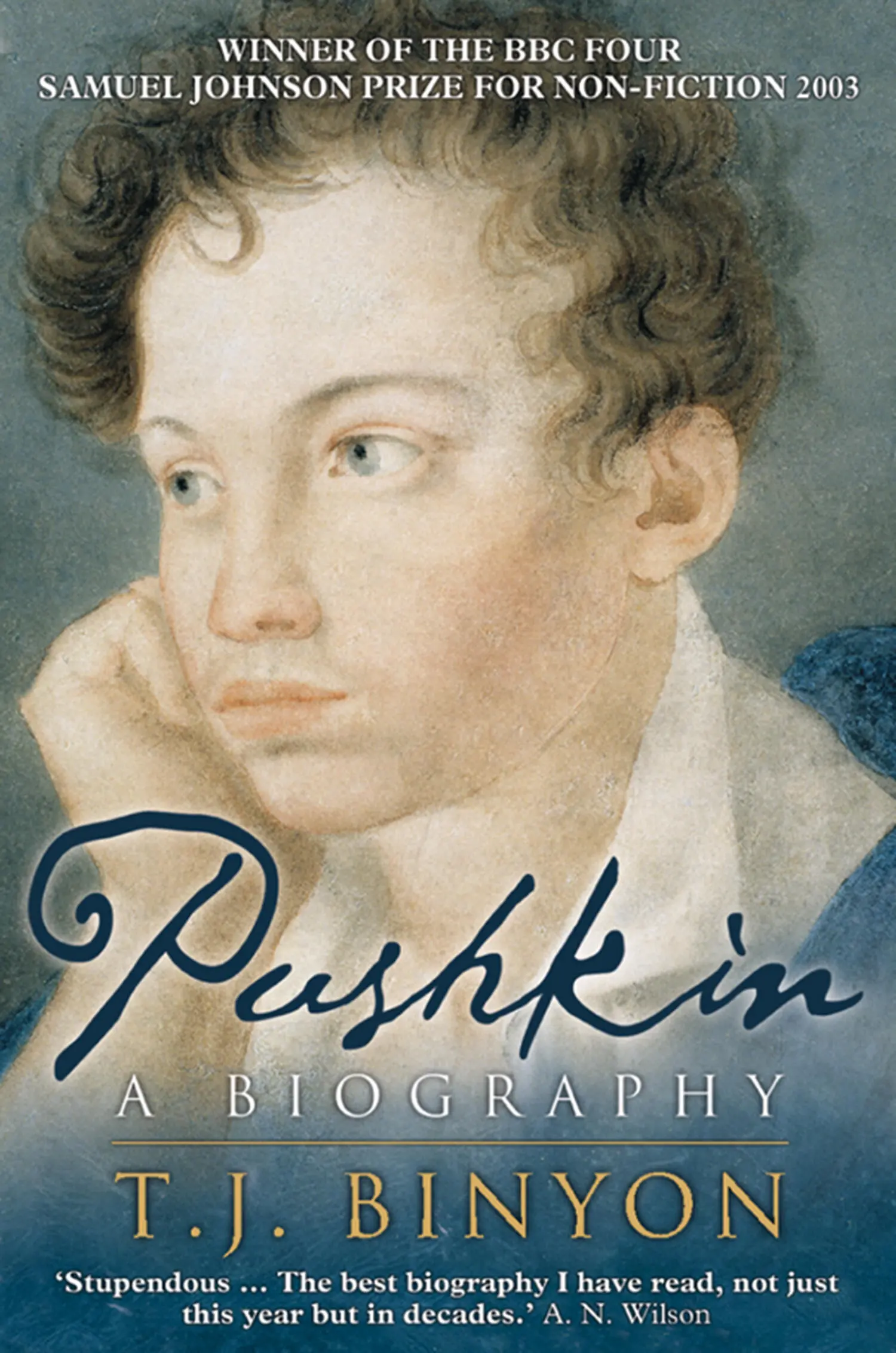
- Название:Pushkin
- Автор:
- Жанр:
- Год:неизвестен
- ISBN:нет данных
- Рейтинг книги:4 / 5. Голосов: 1
-
Избранное:Добавить в избранное
- Отзывы:
-
Ваша оценка:
Pushkin: краткое содержание, описание и аннотация
Предлагаем к чтению аннотацию, описание, краткое содержание или предисловие (зависит от того, что написал сам автор книги «Pushkin»). Если вы не нашли необходимую информацию о книге — напишите в комментариях, мы постараемся отыскать её.
Pushkin — читать онлайн ознакомительный отрывок
Ниже представлен текст книги, разбитый по страницам. Система сохранения места последней прочитанной страницы, позволяет с удобством читать онлайн бесплатно книгу «Pushkin», без необходимости каждый раз заново искать на чём Вы остановились. Поставьте закладку, и сможете в любой момент перейти на страницу, на которой закончили чтение.
Интервал:
Закладка:
The passage, though savagely caricatural, is a recognizable portrait. âThe Cricket hops around the boulevard and the bordellos,â Aleksandr Turgenev told Vyazemsky, later referring to his âtwo bouts of a sickness with a non-Russian nameâ, caught as a result. Once, however, the illness was not that which might have been expected. âThe poet Pushkin is very ill,â Turgenev wrote. âHe caught cold, waiting at the door of a whore, who would not let him in despite the rain, so as not to infect him with her illness. What a battle between generosity and love and licentiousness.â 19 The girl in question might have been the charming Pole, Angelica, who lived with her stout and ugly aunt and a disagreeable little dog on the Moika near Pushchin, also one of her clients.
Intercourse of a different kind was to be had in one of the capitalâs salons â that, for instance, of Ekaterina Muraveva, the widow of Mikhail Muravev, a poet and the curator of Moscow University. Nikita, her elder son, was a member of Arzamas and one of the founders of the Union of Salvation; the younger, Aleksandr, a cavalry cornet, joined the conspiracy in 1820. She entertained in a large house on the Fontanka near the Anichkov Bridge, âone of the most luxurious and pleasant in the capitalâ. 20 The Karamzins usually stayed here when in St Petersburg, as did Batyushkov, to whom Ekaterina Fedorovna was related by marriage: her husbandâs sister had been the poetâs grandmother.
When Batyushkov set out to join the Russian diplomatic mission in Naples on 19 November 1818, she gave a farewell party for him. âYesterday we saw off Batyushkov,â Turgenev wrote to Vyazemsky. âBetween one and two, before dinner, K.F. Muraveva with her son and niece, Zhukovsky, Pushkin, Gnedich, Lunin, Baron Schilling and I drove to Tsarskoe Selo, where a good dinner and a battery of champagne awaited us. We grieved, drank, laughed, argued, grew heated, were ready to weep and drank again. Pushkin wrote an impromptu, which it is impossible to send, and at nine in the evening we sat our dear voyager in his carriage and, sensing a protracted separation, embraced him and took a long farewell of him.â 21 The first signs of Batyushkovâs mental illness showed themselves in Italy. When he returned to Russia in 1822 he was suffering from persecution mania, which grew ever more severe, and was accompanied by attempts at suicide.
The best-known literary salon in St Petersburg was that of the Olenins. Aleksey Olenin was one of the highest government officials, having replaced Speransky as Imperial Secretary in 1812; he was also president of the Academy of Arts, director of the Public Library, an archaeologist and historian. He was charming and extremely hospitable, as was his wife, Elizaveta Markovna â though she was a chronic invalid who often received her guests lying on a sofa. * She had inherited a house on the Fontanka near the Semenovsky Bridge: a three-storey building whose entrance columns supported a first-floor balcony; inside the rooms were ornamented with Aleksey Nikolaevichâs collection of antique statues and Etruscan vases. Pushkin was a frequent visitor, both to the St Petersburg house and to Priyutino, the Oleninsâ small estate some twelve miles to the north of the capital, and enthusiastically took part in their amateur theatricals. He played Alnaskarov in Khmelnitskyâs one-act comedy Castles in the Air , and, on 2 May 1819, composed together with Zhukovsky a ballad for a charade devised by Ivan Krylov, in honour of Elizaveta Markovnaâs birthday. At a party at the Olenins earlier that year, as a forfeit in some game, Krylov â whose satirical fables rival those of La Fontaine â declaimed one of his latest compositions, âThe Donkey and the Peasantâ, before an audience which included Pushkin and an innocent-looking nineteen-year-old beauty, Anna Kern â the daughter of Petr Poltoratsky and hence the niece, both of her hostess and of Praskovya Osipova.
Anna had been married at sixteen â âtoo early and too undiscriminatinglyâ 22 â to Lieutenant-General Ermolay Kern, thirty-five years her senior. Kern, who had lost his command through injudicious behaviour towards a superior officer, had come to St Petersburg in order to petition the emperor for reinstatement. Aware that Alexander was not unsusceptible to Annaâs beauty â which he had compared to that of Princess Charlotte of Prussia, wife of his brother Nicholas â he sent her out to the Fontanka each day in the hope of meeting the emperor, whose habits were well-known: âAt one in the afternoon he came out of the Winter Palace, walked up the Dvortsovaya Embankment, at Pracheshny Bridge turned down the Fontanka to the Anichkov Bridge [â¦] then returned home by the Nevsky Prospect. The walk was repeated each day, and was called le tour impérial.â 23 âThis was very disagreeable to me and I froze and walked along annoyed both with myself and with Kernâs insistence,â Anna wrote. 24 Kernâs intelligence sources were at fault, for Anna and the emperor never met.
Enchanted by Krylovâs recital, she noticed no one else. But Pushkin soon forced himself on her attention:
During a further game to my part fell the role of Cleopatra and, as I was holding a basket of flowers, Pushkin, together with my cousin Aleksandr Poltoratsky, came up to me, looked at the basket, and, pointing at my cousin, said: âAnd this gentleman will no doubt play the asp?â I found that insolent, did not answer and moved away [â¦] At supper Pushkin seated himself behind me, with my cousin, and attempted to gain my attention with flattering exclamations, such as, for example, âCan one be allowed to be so pretty!â There then began a jocular conversation between them on the subject of who was a sinner and who not, who would go to hell and who to heaven. Pushkin said to my cousin: âIn any case, there will be a lot of pretty women in hell, one will be able to play charades. Ask Mme Kern whether she would like to go to hell.â I answered very seriously and somewhat drily that I did not wish to go to hell. âWell, what do you think now, Pushkin?â asked my cousin. âI have changed my mind,â the poet replied. âI do not want to go to hell, even though there will be pretty women there â¦â 25
Eugene has enjoyed his dinner with Kaverin â
⦠the cork hit the ceiling,
A stream of the comet yearâs wine spurted out,
Before him is bloody roast-beef
And truffles â the luxury of our young years,
The finest flower of French cuisine,
And Strasbourgâs imperishable pie
Between a live Limburg cheese
And a golden pineapple â
(I, xvi)
but it is now half past six, and he hurries to the Bolshoy Theatre, where the performance of a new ballet is beginning.
When Pushkin came to St Petersburg in 1817 the capitalâs chief theatre was the Maly (or Kazassi Theatre), a wooden building situated on the south side of the Nevsky near the Anichkov Bridge, in what is now Ostrovsky Square, approximately where the Aleksandrinsky Theatre (designed by Rossi, and built in 1832) stands. On 3 February 1818, however, the Bolshoy (or Kamenny) Theatre, burnt down in 1811, was reopened in Teatralnaya Square in Kolomna, on the site of the present Conservatoire. There was also the German (or Novy) Theatre on Dvortsovaya Square, where a troupe of German actors performed, which existed until the early 1820s. When the Maly Theatre was pulled down at the end of the 1820s, its actors moved for some time to the building of the former circus, near Simeonovsky Bridge on the Fontanka, but this was closed when the Aleksandrinsky Theatre and, a year later, the Mikhailovsky Theatre on Mikhailovskaya Square were opened. In 1827 the wooden Kamennoostrovsky Theatre was built on Kamenny Island, a popular resort for the nobility in the summer months. There was also a theatre, seating four hundred, in the Winter Palace, built by Quarenghi between 1783 and 1787, where performances were given for the royal family and the court, while a number of the richer nobles had small, domestic theatres in their palaces.
Читать дальшеИнтервал:
Закладка:
Похожие книги на «Pushkin»
Представляем Вашему вниманию похожие книги на «Pushkin» списком для выбора. Мы отобрали схожую по названию и смыслу литературу в надежде предоставить читателям больше вариантов отыскать новые, интересные, ещё непрочитанные произведения.









Обсуждение, отзывы о книге «Pushkin» и просто собственные мнения читателей. Оставьте ваши комментарии, напишите, что Вы думаете о произведении, его смысле или главных героях. Укажите что конкретно понравилось, а что нет, и почему Вы так считаете.