T. Binyon - Pushkin
Здесь есть возможность читать онлайн «T. Binyon - Pushkin» — ознакомительный отрывок электронной книги совершенно бесплатно, а после прочтения отрывка купить полную версию. В некоторых случаях можно слушать аудио, скачать через торрент в формате fb2 и присутствует краткое содержание. Жанр: unrecognised, на английском языке. Описание произведения, (предисловие) а так же отзывы посетителей доступны на портале библиотеки ЛибКат.
- Название:Pushkin
- Автор:
- Жанр:
- Год:неизвестен
- ISBN:нет данных
- Рейтинг книги:4 / 5. Голосов: 1
-
Избранное:Добавить в избранное
- Отзывы:
-
Ваша оценка:
Pushkin: краткое содержание, описание и аннотация
Предлагаем к чтению аннотацию, описание, краткое содержание или предисловие (зависит от того, что написал сам автор книги «Pushkin»). Если вы не нашли необходимую информацию о книге — напишите в комментариях, мы постараемся отыскать её.
Pushkin — читать онлайн ознакомительный отрывок
Ниже представлен текст книги, разбитый по страницам. Система сохранения места последней прочитанной страницы, позволяет с удобством читать онлайн бесплатно книгу «Pushkin», без необходимости каждый раз заново искать на чём Вы остановились. Поставьте закладку, и сможете в любой момент перейти на страницу, на которой закончили чтение.
Интервал:
Закладка:
PUSHKIN
A Biography
T. J. BINYON

DEDICATION
For Helen
and In memory of my father Denis Binyon
EPIGRAPH
What business is it of the critic or reader whether I am handsome or ugly, come from an ancient nobility or am not of gentle birth, whether I am good or wicked, crawl at the feet of the mighty or do not even exchange bows with them, whether I gamble at cards and so on. My future biographer, if God sends me a biographer, will concern himself with this.
PUSHKIN, 1830
CONTENTS
Cover
Title Page
Dedication
Epigraph
Family Trees
Maps
Prologue
1 Ancestry and Childhood, 1799â1811
2 The Lycée, 1811â17
3 St Petersburg, 1817â20: I Literature and
4 St Petersburg, 1817â20: II Oneginâs Day
5 St Petersburg, 1817â20: III Triumph
6 The Caucasus and Crimea, 1820
7 Kishinev, 1820â23
8 Odessa, 1823â24
9 Mikhailovskoe, 1824â26
10 In Search of a Wife, 1826â29
11 Courtship, 1828â31
12 Married Life, 1831â33
13 The Tired Slave, 1833â34
14 A Sea of Troubles, 1834â36
15 The Final Chapter, 1836â37
Epilogue
List of Abbreviations
Bibliography
Index
Acknowledgements
About the Author
Notes
A Note on Translation, Transliteration, Dates, Currency and Ranks
Praise
Other Works
Copyright
About the Publisher
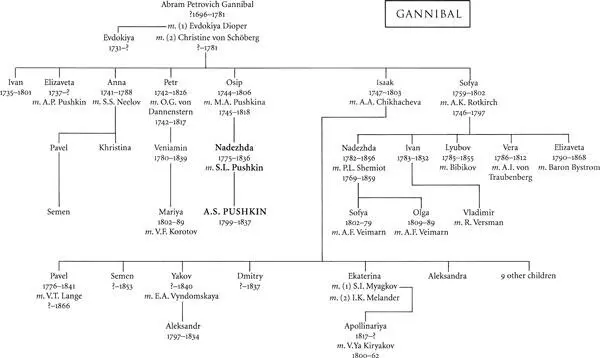
FAMILY TREES
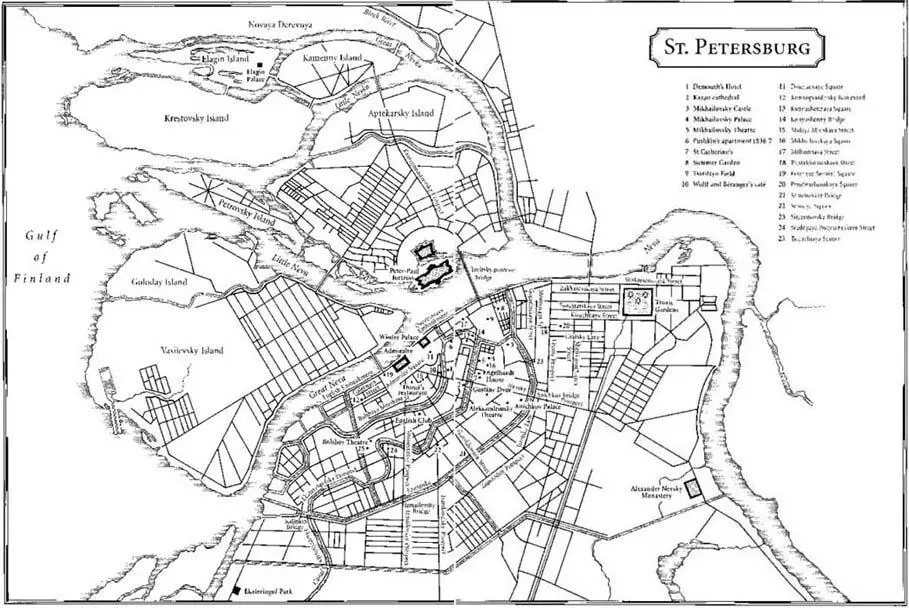
MAPS
PROLOGUE
By now it is not so much Pushkin, our national poet, as our relationship to Pushkin that has become as it were our national characteristic.
ANDREY BITOV, 1986
âPUSHKIN IS OUR ALL,â declared the critic and poet Apollon Grigorev in 1854. 1 His famous remark is perhaps the best expression of Pushkinâs significance, not merely for Russian literature, or even for Russian culture, but for the Russian ethos generally and for Russia as a whole. At the time, however, his was a lone voice. Though Pushkin had been acclaimed as Russiaâs greatest poet during his lifetime, his reputation had begun to sink during his last years. The decline continued after his death in 1837, reaching perhaps its lowest point in the 1850s. In 1855 a petition, noting that monuments to a number of other writers â Lomonosov, Derzhavin, Koltsov, Karamzin and Krylov â had been erected, called for Pushkin to be added to their number. It met with no response. In 1861 Pushkinâs school, the Lycée â which had moved from Tsarskoe Selo to St Petersburg and been renamed the Alexandrine Lycée â celebrated its fiftieth anniversary. In conjunction with this a public subscription was opened to erect a statue to Pushkin in Tsarskoe Selo. Three years later less than a fifth of the necessary sum had been subscribed, and interest in the project had lapsed completely. However, by 1869, when the idea was revived by a group of former lycéens, Pushkinâs reputation was on the rise. This time the subscription was successful, raising over 100,000 roubles. The suggestion of Admiral Matyushkin, a schoolfellow of Pushkin, that the monument should be placed in Moscow, the poetâs native city, was accepted, and a site on Strastnaya Square, at the end of Tverskoy Boulevard, was chosen. After three competitions A.M. Opekushinâs design for a statue showing a meditating Pushkin emerged as the winner.
Only after eleven years of procrastination and preparation, however, was the project completed. The unveiling ceremony was planned for 26 May 1880, the eighty-first anniversary of Pushkinâs birth, but the death of Empress Mariya caused it to be postponed until Friday 6 June. At one oâclock that day, after a service in the Strastnoy monastery opposite the site of the monument, the statue was unveiled in the presence of an immense crowd. Cheers rang out, and many wept. âWhere are the colours, where are the words to convey the intoxication of the triumphal moment?â wrote one reporter. âThose who didnât see it did not see the populace in one of its best moments of spiritual joyousness.â 2 That evening a banquet, given by the city duma, was followed by a literary-musical evening in the hall of the Noble Assembly. Overtures from operas based on Pushkinâs works were performed; congratulatory telegrams from Tennyson, Victor Hugo and others were read out; Dostoevsky, Turgenev and others gave readings from Pushkin: Turgenev especially being greeted with tumultuous applause.
The next day, 7 June, at a public meeting of the Society of Amateurs of Russian Literature, Turgenev gave an elegant and civilized speech. Pushkin was, he said, repeating Belinsky, Russiaâs âfirst artist-poetâ. âThere is no doubt,â he continued, âthat he created our poetic, our literary language and that we and our descendants can only follow the path laid down by his genius.â But in the end he had reluctantly to deny Pushkin the title of âa national poet in the sense of a universal poetâ, as were Shakespeare, Goethe or Homer. Unlike them, he had had to perform two tasks simultaneously, âto establish a language and create a literatureâ. And, unlike them, he had had the misfortune to die young, without fulfilling his true potential. Turgenev ended his speech by apostrophizing the statue itself. âShine forth, like him, thou noble bronze visage, erected in the very heart of our ancient capital, and announce to future generations our right to call ourselves a great nation, because this nation has given birth, among other great men, to such a man!â, a peroration which was greeted with enthusiasm and loud applause. 3
Its reception, however, was completely overshadowed by that given to Dostoevskyâs long, passionate and emotional address the following morning, the third and last day of the celebrations. He began by quoting Gogolâs remark that Pushkin was âan extraordinary, and perhaps unique manifestation of the Russian spiritâ, and added that he was, too, âa prophetic oneâ. Whereas Turgenev had been unable to rank Pushkin with poets such as Shakespeare, Dostoevsky proclaimed his superiority to the âShakespeares, Cervanteses and Schillersâ, because of âsomething almost even miraculousâ, his âuniversal responsivenessâ, a characteristic which he shared with the Russian people. Whereas Shakespeareâs Italians are disguised Englishmen, Pushkinâs Spaniards are Spanish, his Germans German and his Englishmen English. âI can positively say that there has never been a poet with so universal a responsiveness as Pushkin, and it is not just his responsiveness, but its astounding depth, the reincarnation of his spirit in the spirit of foreign peoples, an almost complete, and hence miraculous reincarnation, because nowhere, in no poet of the entire world has this phenomenon been repeated.â It is this national characteristic which will eventually enable Russia to save Europe and âto pronounce the final word of great, general harmony, of the final brotherly agreement of all nations in accordance with the law of Christâs Gospel!â If this seems a presumptuous claim for a land as poor as Russia, âwe can already point to Pushkin, to the universality and panhumanity of his genius [â¦] In art at least, in artistic creation, he undeniably manifested this universality of the aspiration of the Russian spirit.â Had Pushkin lived longer his message would perhaps have been clearer. âBut God decreed otherwise. Pushkin died in the full development of his powers, and undoubtedly carried to his grave a certain great mystery,â Dostoevsky concluded. âAnd now we must solve this mystery without him.â 4
Читать дальшеИнтервал:
Закладка:
Похожие книги на «Pushkin»
Представляем Вашему вниманию похожие книги на «Pushkin» списком для выбора. Мы отобрали схожую по названию и смыслу литературу в надежде предоставить читателям больше вариантов отыскать новые, интересные, ещё непрочитанные произведения.





Обсуждение, отзывы о книге «Pushkin» и просто собственные мнения читателей. Оставьте ваши комментарии, напишите, что Вы думаете о произведении, его смысле или главных героях. Укажите что конкретно понравилось, а что нет, и почему Вы так считаете.