T. Binyon - Pushkin
Здесь есть возможность читать онлайн «T. Binyon - Pushkin» — ознакомительный отрывок электронной книги совершенно бесплатно, а после прочтения отрывка купить полную версию. В некоторых случаях можно слушать аудио, скачать через торрент в формате fb2 и присутствует краткое содержание. Жанр: unrecognised, на английском языке. Описание произведения, (предисловие) а так же отзывы посетителей доступны на портале библиотеки ЛибКат.
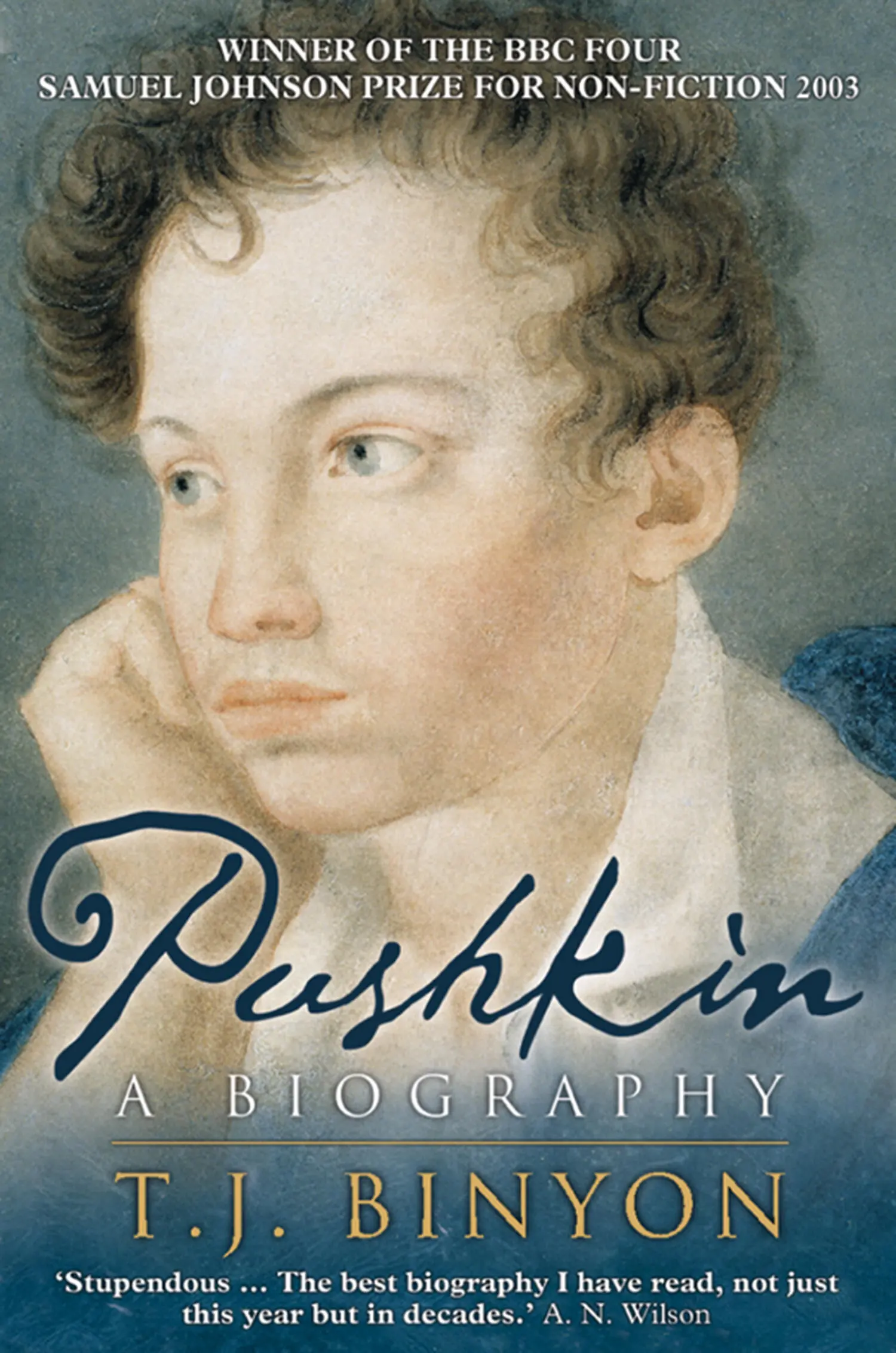
- Название:Pushkin
- Автор:
- Жанр:
- Год:неизвестен
- ISBN:нет данных
- Рейтинг книги:4 / 5. Голосов: 1
-
Избранное:Добавить в избранное
- Отзывы:
-
Ваша оценка:
Pushkin: краткое содержание, описание и аннотация
Предлагаем к чтению аннотацию, описание, краткое содержание или предисловие (зависит от того, что написал сам автор книги «Pushkin»). Если вы не нашли необходимую информацию о книге — напишите в комментариях, мы постараемся отыскать её.
Pushkin — читать онлайн ознакомительный отрывок
Ниже представлен текст книги, разбитый по страницам. Система сохранения места последней прочитанной страницы, позволяет с удобством читать онлайн бесплатно книгу «Pushkin», без необходимости каждый раз заново искать на чём Вы остановились. Поставьте закладку, и сможете в любой момент перейти на страницу, на которой закончили чтение.
Интервал:
Закладка:
Golovin had acquired the two boys as a gift for the tsar, to whom they were presented when he came to Moscow in December 1704. Peter had the elder brother baptized in the Preobrazhensky parish in Moscow, when he was given the name Aleksey, and the patronymic Petrov, from the tsarâs own name. He was trained as a musician and attached to the Preobrazhensky regiment, where he played the hautboy in the regimental band. Unlike his younger brother Abram, he then vanishes from the pages of history.
Abram was from the beginning a favourite of the tsar. On 18 February 1705 the account-book of the royal household notes: âto Abram the negro for a coat and trimming were given 15 roubles 45 copecksâ. 4 In the spring of 1707 Peter began a campaign against the Swedes. That autumn he celebrated a victory over Charles XII in the Orthodox Pyatnitskaya church in Vilna and simultaneously had his new protégé baptized, acting as his godfather and giving him, like his brother, the patronymic Petrov. And a document of 1709 notes that âby the tsarâs order caftans have been made for Joachim the dwarf and Abram the blackamoor, for the Christmas festival, with camisoles and breechesâ. 5
In 1716 Peter made a second journey to Europe. Abram was one of his retinue, and was left in France together with three other young Russians to study fortification, sapping and mining at a military school. They returned to Russia in 1723, when Abram was commissioned as a lieutenant and posted to Riga. Peter died in February 1725, but his wife, Catherine, who succeeded him, continued his favours to Abram: he was employed to teach the tsarâs grandson â the short-lived Peter II (1715â30; tsar 1727â30) â geometry and fortification. About this time he is first referred to as Gannibal. The acquisition of a surname was a step up the social ladder, differentiating him from the serfs and others known only by Christian name and patronymic; while that he should have called himself after the great Carthaginian general implies no lack of confidence in his own abilities. * His fortunes changed after Catherineâs death: under a vague suspicion of political intrigue he was posted, first to Siberia, then to the Baltic coast. It was not until the accession of Elizabeth, Peter the Greatâs younger daughter, that his situation improved. In December 1741 she promoted him major-general from lieutenant-colonel, and appointed him military commander of Reval. The following year she made him a large grant of land in the province of Pskov: this included Mikhailovskoe, the estate where Pushkin was to spend two years in exile, from 1824 to 1826. In 1752 he was transferred to St Petersburg, promoted general in 1759, and, in charge of military engineering throughout Russia, oversaw the building of the Ladoga canal and the fortification of Kronstadt. That a black slave, without relations, wealth or property, should have risen to this position is in the highest degree extraordinary: so remarkable, indeed, as to argue a character far beyond the common, one that was more than justified in appropriating the name and reputation of the great Carthaginian. Elizabethâs death in 1761 put an end to his career; he was retired without promotion or gratuity, and lived for the rest of his life in his country house at Suida, near St Petersburg, where he died on 20 April 1781.
In 1731 he had married Evdokiya Dioper, the daughter of a Dutch sea captain. When she gave birth to a child, who was plainly not his, he divorced her (though bringing up the daughter as his own), and married the daughter of a Swedish officer in the Russian army, Christine von Schöberg. Of his seven children by Christine (three more died in infancy) the eldest son, Ivan, was a distinguished artillery officer who reached the rank of lieutenant-general. Petr, the second son, in old age lived in Pokrovskoe, some four kilometres from Mikhailovskoe, where he occupied himself with the distillation of home-made vodka. âHe called for vodka,â Pushkin wrote after visiting him there in 1817. âVodka was brought. Pouring himself a glass, he ordered it to be offered to me, I did not pull a face â and by this seemed to gratify extraordinarily the old Negro. A quarter of an hour later he called for vodka again â and this happened again five or six times before dinner.â 6 He visited him again in 1825, when he was thinking of composing a biography of Abram, a project which later turned into the fictional Blackamoor of Peter the Great. âI am counting on seeing my old negro of a Great-Uncle who, I suppose, is going to die one of these fine days, and I must get from him some memoirs concerning my great-grandfather,â he wrote on 11 August. 7 He carried out the intention a week or so later, bringing back with him to Mikhailovskoe not only the manuscript of Abramâs biography, written by his son-in-law, Adam Rotkirch, but also a short, unfinished note composed by Petr himself, outlining his and his fatherâs careers. 8
Osip, Abramâs third son and Pushkinâs maternal grandfather, was a gunnery officer in the navy, reaching the rank of commander. Careless and dissolute, he ran up large debts, which his father in the end refused to pay and forbade him the house. At the beginning of the 1770s he was posted to Lipetsk, in the Tambov region, where he met and, in November 1773, married Mariya Pushkina. * Mariya was generally held to have thrown herself away; her Moscow cousins made up an epigram on the marriage:
There was once a great fool,
Who without Cupidâs permission
Married a Vizapur.
The last line is a hit at Osipâs complexion; it is a reference to the âswarthy Vizapurâ, Prince Poryus-Vizapursky, an Indian and a well-known eccentric. 9
Abram forgave the newly-married Osip; he was allowed to return home, and his daughter Nadezhda, Pushkinâs mother, was born in Suida on 21 June 1775. However, Osip found his father overbearing and family life excruciatingly boring. Leaving a note to say he would never return, he fled to Pskov, where he met a pretty young widow, Ustinya Tolstaya. Having received â so he said â a mysterious message announcing his wifeâs death, he married Ustinya in November 1778. Mariya, who was far from dead, lodged a complaint against him; after years of petitions and counter-petitions the marriage to Ustinya was annulled, and the estate of Kobrino outside St Petersburg (which he had now inherited, together with Mikhailovskoe, from his father) made over in trust to Nadezhda. Osip retired in dudgeon to a lonely existence at Mikhailovskoe, where he died in 1806, leaving the estate encumbered with debt.
After the separation Mariya moved to St Petersburg, spending the summers in Kobrino, some thirty miles from the capital. Nadezhda was therefore brought up in far from provincial surroundings. She was well-read, spoke excellent French, and through Mariyaâs relations in the capital gained entrée into society, where she became known as âthe beautiful creoleâ. 10 Here she met Sergey Pushkin; the couple â the poetâs father and mother â were married on 28 September 1796 in the village church at Voskresenskoe on the Kobrino estate.
Though Pushkin claimed to be able to trace his ancestry on the paternal side back to the times of Alexander Nevsky, * the first to bear the family name was Konstantin Pushkin, born in the early fifteenth century, the younger son of a Grigory Pushka. There is a direct line of descent from him to the poet. From this time to the seventeenth century the Pushkins were a minor boyar family whose members never wielded great influence or occupied high positions in the state. They played, however, a lively part during the Time of Troubles (1584â1613), when one Gavrila Pushkin was a prominent supporter of the Pretender Dmitry. Pushkin put him into his historical drama Boris Godunov , remarking, âFinding in history one of my ancestors, who played an important role in that unhappy epoch, I brought him on the stage, without worrying about the delicacies of propriety, con amore , but without aristocratic conceit.â 11 But a decline in importance set in during the reign of Peter the Great. By the Table of Ranks, promulgated in 1722, an hierarchical system of rank, consisting of fourteen grades, was imposed on the military, civil and court services. Those in the first eight grades automatically became gentry: henceforth, therefore, social position was to be determined not by birth, but by rank. The more powerful aristocratic families were little affected, but the less important, such as the Pushkins, were submerged in the influx of the newly ennobled. During the eighteenth century no member of the family achieved distinction in any field, though family tradition erroneously maintained that Aleksey Fedorovich Pushkin, Mariyaâs father, had been voevoda (governor) of Tambov.
Читать дальшеИнтервал:
Закладка:
Похожие книги на «Pushkin»
Представляем Вашему вниманию похожие книги на «Pushkin» списком для выбора. Мы отобрали схожую по названию и смыслу литературу в надежде предоставить читателям больше вариантов отыскать новые, интересные, ещё непрочитанные произведения.







Обсуждение, отзывы о книге «Pushkin» и просто собственные мнения читателей. Оставьте ваши комментарии, напишите, что Вы думаете о произведении, его смысле или главных героях. Укажите что конкретно понравилось, а что нет, и почему Вы так считаете.