T. Binyon - Pushkin
Здесь есть возможность читать онлайн «T. Binyon - Pushkin» — ознакомительный отрывок электронной книги совершенно бесплатно, а после прочтения отрывка купить полную версию. В некоторых случаях можно слушать аудио, скачать через торрент в формате fb2 и присутствует краткое содержание. Жанр: unrecognised, на английском языке. Описание произведения, (предисловие) а так же отзывы посетителей доступны на портале библиотеки ЛибКат.
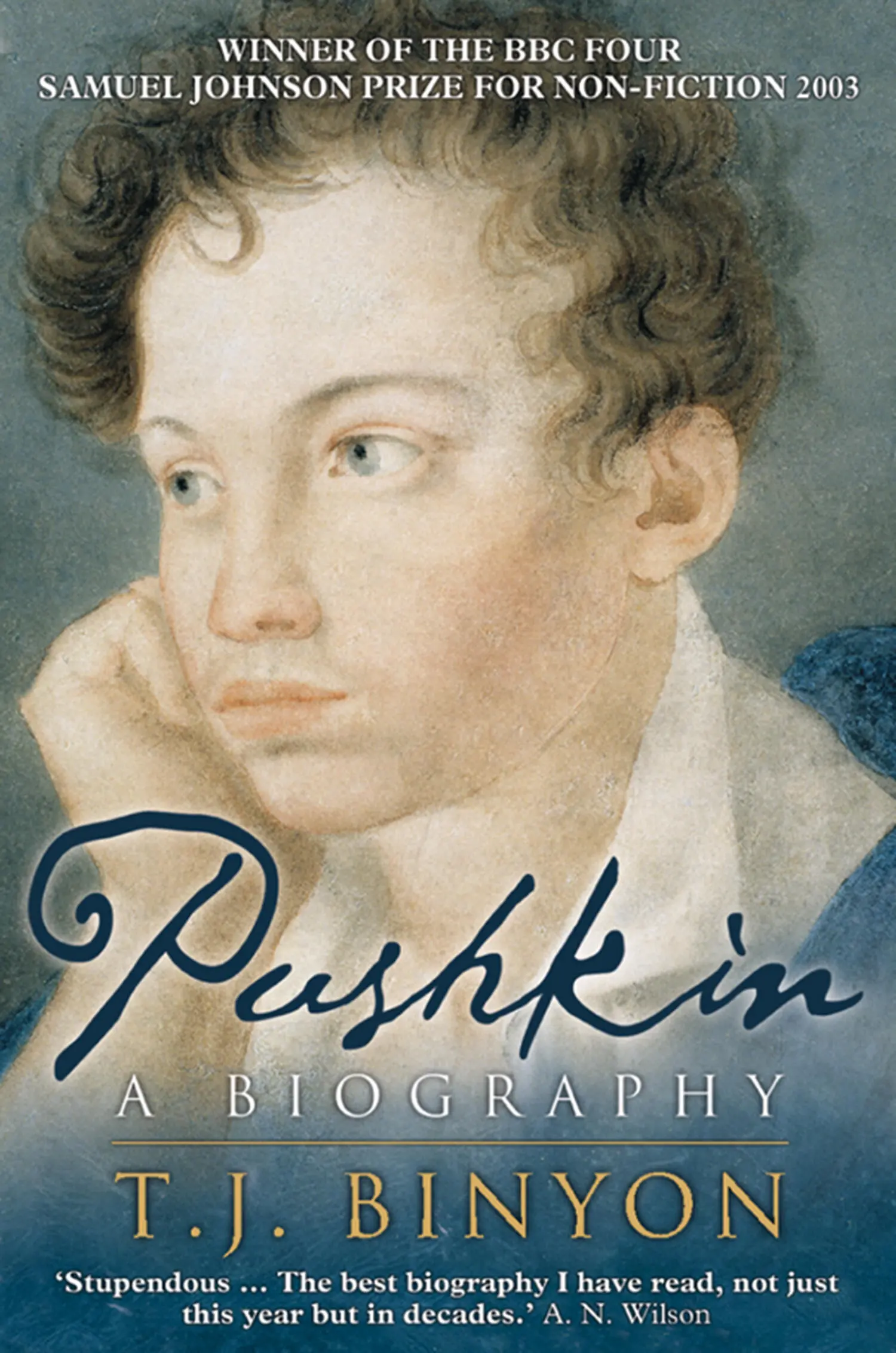
- Название:Pushkin
- Автор:
- Жанр:
- Год:неизвестен
- ISBN:нет данных
- Рейтинг книги:4 / 5. Голосов: 1
-
Избранное:Добавить в избранное
- Отзывы:
-
Ваша оценка:
Pushkin: краткое содержание, описание и аннотация
Предлагаем к чтению аннотацию, описание, краткое содержание или предисловие (зависит от того, что написал сам автор книги «Pushkin»). Если вы не нашли необходимую информацию о книге — напишите в комментариях, мы постараемся отыскать её.
Pushkin — читать онлайн ознакомительный отрывок
Ниже представлен текст книги, разбитый по страницам. Система сохранения места последней прочитанной страницы, позволяет с удобством читать онлайн бесплатно книгу «Pushkin», без необходимости каждый раз заново искать на чём Вы остановились. Поставьте закладку, и сможете в любой момент перейти на страницу, на которой закончили чтение.
Интервал:
Закладка:
*Pulled down in 1837; the present church on the same site in what is now Bauman Square was finished in 1845.
*Abramâs origins are obscure. In a petition of 1742 he wrote, âI ⦠am from Africa, of the high nobility there, was born in the town of Logon in the domain of my father, who besides had under him two other townsâ (Teletova, 170). And a short biography of Abram, written in German, probably in the late 1780s, by his son-in-law, Adam Rotkirch, asserts that he âwas by birth an African Moor from Abyssiniaâ ( Rukoyu Pushkina , 43). Logon has hence traditionally been placed in Ethiopia. Recently, however, it has been identified with Logone, a town in the north-east corner of the present state of Cameroon: a conjecture which is more in agreement with the sparse evidence than the Ethiopian hypothesis (see Gnammankou, 19â26.) Though Pushkin had a translation of the German biography, he never refers to a specific region when writing of his ancestorâs origins, but remarks, for instance, that he was âstolen from the shores of Africaâ (VI, 530). However, his friend Aleksey Vulf mentions in his journal that on 15 September 1827 Pushkin showed him the first two chapters of The Blackamoor of Peter the Great , âin which the main character represents his great-grandfather Gannibal, the son of an Abyssinian emir, captured by the Turksâ ( Lyubovny byt , I, 268).
*There is no h in the Russian alphabet; in transliteration g (or kh) is substituted for it. The assertion in Rotkirchâs biography that Abramâs princely father âproudly derived his descent in a direct line from the lineage of the renowned Hannibal, the terror of Romeâ ( Rukoyu Pushkina , 43) is plainly ridiculous, though it might have suited Abram for this to be believed.
*This marriage would make Osipâs daughter, Nadezhda, and her husband, Sergey Pushkin, distant cousins, sharing a common ancestor: Petr Pushkin (1644â92), Nadezhdaâs maternal great-great-grandfather and Sergeyâs paternal great-grandfather.
*Alexander Nevsky (c.1220â63), canonized in 1547, was prince of Novgorod (1236â52), of Kiev (1246â52) and grand prince of Vladimir (1252â63).
*Tolstoy describes one of Iogelâs dances in War and Peace , book 2, part 1, chapter 12.
*Author of A Journey round My Room (1794), and younger brother of the more famous Joseph de Maistre, Sardinian ambassador in St Petersburg 1802â17, best known for his St Petersburg Dialogues [ Les soirées de Saint-Pétersbourg ] (1821).
2 THE LYCÃE 1811â17
In those days, when in the Lycée gardens
I serenely flourished,
Read Apuleius eagerly
But did not read Cicero,
In those days, in mysterious vales,
In spring, to the cry of swans,
Near waters gleaming in stillness,
The Muse began to visit me.
Eugene Onegin , VIII, i
IN 1710 PETER THE GREAT GRANTED to his consort Catherine an estate some fifteen miles to the south of Petersburg, a locality which later acquired the name Tsarskoe Selo â Tsarâs Village. Catherine replaced the old wooden mansion with a small stone palace, laid out a park and a vegetable garden, and constructed greenhouses, an orangery and a menagerie. On her death in 1727 the estate passed to her daughter Elizabeth, whose favourite residence it soon became. To begin with she lacked the means to improve it, but after her accession in 1741 she called on her architects to turn it into a Russian Versailles. In 1752â6 the palace was completely rebuilt by the Italian architect Rastrelli, who later designed the Winter Palace in St Petersburg. Rastrelliâs Catherine or Great Palace is a magnificent three-storey Baroque edifice with a façade of colossal length â 306 metres â and an immense cour dâhonneur formed by a low, single-storeyed semi-circle of service buildings pierced by three fine wrought-iron gates. The park was laid out in the formal Dutch style, with âfish canals, avenues, neat bowers, alleys, espaliers, and âclose boskets with mossy seatsââ, and ornamented with pavilions and follies. 1
Elizabeth was succeeded by Peter III, Peter the Greatâs grandson, who ruled for only six months before being deposed and assassinated. His wife, the German princess Sophia of Anhalt-Zerbst, who had changed her name on her conversion to Orthodoxy, then came to the throne as Catherine II. Her passion for Tsarskoe Selo was even greater than that of Elizabeth, and, like her predecessor, she completely changed the nature of the palace and its grounds. The Dutch style was swept away and the park recast in the English fashion. âI love to distraction these gardens in the English style â their curving lines, the gentle slopes, the ponds like lakes. My Anglomania predominates over my plutomania,â she wrote to Voltaire in 1772. 2 She employed as landscape gardener an Englishman, John Bush, head of a noted nursery garden at Hackney, who came out to Russia in the late 1770s. New dams and ponds were created, and the park wall replaced by a canal. âAt the moment I have taken possession of mister Cameron, a Scot by nationality, a Jacobite by profession, a great designer nurtured by antiquities; together we are fashioning a terraced garden with baths beneath, a gallery above; that will be so beautiful, beautiful.â 3 Cameron remodelled much of the interior of the Catherine Palace, built the famous Cameron Gallery: a large, covered Ionic terrace which juts out at right angles from the south-east corner of the palace, on the garden side, and added to the constructions in the park several examples of chinoiserie : a theatre, a bridge on whose balustrade sit four stone Chinamen with parasols, and a village â nineteen little houses surrounding a pagoda. His summer-house in the form of a granite pyramid was a memorial to Catherineâs favourite dogs, three English whippets: Sir Tom Anderson, Zemira and Duchesse, who are buried behind it, on the bank of a small stream. Catherineâs anglomania was catered for by the Marble Bridge, a copy of the Palladian bridge in the grounds at Wilton, and the red-brick Admiralty on the bank of the lake, built in the English Gothic style. The most prominent addition to Tsarskoe Selo in these years, however, was the severely classical Alexander Palace, built in 1792â6 to the designs of the Italian architect Quarenghi for Catherineâs grandson, the future Alexander I. Earlier, in 1789, she had employed a Russian architect, Neelov, to add a wing to the Great Palace for the accommodation of her grandchildren: this stands across the street from the north end of the main building, to which it is connected by a triple-bay arch. In 1811, after a complete renovation, it became the building of the Lycée. The ground floor was occupied by the domestic offices and staff apartments; the dining-room, sickbay, school office and teachersâ common-room were on the first floor; classrooms, reading-room, science laboratory and the school hall on the second; the third was divided into fifty small study-bedrooms with a central corridor, and the gallery over the arch became the library. Games were to be played on the Champ des Roses, so called because it had in Elizabethâs time been bounded by wild rose bushes, in the south-western corner of the Catherine park. The palace swimming-pool, constructed for the empressâs grandsons in a grove near the Great Pond, with its two bright yellow wooden pavilions in the style of Louis XVI, was taken over by the school a little later. One of the houses built for court functionaries in the time of Elizabeth, on the corner of Sadovaya Street and Pevchesky Lane, just opposite the Lycée, was allotted to the schoolâs director, Malinovsky. A single-storey wing of this house became the schoolâs kitchen and bath-house.
Читать дальшеИнтервал:
Закладка:
Похожие книги на «Pushkin»
Представляем Вашему вниманию похожие книги на «Pushkin» списком для выбора. Мы отобрали схожую по названию и смыслу литературу в надежде предоставить читателям больше вариантов отыскать новые, интересные, ещё непрочитанные произведения.








Обсуждение, отзывы о книге «Pushkin» и просто собственные мнения читателей. Оставьте ваши комментарии, напишите, что Вы думаете о произведении, его смысле или главных героях. Укажите что конкретно понравилось, а что нет, и почему Вы так считаете.