T. Binyon - Pushkin
Здесь есть возможность читать онлайн «T. Binyon - Pushkin» — ознакомительный отрывок электронной книги совершенно бесплатно, а после прочтения отрывка купить полную версию. В некоторых случаях можно слушать аудио, скачать через торрент в формате fb2 и присутствует краткое содержание. Жанр: unrecognised, на английском языке. Описание произведения, (предисловие) а так же отзывы посетителей доступны на портале библиотеки ЛибКат.
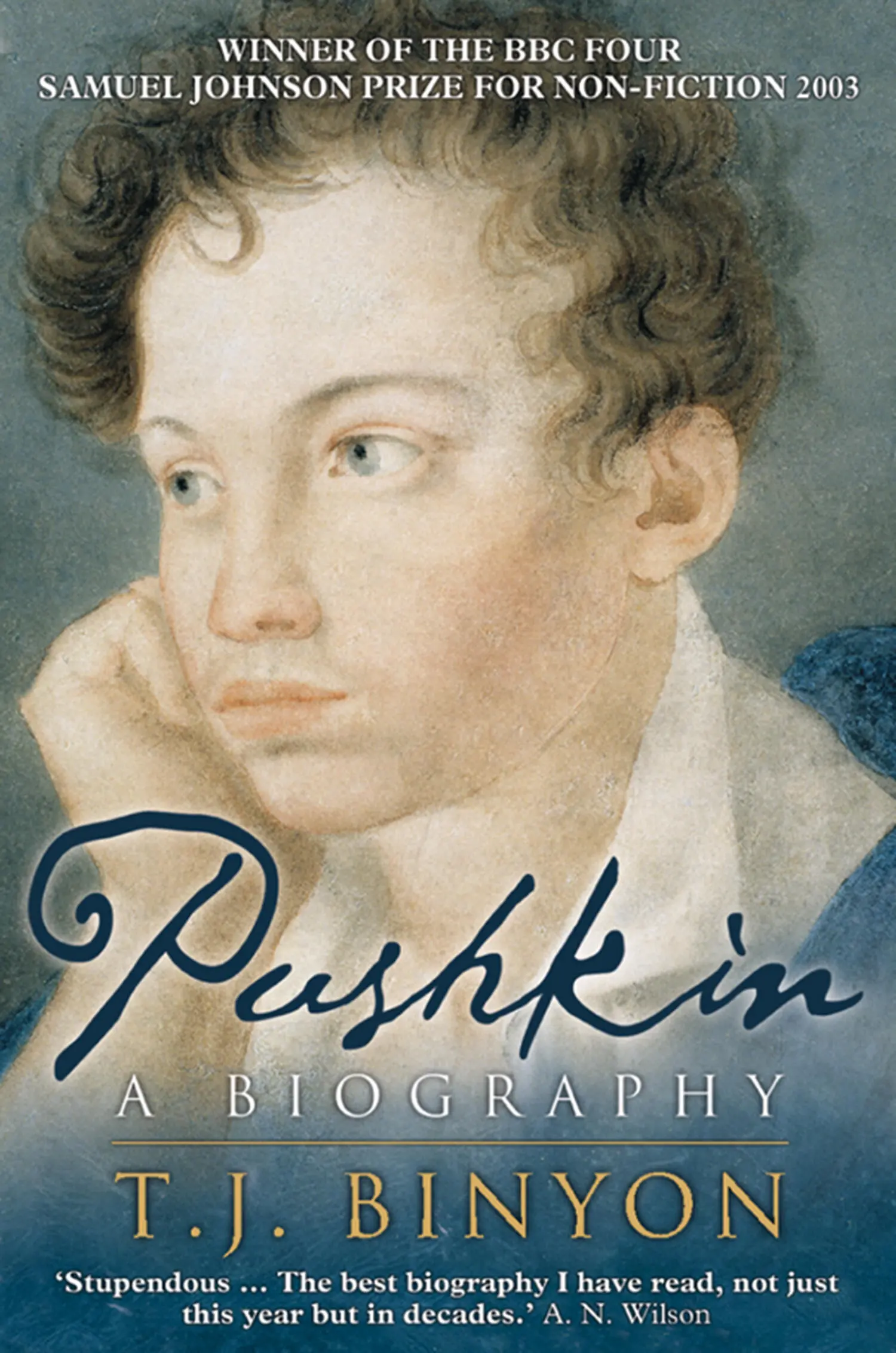
- Название:Pushkin
- Автор:
- Жанр:
- Год:неизвестен
- ISBN:нет данных
- Рейтинг книги:4 / 5. Голосов: 1
-
Избранное:Добавить в избранное
- Отзывы:
-
Ваша оценка:
Pushkin: краткое содержание, описание и аннотация
Предлагаем к чтению аннотацию, описание, краткое содержание или предисловие (зависит от того, что написал сам автор книги «Pushkin»). Если вы не нашли необходимую информацию о книге — напишите в комментариях, мы постараемся отыскать её.
Pushkin — читать онлайн ознакомительный отрывок
Ниже представлен текст книги, разбитый по страницам. Система сохранения места последней прочитанной страницы, позволяет с удобством читать онлайн бесплатно книгу «Pushkin», без необходимости каждый раз заново искать на чём Вы остановились. Поставьте закладку, и сможете в любой момент перейти на страницу, на которой закончили чтение.
Интервал:
Закладка:
Screams and cries were heard from the audience. A number of people fainted; a student burst through the throng and fell in hysterics at Dostoevskyâs feet where he lost consciousness. At the end of the session a hundred young women, pushing Turgenev aside, made their way on to the stage bearing a huge laurel wreath, nearly five feet in diameter, and placed it round the authorâs neck. It bore the inscription âFor the Russian woman, about whom you said so much that was good!â Late that evening Dostoevsky took a cab to Tverskaya Square, placed the wreath at the foot of the granite pedestal on which the statue stood, and, stepping back a pace, bowed to the ground. 5
Dostoevskyâs speech had little to do with the reality of Pushkinâs work: he had, rather, unscrupulously made use of the otherâs reputation to propagate his own belief in Russiaâs messianic mission. However, it came as a fitting conclusion to what one newspaper referred to as âdays of a magically poetic fairy-taleâ, and others as âdays of holy ecstasyâ and âthe âholy weekâ of the Russian intelligentsiaâ. Some witnesses experienced something akin to a religious conversion, one reporter writing, âIt was as if the atmosphere surrounding the celebration caught fire and was lit by an iridescent radiance. Oneâs heart beat faster, more joyfully, oneâs thoughts became bright and lucid, and oneâs whole being opened up to impressions and emotions that would have been incomprehensible and strange given other less elevating circumstances. Some kind of moral miracle took place, a moral shock that stirred oneâs innermost soul.â 6 But it also established a new attitude to Pushkin: from now on he was not merely a poet superior to all others, but also was no longer a man; he had become a symbol, a myth, an icon.
By 1899, the hundredth anniversary of his birth, the state had taken account of the potency of the poetâs image, and organized for the occasion an immense celebration throughout the Russian empire. Busts and portraits were mass-produced, and schoolchildren given free copies of his works, together with bars of chocolate stamped with his picture. The Pushkin of 1899 was far removed from the prophetic, miraculously responsive Pushkin of 1880; he was a solid, upright, moral citizen, a firm patriot and a loyal supporter of autocracy. In 1937 the Soviet state launched an even more massive celebration of the hundredth anniversary of Pushkinâs death. His works were recruited to assist the drive towards universal literacy in the Soviet Union, while his image was tailored to fit Soviet ideology. âPushkin is completely ours, Soviet, for the Soviet state inherited everything that is best in our people, and itself is the embodiment of the best aspirations of our people,â wrote Pravda. 7 The myth had now become the basis for a cult â at times uncomfortably close to the Stalin cult â and Pushkin himself a quasi-divine figure, not only âcreator of the Russian literary language, father of new Russian literature, a genius who enriched humanity with his worksâ, 8 but also a proto-Marxist who espoused the cause of liberty and of the common people; a man who gilded everything he touched and was without fault in every aspect of his life. Most recently, the celebrations of 1999 have enlisted Pushkin in the service of capitalism and commercial enterprise. The Bank of Russia brought out a number of commemorative silver and gold coins; the twenty-five-rouble silver has on its reverse âa picture of A.S. Pushkin holding a writing book and a goose-quill in his hands, in the background to the right â personages of his works of literatureâ. 9 His portrait was to be seen in shop windows, on the sides of buses and trams, on billboards, boxes of matches, vodka bottles and T-shirts, while Coca-Cola ran an advertisement featuring lines from his most famous love lyric, âI recollect a wondrous momentâ. And the Foreign Minister, Igor Ivanov, when condemning in language reminiscent of the Cold War western intervention in Yugoslavia, added that NATO had foolishly ignored Pushkinâs lessons on the Balkans â thus preserving the poetâs reputation, acquired in the Soviet era, for being a genius in every sphere. *
Of course, in one sense the myth is justified: Pushkin is Russiaâs greatest poet, the composer of a large body of magnificent lyrics, extraordinarily diverse both in theme and treatment; of a number of great narrative poems â Ruslan and Lyudmila, The Gypsies, Poltava and The Bronze Horseman â and of a unique novel in verse, Eugene Onegin. He reformed Russian poetic language: in his hands it became a powerful, yet flexible instrument, with a diapason stretching from the solemnly archaic to the cadences of everyday speech. The aim of this biography, however, is, in all humility, to free the complex and interesting figure of Pushkin the man from the heroic simplicity of Pushkin the myth. It concerns itself above all with the events of his life: though the appearance of his main works is noted, and the works themselves are commented on briefly, literary analysis has been eschewed, as being the province of the critic, rather than the biographer.
*He is presumably referring to Pushkinâs remarks on the Polish revolt of 1830, particularly the poem âTo the Slanderers of Russiaâ.
1 ANCESTRY AND CHILDHOOD 1799â1811
Lack of respect for oneâs ancestors is the first sign of barbarism and immorality.
VIII, 42
A LEKSANDR PUSHKIN was born in Moscow on Thursday 26 May 1799, in a âhalf-brick and half-wooden houseâ on a plot of land situated on the corner of Malaya Pochtovaya Street and Gospitalny Lane. 1 This was in the eastern suburb known as the German Settlement, to which foreigners had been banished in 1652. Though distant from the centre, it was, up to the fire of 1812, a fashionable area, âthe faubourg Saint-Germain of Moscowâ. 2 On 8 June he was baptized in the parish church, the Church of the Epiphany on Elokhovskaya Square. * And that autumn his parents, Sergey and Nadezhda, took him and his sister Olga â born in December 1797 â to visit their grandfather Osip Gannibal, Nadezhdaâs father, on his estate at Mikhailovskoe, in the Pskov region. Most of the next year was spent in St Petersburg. The Emperor Paul, coming across Pushkin and his nurse, reprimanded the latter for not removing the babyâs cap in the presence of royalty, and proceeded to do so himself. In the autumn they moved back to Moscow, where they were to remain for the duration of Pushkinâs childhood.
Pushkin was proud of both sides of his ancestry: both of his fatherâs family, the Pushkins, and of his motherâs, the Gannibals. However, the two were so different from one another, antipodes in almost every respect, that to take equal pride in both required the reconciliation of contradictory values. In Pushkin the contradictions were never completely resolved, and the resulting tension would occasionally manifest itself, both in his behaviour and in his work. The most obvious difference lay in the origins of the two families: whereas the Pushkins could hardly have been more Russian, the Gannibals could hardly have been more exotic and more foreign.
On 15 November 1704 an official at the Foreign Office in Moscow passed on to General-Admiral Golovin, the minister, news of a Serbian trader who was employed by the department. âBefore leaving Constantinople on 21 June,â he wrote, âMaster Savva Raguzinsky informed me that according to the order of your excellency he had acquired with great fear and danger to his life from the Turks two little blackamoors and a third for Ambassador Petr Andreevich [Tolstoy], and that he had sent these blackamoors with a man of his for safety by way of land through the Walachian territories.â 3 The boys had just arrived, the writer added; he had dispatched one to the ambassadorâs home, and the other two, who were brothers, to the Golovin palace. The younger of these was in the course of time to become General Abram Petrovich Gannibal, cavalier of the orders of St Anne and Alexander Nevsky: Pushkinâs maternal great-grandfather. *
Читать дальшеИнтервал:
Закладка:
Похожие книги на «Pushkin»
Представляем Вашему вниманию похожие книги на «Pushkin» списком для выбора. Мы отобрали схожую по названию и смыслу литературу в надежде предоставить читателям больше вариантов отыскать новые, интересные, ещё непрочитанные произведения.





Обсуждение, отзывы о книге «Pushkin» и просто собственные мнения читателей. Оставьте ваши комментарии, напишите, что Вы думаете о произведении, его смысле или главных героях. Укажите что конкретно понравилось, а что нет, и почему Вы так считаете.