T. Binyon - Pushkin
Здесь есть возможность читать онлайн «T. Binyon - Pushkin» — ознакомительный отрывок электронной книги совершенно бесплатно, а после прочтения отрывка купить полную версию. В некоторых случаях можно слушать аудио, скачать через торрент в формате fb2 и присутствует краткое содержание. Жанр: unrecognised, на английском языке. Описание произведения, (предисловие) а так же отзывы посетителей доступны на портале библиотеки ЛибКат.
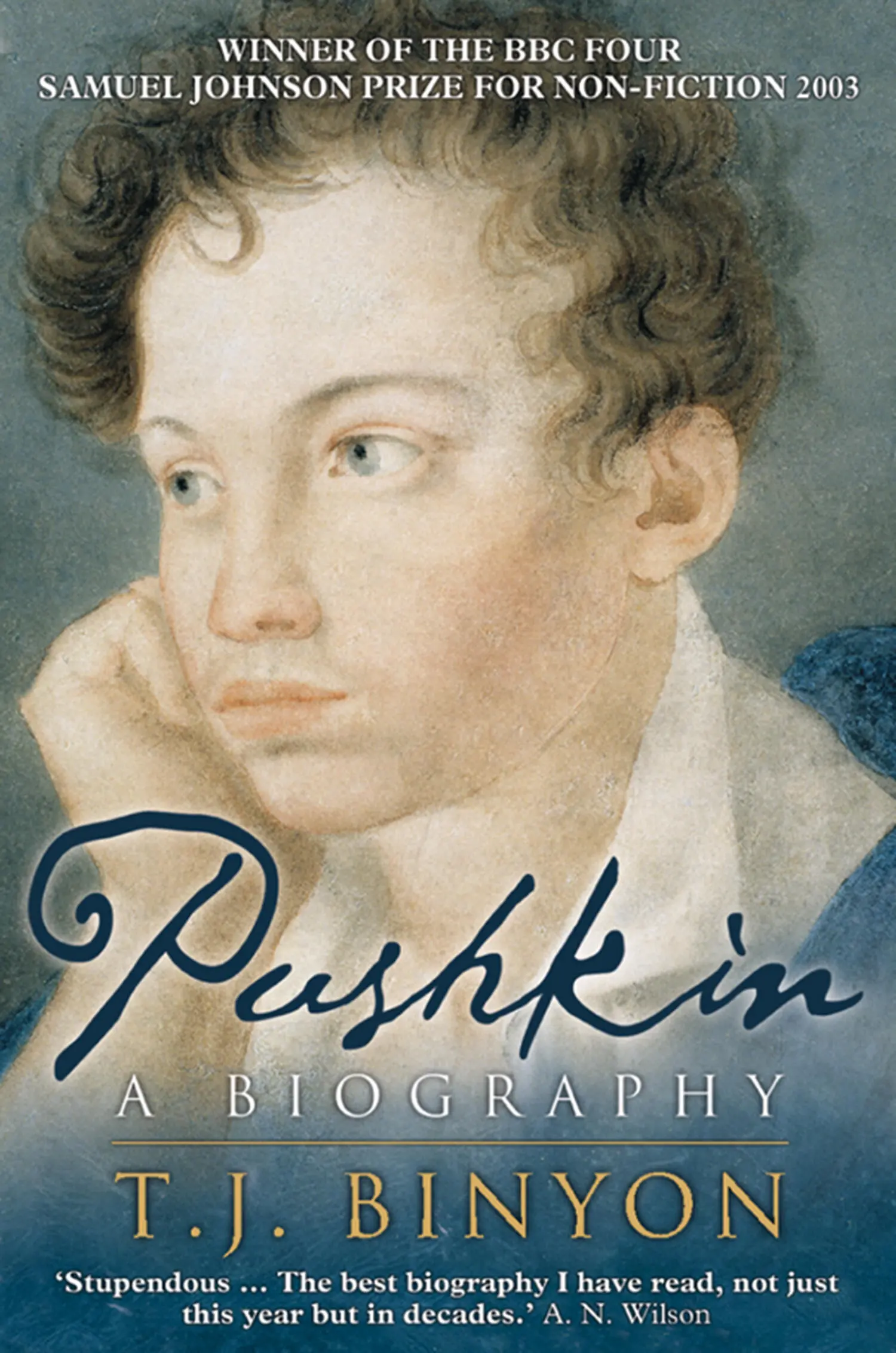
- Название:Pushkin
- Автор:
- Жанр:
- Год:неизвестен
- ISBN:нет данных
- Рейтинг книги:4 / 5. Голосов: 1
-
Избранное:Добавить в избранное
- Отзывы:
-
Ваша оценка:
Pushkin: краткое содержание, описание и аннотация
Предлагаем к чтению аннотацию, описание, краткое содержание или предисловие (зависит от того, что написал сам автор книги «Pushkin»). Если вы не нашли необходимую информацию о книге — напишите в комментариях, мы постараемся отыскать её.
Pushkin — читать онлайн ознакомительный отрывок
Ниже представлен текст книги, разбитый по страницам. Система сохранения места последней прочитанной страницы, позволяет с удобством читать онлайн бесплатно книгу «Pushkin», без необходимости каждый раз заново искать на чём Вы остановились. Поставьте закладку, и сможете в любой момент перейти на страницу, на которой закончили чтение.
Интервал:
Закладка:
In the foaming goblet froths
Ayâ s cold stream;
In the thick smoke of lazy pipes,
In dressing-gowns, your new friends
Shout and drink! 54
Like Arzamas , the Green Lamp provided Pushkin with a ready-made circle of friends, though in the majority of cases his intimacy with them was confined to this period of his life. They were, however, closer to him in age than the Arzamasites, and shared the tastes and predilections which governed his life in these years. Whereas his elder friends sighed over his behaviour and saw him as wasting his talent â Aleksandr Turgenev told Zhukovsky that he daily scolded Pushkin for âhis laziness and neglect of his own educationâ, to which âhe had added a taste for vulgar philandering and equally vulgar eighteenth-century freethinkingâ 55 â the members of the Green Lamp were companions in his amusements: drinking, whoring and gambling. As with Arzamas , his loyalty to the group persisted in exile; in 1821 he looked back nostalgically at its meetings:
Do you still burn, our lamp,
Friend of vigils and of feasts?
Do you still foam, golden cup,
In the hands of merry wits?
Are you still the same, friends of mirth,
Friends of Cypris and of verse?
Do the hours of love, the hours of drunkenness
Still fly to the call
Of Freedom, indolence and idleness? 56
Pushkinâs tastes were not wholly identical with those of Eugene: âI am always glad to note the difference/Between Onegin and myselfâ, he remarks, in case some âsarcastic readerâ should imagine that, like Byron, he is painting his own portrait (I, lvi). One vice Eugene did not share was Pushkinâs addiction to gambling.
Passion for bank! neither the love of liberty,
Nor Phoebus, nor friendship, nor feasts
Could have distracted me in past years
From cards. 57
So he described, in a cancelled stanza of the second chapter of Eugene Onegin , himself during the years in St Petersburg. It was an addiction, moreover, not confined to this period, as he here implies, but which lasted throughout his life. The game to which he was addicted â which was also Casanovaâs passion â was bank, also known as faro (or pharo, originally le pharaon) or shtoss, a descendant of lansquenet, the game played by dâArtagnan and the musketeers on the bastion at La Rochelle while under Huguenot fire, and of basset, the favourite card-game at the court of Charles II. Each player chose a card from his pack, placed it either face-up or face-down â in the latter case it was known as a âdarkâ card â in front of him on the table and set his stake upon it. The banker, taking a fresh pack, turned the cards up from the top, dealing them alternately to his right and left, stopping momentarily if a player called out attendez , in order to make or reconsider a bet. If a card which fell to the right was of the same denomination as one on which a stake had been placed the banker won; he lost, and paid out the amount of the stake, when such a card fell to the left. If both cards exposed in one turn were the same, a player wagering on that denomination lost either half, or the whole of his stake, depending on the rules in force at the game. Having won once, the player could then cock his card â turn up one corner â to wager both his original stake and his gains: this was known as a parolet ; or bend the card, to bet only his gains. This was a paix , or parolet-paix , if he had just won a parolet. After winning a parolet , he could cock another corner, to double his winnings again ( sept-et-le-va ), followed by a third ( quinze-et-le-va ) and a fourth ( trente-et-le-va ). 58
Pushkin gambled constantly, and as constantly lost, as a result having to resort to money-lenders. He played frequently with Nikita Vsevolozhsky, whose deep pockets enabled him to bear his losses. Pushkin, less fortunate, was compelled to stake his manuscripts, and in 1820 lost to Vsevolozhsky a collection of poems which he valued at 1,000 roubles. When, four years later, he was preparing to publish his verse, he employed his brother Lev to buy the manuscript back. Vsevolozhsky generously asked for only 500 roubles in exchange, but Pushkin insisted that the full amount should be paid. âThe second chapter of âOneginâ/ Modestly slid down [i.e., was lost] upon an ace,â Ivan Velikopolsky, an old St Petersburg acquaintance, recorded in 1826, adding elsewhere: âthe long nails of the poet/Are no defence against the misfortunes of play.â 59 And in December of the same year, when Pushkin was staying at a Pskov inn to recover after having been overturned in a carriage on the road from Mikhailovskoe, he told Vyazemsky that âinstead of writing the 7th chapter of Onegin, I am losing the fourth at shtoss: itâs not funnyâ. 60 Another favourite opponent at the card-table was Vasily Engelhardt, described by Vyazemsky as âan extravagant rich man, who did not neglect the pleasures of life, a deep gambler, who, however, during his life seems to have lost more than he wonâ. âPushkin was very fond of Engelhardt,â he adds, âbecause he was always ready to play cards, and very felicitously played on words.â 61 In July 1819, having recovered from a serious illness â âI have escaped from Aesculapius/Thin and shaven â but aliveâ â Pushkin, who was leaving for Mikhailovskoe to convalesce, in a verse epistle begged Engelhardt, âVenusâs pious worshipperâ, to visit him before his departure. 62
The cold he had caught while, as Turgenev reported, standing outside a prostituteâs door, had turned into a more serious illness â it seems likely to have been typhus. On 25 June his uncle wrote from Moscow to Vyazemsky in Warsaw: âPity our poet Pushkin. He is ill with a severe fever. My brother is in despair, and I am extremely concerned by such sad news.â 63 James Leighton, the emperorâs personal physician, was called in. He prescribed baths of ice and had Pushkinâs head shaved. After six weeksâ illness Pushkin recovered, but had to wear a wig while his own hair grew again. This was not Pushkinâs only illness, though it was the most severe, during these years in the unhealthy â both in climate and amusements â atmosphere of St Petersburg. Besides a series of venereal infections, he was also seriously ill in January 1818: âOur poet Aleksandr was desperately ill, but, thank God, is now better,â Vasily Pushkin informed Vyazemsky. 64 During this illness Elizaveta Schott-Schedel, a St Petersburg demi-mondaine , had visited him dressed as an hussar officer, which apparently contributed to his recovery. âWas it you, tender maiden, who stood over me/In warrior garb with pleasing gaucherie?â he wonders, pleading with her to return now he is convalescent:
Appear, enchantress! Let me again glimpse
Beneath the stern shako your heavenly eyes,
And the greatcoat, and the belt of battle,
And the legs adorned with martial boots. 65
âPushkin has taken to his bed,â Aleksandr Turgenev wrote the following February; 66 a year later, in February 1820, he was laid up yet again. Unpleasant though the recurrent maladies were, the periods of convalescence that followed afforded him the leisure to read and compose: he can have had little time for either in the frenetic pursuit of pleasure that was his life when healthy. The first eight volumes of Karamzinâs History of the Russian State had come out at the beginning of February 1818. âI read them in bed with avidity and attention,â Pushkin wrote. âThe appearance of this work (as was fitting) was a great sensation and produced a strong impression. 3,000 copies were sold in a month (Karamzin himself in no way expected this) â a unique happening in our country. Everyone, even society women, rushed to read the History of their Fatherland, previously unknown to them. It was a new revelation for them. Ancient Russia seemed to have been discovered by Karamzin, as America by Columbus.â 67
Читать дальшеИнтервал:
Закладка:
Похожие книги на «Pushkin»
Представляем Вашему вниманию похожие книги на «Pushkin» списком для выбора. Мы отобрали схожую по названию и смыслу литературу в надежде предоставить читателям больше вариантов отыскать новые, интересные, ещё непрочитанные произведения.









Обсуждение, отзывы о книге «Pushkin» и просто собственные мнения читателей. Оставьте ваши комментарии, напишите, что Вы думаете о произведении, его смысле или главных героях. Укажите что конкретно понравилось, а что нет, и почему Вы так считаете.