T. Binyon - Pushkin
Здесь есть возможность читать онлайн «T. Binyon - Pushkin» — ознакомительный отрывок электронной книги совершенно бесплатно, а после прочтения отрывка купить полную версию. В некоторых случаях можно слушать аудио, скачать через торрент в формате fb2 и присутствует краткое содержание. Жанр: unrecognised, на английском языке. Описание произведения, (предисловие) а так же отзывы посетителей доступны на портале библиотеки ЛибКат.
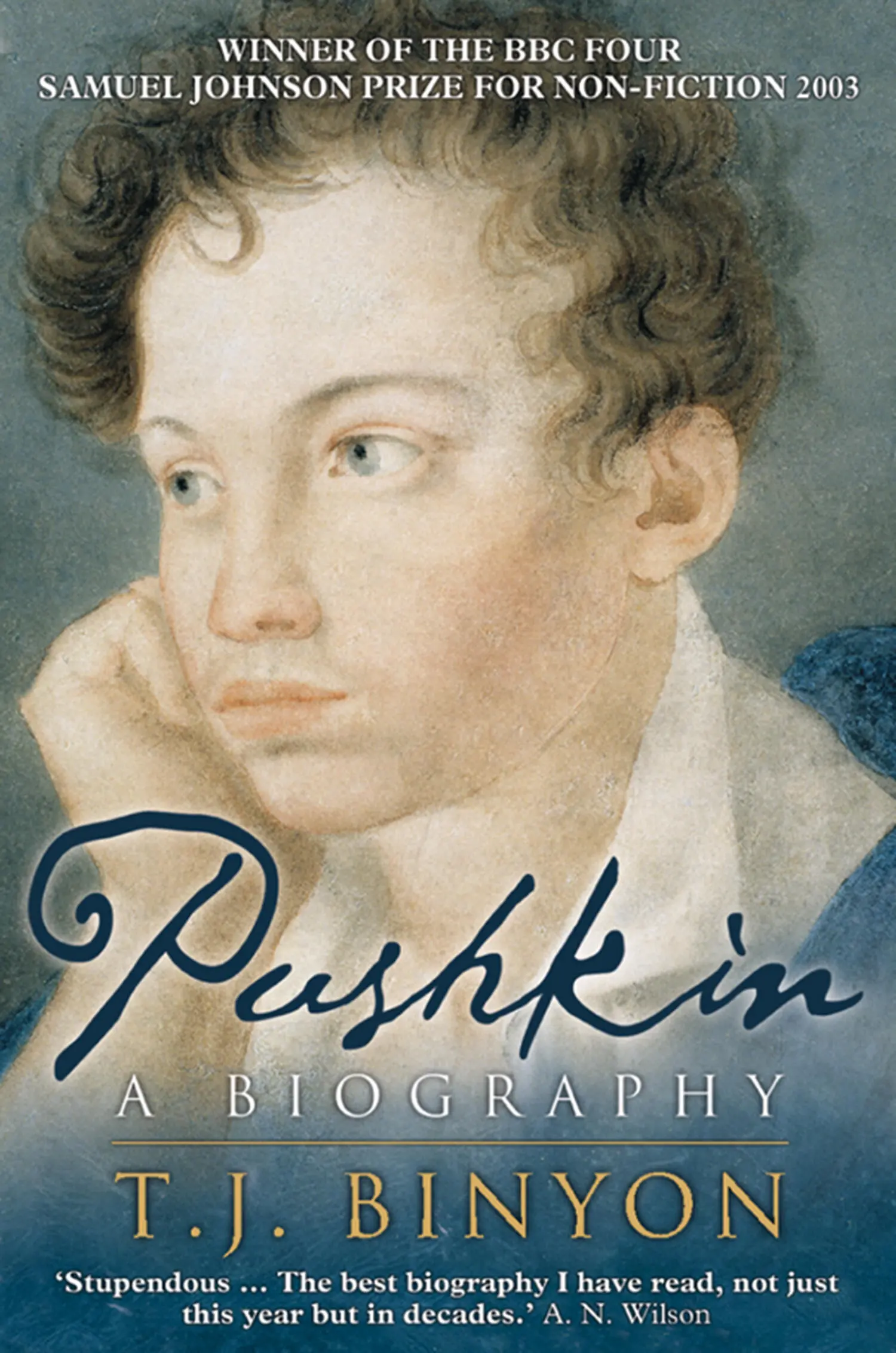
- Название:Pushkin
- Автор:
- Жанр:
- Год:неизвестен
- ISBN:нет данных
- Рейтинг книги:4 / 5. Голосов: 1
-
Избранное:Добавить в избранное
- Отзывы:
-
Ваша оценка:
Pushkin: краткое содержание, описание и аннотация
Предлагаем к чтению аннотацию, описание, краткое содержание или предисловие (зависит от того, что написал сам автор книги «Pushkin»). Если вы не нашли необходимую информацию о книге — напишите в комментариях, мы постараемся отыскать её.
Pushkin — читать онлайн ознакомительный отрывок
Ниже представлен текст книги, разбитый по страницам. Система сохранения места последней прочитанной страницы, позволяет с удобством читать онлайн бесплатно книгу «Pushkin», без необходимости каждый раз заново искать на чём Вы остановились. Поставьте закладку, и сможете в любой момент перейти на страницу, на которой закончили чтение.
Интервал:
Закладка:
In 1818 he had addressed a poem to him which concludes with the stirring lines,
While we yet with freedom burn,
While our hearts yet live for honour,
My friend, let us devote to our country
The sublime impulses of our soul!
Comrade, believe: it will arise,
The star of captivating joy,
Russia will start from her sleep,
And on the ruins of autocracy
Our names will be inscribed! 51
The epistle, which has been called âthe most optimistic verse in Pushkinâs entire poetryâ, 52 circulated widely in manuscript, together with âFairy Talesâ, âThe Countryâ and the epigrams on Arakcheev; according to Yakushkin âthere was scarcely a more or less literate ensign in the army who did not know them by heartâ. 53
*A reference to contemporary portraits of Simon Bolivar (1783â1830), the hero of South American independence.
*The artist, Aleksandr Notbek, ignored Pushkinâs instructions; his ill-executed engraving, printed in the Neva Almanac in January 1829, shows the poet facing the spectator with arms crossed on his chest. Pushkin greeted the travesty with an amusing, if scatological epigram:
Here, having crossed Kokushkin Bridge,
Supporting his arse on the granite,
Aleksandr Sergeich Pushkin himself
Stands with Monsieur Onegin.
Scorning to glance
At the citadel of fateful power,
He has proudly turned his posterior to the fortress:
Donât spit in the well, dear chap. (III, 165)
*A desyatin is approximately 2.7 acres: only adult male serfs were numbered in the census.
*Modelled on âThe Vision of Charles Palissotâ (1760), an attack by Abbé André Morellet on Palissotâs play Les Philosophes , itself a satire directed at the Encyclopédistes.
*In the reign of Peter the Great the custom had been established of presenting to ladies attached to the court a miniature portrait of the monarch which was worn on state occasions.
â Other members included Dmitry Kavelin, Aleksandr Voeikov, Aleksandr Pleshcheev, Petr Poletika, Dmitry Severin; and, later, Nikita Muravev, General Mikhail Orlov and Nikolay Turgenev.
*On 7 January 1834 after a visit from Wiegel Pushkin noted in his diary, âI like his conversation â he is entertaining and sensible, but always ends up by talking of sodomyâ (Wiegel was homosexual), and in June, after an evening at the Karamzins, wrote, âI am very fond of Poletikaâ (XII, 318, 330).
*âLoyal without flatteryâ was the motto adopted by Arakcheev for his coat-of-arms; the last line is a reference to his mistress, Anastasiya Minkina, in 1825 murdered by the serfs for her intolerable cruelty.
*Count Dmitry Ivanovich Khvostov, the Alfred Austin of Alexandrine Russia, an extraordinarily prolific, but talentless poet, the constant butt of Pushkinâs jokes.
â Herostratus set fire to the temple of Artemis in Ephesus in order, he confessed, to gain everlasting fame; the German dramatist Kotzebue, employed by the Russian foreign service as a political informant, was assassinated in 1819 by the student Karl Ludwig Sand.
*By an order of 5 August 1816 certain districts in the Novgorod province and, later, in the south, had been turned into military colonies. Every village was transformed into an army camp; all peasants under fifty had to shave their beards and crop their hair, while those under forty-five had to wear uniform. Children received military training, and girls were married by order of the military authorities. Arakcheev was particularly hated for his merciless enforcement of the rules governing these colonies.
*The Decembrist Ivan Gorbachevsky, a member of the Society of United Slavs (which amalgamated with the southern society in 1825), who knew Pushchin well, having shared a cell with him in the Peter-Paul fortress, after reading this passage in the latterâs memoirs, remarked in a letter to M.A. Bestuzhev dated 12 June 1861: âPoor Pushchin, â he did not know that the Supreme Duma [of the society] had even forbidden us to make the acquaintance of the poet Aleksandr Sergeevich Pushkin, when he lived in the south; â and for what reason? It was openly said that because of his character and pusillanimity, because of his debauched life, he would immediately inform the government of the existence of a secret society [â¦] Muravev-Apostol and Bestuzhev-Ryumin told me about such antics of Pushkin in the south that even now turn oneâs ears red.â Shchegolev (1931), 294â5.
â A quotation from Eugene Onegin , I, xii; Davydovâs wife, Aglaë (née de Grammont) was generous with her favours.
*I.e., in secret, in strict confidence.
4 ST PETERSBURG 1817â20
II: Oneginâs Day
I love thee, Peterâs creation,
Love thy stern, harmonious air,
The Nevaâs majestic flow,
The granite of her embankments,
Thy railingsâ iron pattern,
Thy pensive nightsâ
Translucent twilight, moonless glimmer,
When in my room
I write and read without a lamp,
And distinct are the sleeping piles
Of the empty streets, and bright
The Admiraltyâs spire,
And, not admitting nocturnal dark
To the golden heavens,
Dawn to replace dusk
Hastens, giving to night but half an hour.
I love your cruel winterâs
Still air and frost,
The flight of sleighs along the broad Neva,
Maidensâ faces brighter than roses,
The brilliance, hubbub and chatter of balls,
And at the bachelor banquet
The hiss of foaming beakers
And the blue flame of punch.
The Bronze Horseman , 43â66
THE PETERSBURG THROUGH WHICH the hero of Eugene Onegin moves in the first chapter of the poem is not fictional: it is the Petersburg of Pushkin. Eugeneâs friends and acquaintances, his amusements and diversions, his interests and infatuations are also Pushkinâs. This âdescription of the fashionable life of a St Petersburg young man at the end of 1819, reminiscent of Beppo , sombre Byronâs comic workâ, 1 thus provides a skeleton on which to drape a description of Pushkinâs own social life at St Petersburg: his friends and associates, literary salons, the theatre, balls, gambling, liaisons, romances and flirtations.
Rising late, Eugene dons his âwide Bolivar â to saunter up and down âthe boulevardâ â the shaded walk, lined by two rows of lime trees, which ran down the middle of the Nevsky from the Fontanka canal to the Moika. Warned by his watch that it is around four in the afternoon, he hurries to Talonâs French restaurant on the Nevsky, where Petr Kaverin, the hard-drinking hussar officer who considers cold champagne the best cure for the clap, is waiting. On 27 May 1819 Kaverin noted in his diary: âShcherbinin, Olsufev, Pushkin â supped with me in Petersburg â champagne had been put on ice the day before â by chance my beauty at that time (for the satisfaction of carnal desires) passed by â we called her in â the heat was insupportable â we asked Pushkin to prolong the memory of the evening in verse â here is the result:
A joyful evening in our life
Let us remember, youthful friends;
In the glass goblet champagneâs
Cold stream hissed.
We drank â and Venus with us
Sat sweating at the table.
When shall we four sit again
With whores, wine and pipes?â 2
Pushkin had not lost his taste for military company, though now he was as apt to mingle with generals as with subalterns, much to Pushchinâs disapproval. âThough liberal in his views, Pushkin had a kind of pathetic habit of betraying his noble character and often angered me and all of us by, for example, loving to consort in the orchestra-pit with Orlov, Chernyshev, Kiselev and others: with patronizing smiles they listened to his jokes and witticisms. If you made him a sign from the stalls, he would run over immediately. You would say to him: âWhy do you want, dear chap, to spend your time with that lot; not one of them is sympathetic to you, and so on.â He would listen patiently, begin to tickle you, embrace you, which he usually did when he was slightly flustered. A moment later you would see Pushkin again with the lions of that time!â 3 However, something was to be gained from their company. When in 1819 he resurrected the idea of joining the hussars â âIâm sorry for poor Pushkin!â Batyushkov wrote from Naples. âHe wonât be a good officer, and there will be one good poet less. A terrible loss for poetry! Perchè? Tell me, for Godâs sake.â 4 â General Kiselev promised him a commission. However, Major-General Aleksey Orlov â brother of Mikhail, he had âthe face of Eros, the figure of the Apollo Belvedere and Herculean musclesâ 5 â dissuaded him from the idea, a service for which Pushkin, on second thoughts, was grateful: âOrlov, you are right: I forgo/My hussar dreams/And with Solomon exclaim:/Uniform and sabre â all is vanity!â 6 Orlov was either extraordinarily magnanimous, or had no knowledge of the epigram Pushkin had devoted to him and his mistress, the ballet-dancer Istomina, in 1817:
Читать дальшеИнтервал:
Закладка:
Похожие книги на «Pushkin»
Представляем Вашему вниманию похожие книги на «Pushkin» списком для выбора. Мы отобрали схожую по названию и смыслу литературу в надежде предоставить читателям больше вариантов отыскать новые, интересные, ещё непрочитанные произведения.







Обсуждение, отзывы о книге «Pushkin» и просто собственные мнения читателей. Оставьте ваши комментарии, напишите, что Вы думаете о произведении, его смысле или главных героях. Укажите что конкретно понравилось, а что нет, и почему Вы так считаете.