T. Binyon - Pushkin
Здесь есть возможность читать онлайн «T. Binyon - Pushkin» — ознакомительный отрывок электронной книги совершенно бесплатно, а после прочтения отрывка купить полную версию. В некоторых случаях можно слушать аудио, скачать через торрент в формате fb2 и присутствует краткое содержание. Жанр: unrecognised, на английском языке. Описание произведения, (предисловие) а так же отзывы посетителей доступны на портале библиотеки ЛибКат.
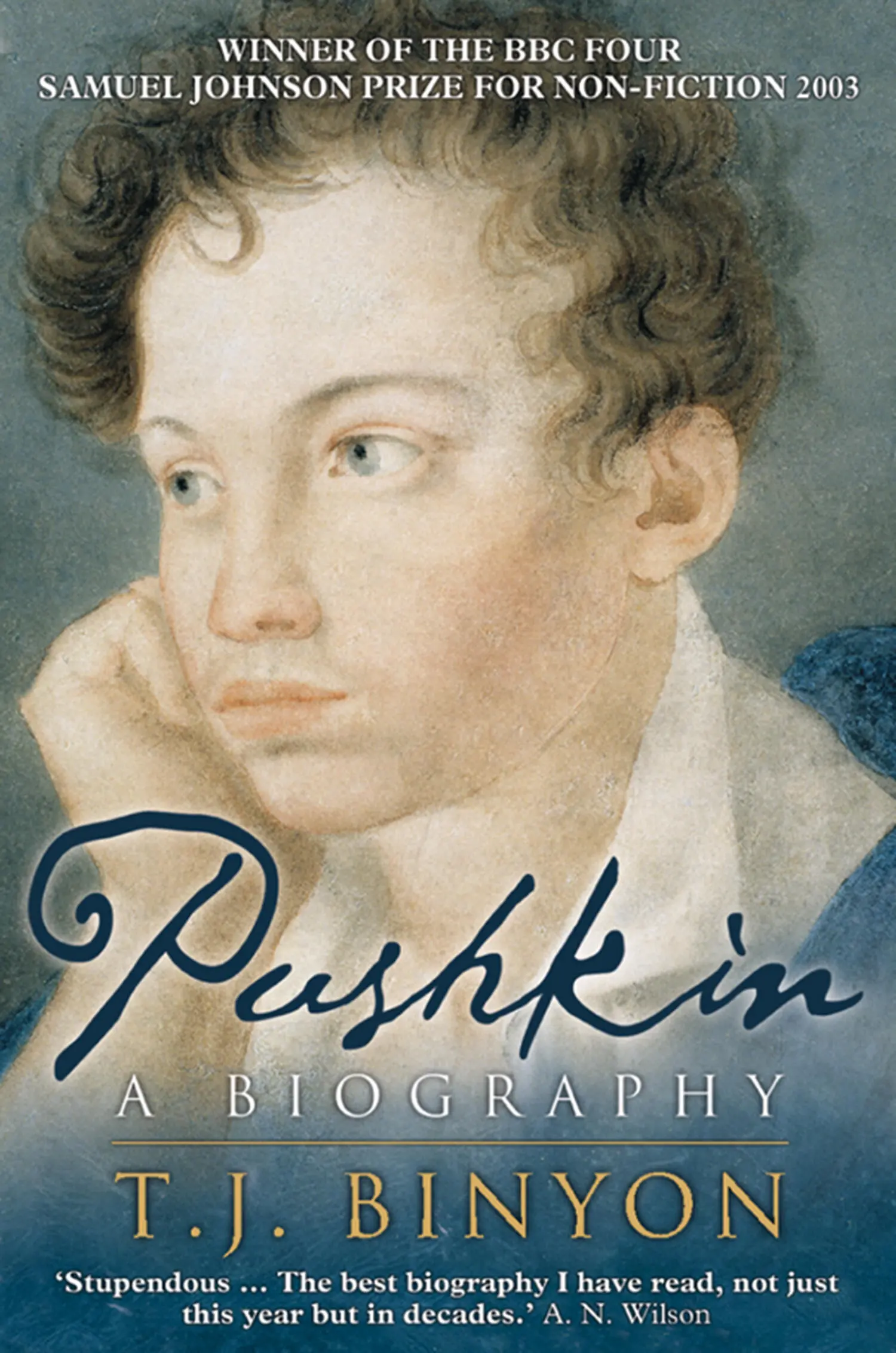
- Название:Pushkin
- Автор:
- Жанр:
- Год:неизвестен
- ISBN:нет данных
- Рейтинг книги:4 / 5. Голосов: 1
-
Избранное:Добавить в избранное
- Отзывы:
-
Ваша оценка:
Pushkin: краткое содержание, описание и аннотация
Предлагаем к чтению аннотацию, описание, краткое содержание или предисловие (зависит от того, что написал сам автор книги «Pushkin»). Если вы не нашли необходимую информацию о книге — напишите в комментариях, мы постараемся отыскать её.
Pushkin — читать онлайн ознакомительный отрывок
Ниже представлен текст книги, разбитый по страницам. Система сохранения места последней прочитанной страницы, позволяет с удобством читать онлайн бесплатно книгу «Pushkin», без необходимости каждый раз заново искать на чём Вы остановились. Поставьте закладку, и сможете в любой момент перейти на страницу, на которой закончили чтение.
Интервал:
Закладка:
Far less ethereal were his feelings for Natasha, Princess Varvara Volkonskayaâs pretty maid, well-known to the lycéens and much admired by them. One dark evening in 1816, Pushkin, running along one of the palace corridors, came upon someone he thought to be Natasha, and began to âpester her with rash words and even, so the malicious say, with indiscreet caressesâ. 59 Unfortunately the woman was not Natasha, but her mistress, who recognized Pushkin and through her brother complained to the emperor. The following day Alexander came to see Engelhardt about the affair. âYour pupils not only climb over the fence to steal my ripe apples, and beat gardener Lyaminâs watchmen,â he complained, âbut now will not let my wifeâs ladies-in-waiting pass in the corridor.â Engelhardt assured him that Pushkin was in despair, and had asked the director for permission to write to the princess, âasking her magnanimously to forgive him for this unintended insultâ. âLet him write â and there will be an end of it. I will be Pushkinâs advocate; but tell him that it is for the last time,â said Alexander, adding in a whisper, âBetween ourselves, the old woman is probably enchanted at the young manâs mistake.â 60 Pushkin made up for the letter of apology with a malicious French epigram:
One could easily, miss,
Take you for a brothel madam,
Or for an old hag;
But for a trollop, â oh, my God, no. 61
Another object of desire was the young Marie Smith, âvery pretty, amiable and wittyâ, 62 who came to stay with her relations the Engelhardts towards the end of 1816. Pushkin was soon addressing his verse to her, not a whit discomposed by the facts that she had very recently lost her husband and was three monthsâ pregnant. At first the tone is light and humorous, no word of love is breathed; but early in 1817 he sent her âTo a Young Widowâ:
Lida, my devoted friend,
Why do I, through my light sleep,
Exhausted with pleasure,
Often hear your quiet sigh?
âWill you eternally shed tears,/Eternally your dead husband/Call from the grave?â If so, she will call in vain, âthe furious, jealous husband/Will not arise from eternal darkness.â 63 In a sense the poem is harmless. Pushkin is not serious in imagining himself to be in bed with Mrs Smith, urging her to forget her husband: these are mere poetic conceits, no different, in a way, from those of an earlier poem, when he calls her âthe confidante of Venus/[â¦] whose throne Cupid/And the playful children of Cytheraea/Have decorated with flowers.â 64 But it is understandable that literary considerations of this kind did not present themselves to Mrs Smithâs mind when she received the poem. She saw only the literal, highly indecent meaning, was insulted by it, and took the poem to Engelhardt, who was obliged to give Pushkin another severe dressing-down.
In the spring of 1817 the Karamzins returned to Tsarskoe Selo. Karamzinâs second wife, the severely beautiful Ekaterina Andreevna, was then thirty-six. Of her Filipp Wiegel, whom Pushkin later knew well, wrote in his memoirs, âWhat can I say of her? If the pagan Phidias could have been inspired by a Christian ideal, and have wished to sculpt a Madonna, he would of course have given her the features of Karamzina in her youth.â 65 Pushkin, always susceptible to beauty, and who was, in addition, beginning to be attracted chiefly to older women, sent her a love-letter. Ekaterina, unaffected by his devotion, was amused, and showed it to her husband; they laughed heartily over it. Nevertheless, Karamzin felt it necessary to read Pushkin a stern lecture, affecting the latter so much that he burst into tears. In later years Karamzin took pleasure in showing friends the spot in his study which had been sprinkled with Pushkinâs sobs.
As the course of the first intake at the Lycée neared its end, the thoughts of its members turned towards the future, and Pushkin startled his father with a letter requesting permission to join the Life Guards Hussars. It was an odd request, for he had not attended any of the classes on military subjects which had been held for those intending to enter the army. Sergey Lvovich wrote back to say that while he could not afford to support Pushkin in a cavalry regiment, he would have no objection were his son to join an infantry guards regiment. But it was the glamour of the hussars which had attracted Pushkin:
Iâll put on narrow breeches,
Curl the proud moustache in rings,
A pair of epaulettes will gleam,
And I â a child of the severe Muses â
Will be among the martial cornets! 66
The regimentâs barracks were just outside the park, facing the south bank of the Great Lake, in Sofiya, the new settlement built by Catherine II. The lycéens were frequent visitors, Pushkin becoming acquainted âwith a number of hussars, living then in Tsarskoe Selo (such as Kaverin, Molostvov, Solomirsky, Saburov and others * ). Together with these he loved, in secret from the school authorities, to make an occasional sacrifice to Bacchus and to Venus,â a fellow-lycéen later wrote, with metonymical delicacy. 67 Kaverin was a well-known rake, and in his company Pushkin would certainly have made considerable sacrifices to both gods. But in the end his military career went no further, and he resigned himself to entering the civil service. Looking back on the episode in the winter of 1824, he wrote:
Saburov, you poured scorn
On my hussar dreams,
When I roistered with Kaverin,
Abused Russia with Molostvov,
Read with my Chedaev,
When, casting aside all cares,
I spent a whole year among them,
But Zubov did not tempt me
With his swarthy arse. 68
The final examinations at the Lycée lasted a fortnight, from 15 to 31 May 1817. The graduation ceremony took place on 9 June in the presence of the emperor. Engelhardt gave a short speech; Kunitsyn a factual report on the achievements of the Lycée; Prince Aleksandr Golitsyn, who had succeeded Razumovsky as Minister of Education in 1816, introduced the pupils to Alexander, who presented their medals and graduation certificates, gave a âshort, fatherly exhortationâ, and thanked the director and the staff for their work. 69 The ceremony ended with the lycéens singing a farewell hymn, composed by Delvig and put to music by Tepper de Ferguson. Pushkin had been asked by Engelhardt to write a poem for the occasion, but had evaded the task. In the evening at the directorâs house Lomonosov, Gorchakov, Korsakov, Yakovlev, Malinovsky and Engelhardtâs children performed a French play written by Marie Smith. Korsakov and Yakovlev read poems. Finally, Engelhardt gave each of his pupils a cast-iron ring on which was engraved a phrase of Delvigâs hymn.
On 11 June Pushkin, in the company of six other lycéens, left Tsarskoe Selo for St Petersburg. He had been appointed to the Ministry of Foreign Affairs as a collegial secretary â the tenth rank â with a salary of 700 roubles a year.
*In January 1814 a preparatory school was set up, also in Tsarskoe Selo, whose pupils replaced the junior course on the latterâs graduation to the senior level.
*After being sued for divorce by his wife on grounds of adultery, Vasily had spent two years in France with his mistress, returning âdressed in Parisian finery from head to toeâ (Veresaev (1937), I, 17).
â The thirty who formed the first course at the Lycée were Aleksandr Bakunin, Count Silvery Broglio, Konstantin Danzas, Baron Anton Delvig, Semen Esakov, Prince Aleksandr Gorchakov, Baron Pavel Grevenits, Konstantin Gurev, Aleksey Illichevsky, Sergey Komovsky, Baron Modest Korff, Aleksandr Kornilov, Nikolay Korsakov, Konstantin Kostensky, Wilhelm Küchelbecker, Sergey Lomonosov, Ivan Malinovsky, Arkady Martynov, Dmitry Maslov, Fedor Matyushkin, Pavel Myasoedov, Ivan Pushchin, Aleksandr Pushkin, Nikolay Rzhevsky, Petr Savrasov, Fedor Steven, Aleksandr Tyrkov, Vladimir Volkhovsky, Mikhail Yakovlev and Pavel Yudin. Gurev was expelled in September 1813 for âGreek tastesâ, i.e. homosexuality.
Читать дальшеИнтервал:
Закладка:
Похожие книги на «Pushkin»
Представляем Вашему вниманию похожие книги на «Pushkin» списком для выбора. Мы отобрали схожую по названию и смыслу литературу в надежде предоставить читателям больше вариантов отыскать новые, интересные, ещё непрочитанные произведения.








Обсуждение, отзывы о книге «Pushkin» и просто собственные мнения читателей. Оставьте ваши комментарии, напишите, что Вы думаете о произведении, его смысле или главных героях. Укажите что конкретно понравилось, а что нет, и почему Вы так считаете.