T. Binyon - Pushkin
Здесь есть возможность читать онлайн «T. Binyon - Pushkin» — ознакомительный отрывок электронной книги совершенно бесплатно, а после прочтения отрывка купить полную версию. В некоторых случаях можно слушать аудио, скачать через торрент в формате fb2 и присутствует краткое содержание. Жанр: unrecognised, на английском языке. Описание произведения, (предисловие) а так же отзывы посетителей доступны на портале библиотеки ЛибКат.
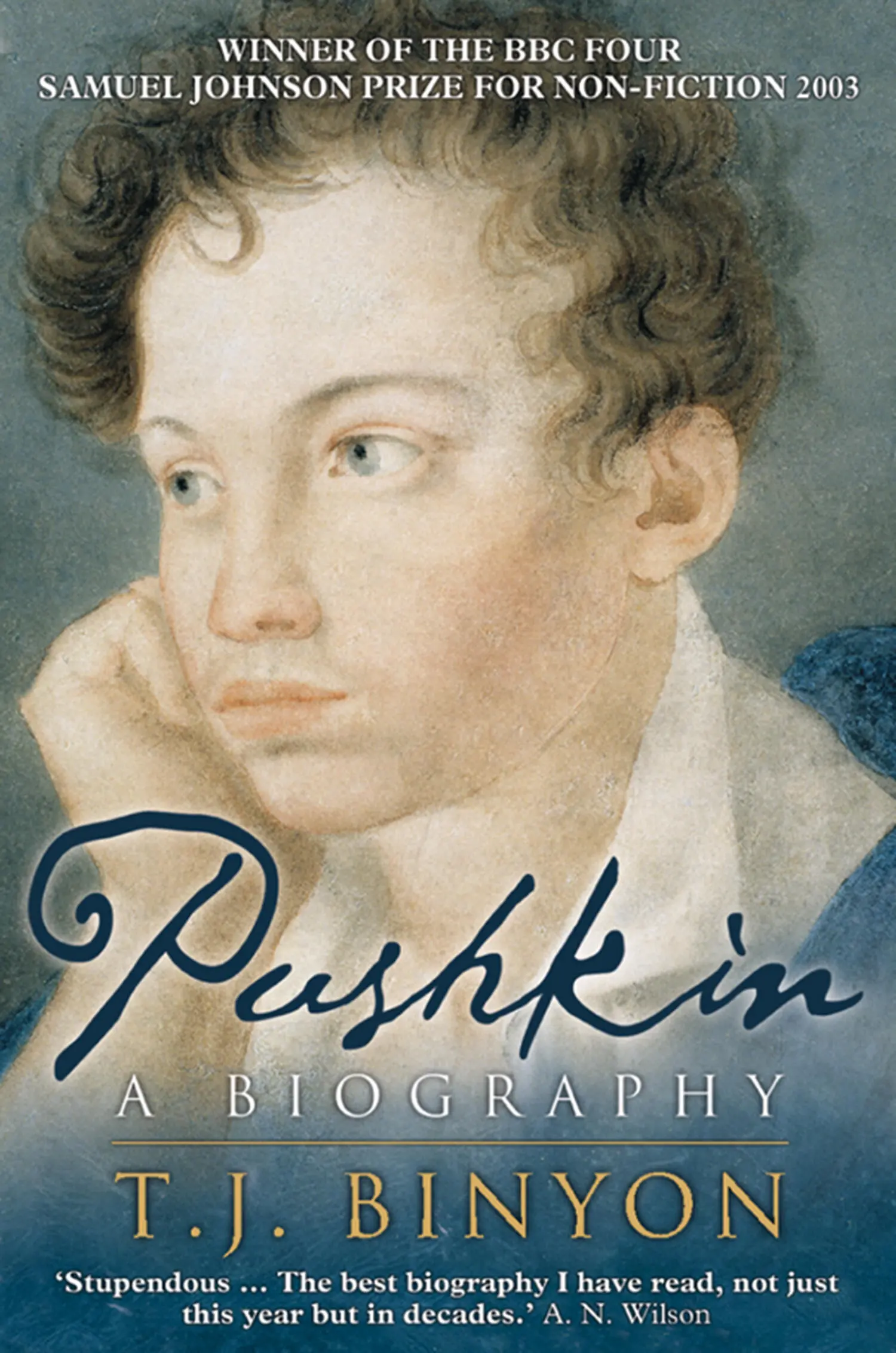
- Название:Pushkin
- Автор:
- Жанр:
- Год:неизвестен
- ISBN:нет данных
- Рейтинг книги:4 / 5. Голосов: 1
-
Избранное:Добавить в избранное
- Отзывы:
-
Ваша оценка:
Pushkin: краткое содержание, описание и аннотация
Предлагаем к чтению аннотацию, описание, краткое содержание или предисловие (зависит от того, что написал сам автор книги «Pushkin»). Если вы не нашли необходимую информацию о книге — напишите в комментариях, мы постараемся отыскать её.
Pushkin — читать онлайн ознакомительный отрывок
Ниже представлен текст книги, разбитый по страницам. Система сохранения места последней прочитанной страницы, позволяет с удобством читать онлайн бесплатно книгу «Pushkin», без необходимости каждый раз заново искать на чём Вы остановились. Поставьте закладку, и сможете в любой момент перейти на страницу, на которой закончили чтение.
Интервал:
Закладка:
Mikhailovskoe lay between the two other estates, just over two miles from Petrovskoe, and nearly six from Voskresenskoe. The manor house was built on the high wooded south bank of the Sorot, between Lake Kuchane and the much smaller Lake Malenets. It was a small â fifty-six feet by forty-five â single-storey wooden house on a stone foundation with an open porch before the front door. On either side, shaded by limes and maples, stood smaller buildings in the same style, on the left the bath-house, on the right the kitchen and servantsâ quarters. Two long, low buildings at right angles to the kitchen contained the estate office and lodgings for the bailiff and his family with a coach-house beyond; behind these lay the orchard. In front of the house was a circular lawn, surrounded by a path bordered with lilac and jasmine, the whole being enclosed by a fence with wicket gates. Behind the bath-house a steep path led to the Sorot. In front of the house, beyond the fence, lay the well-wooded park, divided in two by a wide linden alley down which ran the entrance drive. In the middle of the portion to the left stood a small summer-house from which radiated alleys of limes, birches and maples. Flower-beds, little artificial mounds topped with benches and ponds, small and large, were scattered here and there, and the boundary was marked by an avenue of birches.
By contemporary standards Mikhailovskoe was a small to modest estate: according to the census of 1816, some five thousand acres (1,863 desyatins) with 164 male serfs on the land and 23 attached to the household. In 1806, on Osipâs death, the estate had passed to Nadezhda. But the Pushkinsâ financial circumstances were hardly improved, since for several years thereafter the income of the estate had to be used to extinguish the large debts Osip had accumulated. Since Nadezhda had little taste for provincial life, her mother, Mariya Gannibal, having sold Zakharovo, had moved to Mikhailovskoe, taking with her the familyâs old nurse, Arina Rodionovna.
These two and a crowd of servants now greeted the Pushkins on their arrival: it was the first time that Pushkin had seen his grandmother since parting from her six years before to go to the Lycée. The district, very different from the countryside around Moscow or St Petersburg, was completely new to him. He wandered round the park, with its âpond in the shadow of thick willows,/Playground for ducklingsâ, 11 and stood on the heights above the Sorot, looking over
the azure levels of two lakes,
Where sometimes gleams the fishermanâs white sail,
Behind them a ridge of hills and striped cornfields,
Scattered huts in the distance,
On the moist banks wandering herds,
Smoking drying-barns and winged windmills ⦠12
âI remember how happy I was with village life, Russian baths, strawberries and so on, but all this did not please me for long. I loved and still love noise and crowds.â 13 The district certainly lacked metropolitan bustle; Voskresenskoe, inhabited by his great-aunt and a swarm of cousins, was a poor substitute. Dancing there one evening, Pushkin fell into a quarrel with his cousin Semen when the latter cut him out in a figure of the cotillion with a Miss Loshakova, âwith whom, despite her ugliness and false teeth, Aleksandr Sergeevich had fallen head over heels in loveâ. 14
The most congenial local society was to be found at Trigorskoe, an estate some two miles from Mikhailovskoe, reached by a path along the bank of the Sorot. Here lived Praskovya Osipova, an attractive thirty-six year-old, together with the five children from her first marriage to Nikolay Vulf: the eighteen-year-old Annette, Aleksey, Mikhail, Evpraksiya (known as Zizi) and Valerian, respectively twelve, nine, eight and five; and Aleksandra, the nine-year-old daughter of her second husband, Ivan Osipov. The Osipovs were not provincial philistines, but a cultured family. Praskovyaâs father, Aleksandr Vyndomsky, had collected a large library, had corresponded with Novikov, imprisoned for his writings by Catherine II, and had subscribed to Moscow and St Petersburg literary journals, one of which had even printed his poem âThe Prayer of a Repentant Sinnerâ. Pushkinâs acquaintance with the family was the most significant event of the visit: on 17 August, just before leaving, he wrote, in the only lyric produced during his stay,
Farewell, Trigorskoe, where joy
So often was encountered!
Did I discover your sweetness
Only in order to leave you for ever?
From you I take memories,
To you I leave my heart. 15
When Vasily Pushkin had brought his nephew to St Petersburg in 1811, he was engaged in a polemic with Admiral Shishkov, leader of the conservative, or Archaist group of Russian writers. Opposed to this were the more liberal modernists, whose centre was Karamzin. In March 1811 Shishkov had founded the Symposium of Amateurs of the Russian Word , a society whose purpose was to defend âclassicalâ forms of Russian against foreign infection. The writers of both factions directed at each other a continual cross-fire of articles and reviews, enlivened by satirical jibes. If the dramatist Prince Shakhovskoy poked fun at Karamzinâs sentimentalism in the one-act comedy A New Sterne (1805), in Vasilyâs A Dangerous Neighbour admirers of the princeâs dramatic talents were discovered among the strumpets in a brothel.
On 23 September 1815 several of the younger group â Dmitry Bludov, Dmitry Dashkov, Stepan Zhikharev, Filipp Wiegel, Aleksandr Turgenev and Zhukovsky â attended the première of Shakhovskoyâs new comedy, The Lipetsk Waters; or, A Lesson for Coquettes at the Bolshoy Theatre. Zhukovskyâs companions were soon embarrassed to discover that Shakhovskoy âin the poet Fialkin, a miserable swain, whom all scorned, and who bent himself double before all, intended to represent the noble modesty of Zhukovsky; [â¦] One can imagine the situation of poor Zhukovsky, on whom numerous immodest glances were turned! One can imagine the astonishment and indignation of his friends, seated around him! A gauntlet had been thrown down; Bludov and Dashkov, still ebullient with youth, hastened to pick it up.â 16 Bludovâs reply was a wretchedly unfunny lampoon directed at Shakhovskoy, A Vision in some Tavern, published by the Society of Learned People. * This purported to have taken place in the little provincial town of Arzamas. The idea that a learned society, dedicated to literature, could exist in such a sleepy backwater famous only for its geese amused Bludovâs friends, and led in October to the foundation of the Arzamas Society of Unknown People.
From the beginning Arzamas was an elaborate joke, a parody of the solemn proceedings of the Symposium of Amateurs of the Russian Word. These took place in the huge hall of Derzhavinâs house on the Fontanka, when âthe members sat at tables in the centre, around them were armchairs for the most honoured guests, and round the walls in three tiers was well-arranged seating for other visitors, admitted by ticket. To add greater lustre to these gatherings, the fair sex appeared in ball-gowns, ladies-in-waiting wore their royal miniatures, * grandees and generals their ribbons and stars, and all their full-dress uniform.â 17 The lively facetiousness of Arzamas could hardly have been more different. The meetings took place on Thursday evenings, usually at the home of one of the two married members â Bludovâs on the Nevsky Prospect or Sergey Uvarovâs in Malaya Morskaya Street. Each member had been given a name taken from one of Zhukovskyâs ballads. The president for the evening wore a Jacobin red cap; the proceedings were conducted in a parodic imitation of the high style employed at the Symposium and invariably ended with the consumption of an Arzamas goose. Vyazemsky and Batyushkov soon joined; and when Vasily Pushkin â at fifty-one, the oldest of the group â was elected in March 1816, advantage was taken of his good-natured credulity to stage a parody of Masonic initiation rites, an immensely long mummery which concluded with Vasily shooting an arrow into the heart of a dummy representing the bad taste of the Shishkovites. â This set the tone for his position in Arzamas : he became the internal butt for its membersâ jokes, as members of the Symposium were the external. Having dallied at a cake-shop, he arrived late at the next meeting, to be greeted with a flood of facetious speeches and resolutions; but, forgiven, he was made the societyâs elder with various privileges, including that of having âat Arzamas suppers a special goose roasted for him alone, which, at his choice, he may either consume entirely, or, having consumed a portion, may take the rest homeâ. 18
Читать дальшеИнтервал:
Закладка:
Похожие книги на «Pushkin»
Представляем Вашему вниманию похожие книги на «Pushkin» списком для выбора. Мы отобрали схожую по названию и смыслу литературу в надежде предоставить читателям больше вариантов отыскать новые, интересные, ещё непрочитанные произведения.










Обсуждение, отзывы о книге «Pushkin» и просто собственные мнения читателей. Оставьте ваши комментарии, напишите, что Вы думаете о произведении, его смысле или главных героях. Укажите что конкретно понравилось, а что нет, и почему Вы так считаете.