T. Binyon - Pushkin
Здесь есть возможность читать онлайн «T. Binyon - Pushkin» — ознакомительный отрывок электронной книги совершенно бесплатно, а после прочтения отрывка купить полную версию. В некоторых случаях можно слушать аудио, скачать через торрент в формате fb2 и присутствует краткое содержание. Жанр: unrecognised, на английском языке. Описание произведения, (предисловие) а так же отзывы посетителей доступны на портале библиотеки ЛибКат.
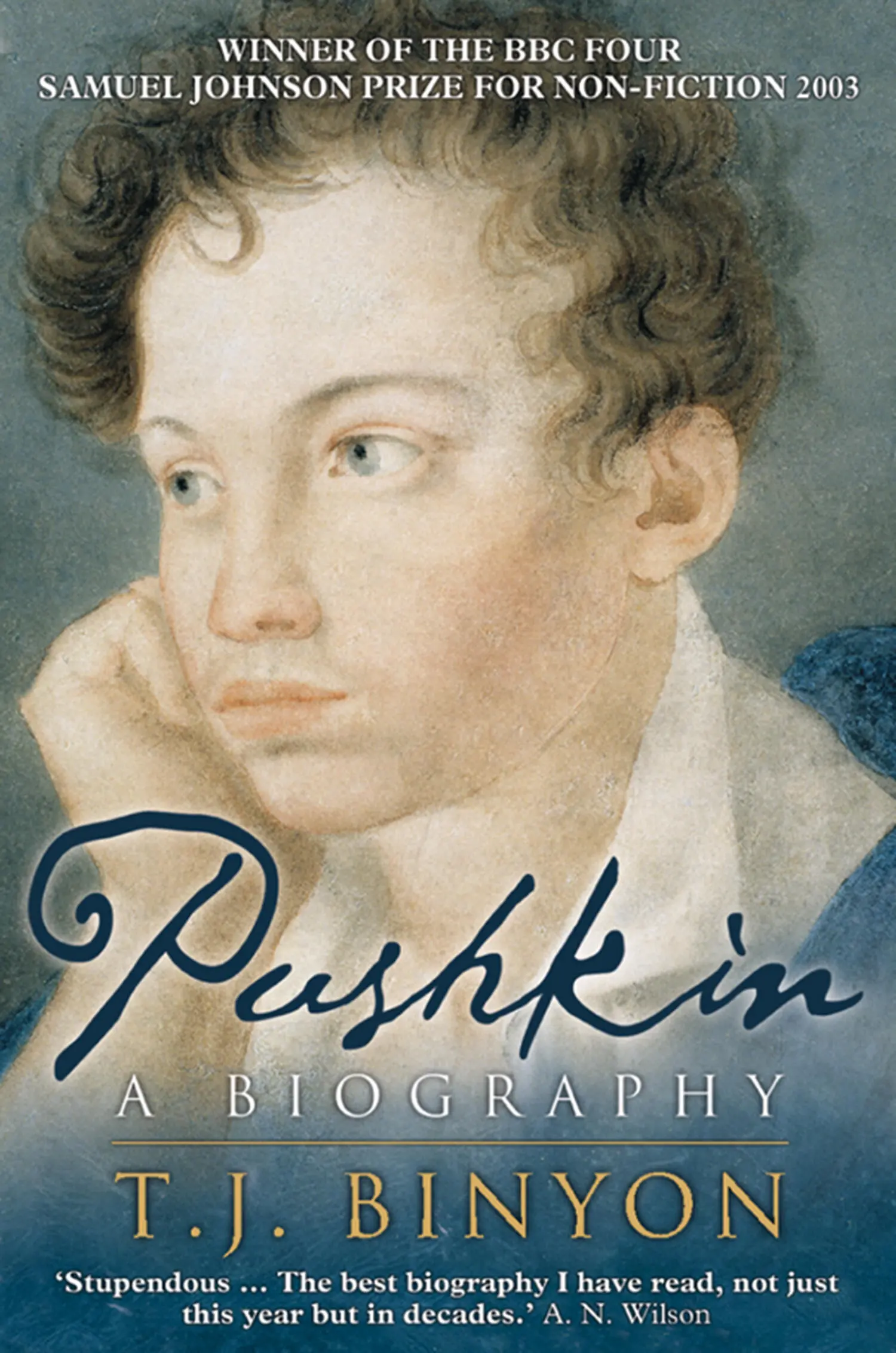
- Название:Pushkin
- Автор:
- Жанр:
- Год:неизвестен
- ISBN:нет данных
- Рейтинг книги:4 / 5. Голосов: 1
-
Избранное:Добавить в избранное
- Отзывы:
-
Ваша оценка:
Pushkin: краткое содержание, описание и аннотация
Предлагаем к чтению аннотацию, описание, краткое содержание или предисловие (зависит от того, что написал сам автор книги «Pushkin»). Если вы не нашли необходимую информацию о книге — напишите в комментариях, мы постараемся отыскать её.
Pushkin — читать онлайн ознакомительный отрывок
Ниже представлен текст книги, разбитый по страницам. Система сохранения места последней прочитанной страницы, позволяет с удобством читать онлайн бесплатно книгу «Pushkin», без необходимости каждый раз заново искать на чём Вы остановились. Поставьте закладку, и сможете в любой момент перейти на страницу, на которой закончили чтение.
Интервал:
Закладка:
a golden age of tranquillity will come,
Rust will cover the helms, and the tempered arrows,
Hidden in quivers, will forget their flight,
The happy villager, untroubled by stormy disaster,
Will drag across the field a plough sharpened by peace;
Flying vessels, winged by trade,
Will cut the free ocean with their keels;
and, occasionally, before âthe young sons of the martial Slavsâ, an old man will trace plans of battle in the dust with his crutch, and
With simple, free words of truth will bring to life
In his tales the glory of past years
And will, in tears, bless the good tsar. 38
The Pushkins had decided not to return to Moscow, four-fifths of which had been destroyed by the fire of 1812, but to move to St Petersburg. Nadezhda, with her surviving children, Olga and Lev (Mikhail, born in October 1811, had died the following year), arrived in the capital in the spring of 1814, and rented lodgings on the Fontanka, by the Kalinkin Bridge, in the house of Vice-Admiral Klokachev. When she and the children drove out to visit Pushkin at the beginning of April, it was the first time for more than two years that he had seen his mother, and nearly three years since he had last seen his brother and sister. Lev became a boarder at the Lycée preparatory school, and from now on Nadezhda, usually accompanied by Olga, came to Tsarskoe Selo almost every Sunday. In the autumn the family circle was completed by the arrival of Sergey, after a leisurely journey from Warsaw. His first visit to his sons was on 11 October. In the final school year Engelhardt relaxed the regulations and allowed lycéens whose families lived nearby to visit them at Christmas 1816 and at Easter 1817. Pushkin spent both holidays with his family.
âI began to write from the age of thirteen,â Pushkin once wrote. 39 The first known Lycée poem was written in the summer of 1813. From then on the school years were, in Goetheâs words, a time â Da sich ein Quell gedrängter Lieder/Ununterbrochen neu gebar â. * Impromptu verse sprang into being almost without conscious thought: Pushchin, recuperating in the sickbay, woke to find a quatrain scrawled on the board above his head:
Here lies a sick student â
His fate is inexorable!
Away with the medicine:
Loveâs disease is incurable! 40
Semen Esakov, walking one winterâs day in the park with Pushkin, was suddenly addressed:
Weâre left with the question
On the frozen watersâ bank:
âWill red-nosed Mademoiselle Schräder
Bring the sweet Velho girls here?â 41
Like other lycéens, the two were ardent admirers of Sophie and Josephine, the banker Joseph Velhoâs two beautiful daughters, whom they often met at the house of Velhoâs brother-in-law, Ludwig-Wilhelm Tepper de Ferguson, the Lycéeâs music teacher. Sophie was unattainable, however: she was Alexander Iâs mistress, and would meet him in the little, castle-like Babolovsky Palace, hidden in the depths of the park.
Beauty! Though ecstasy be enjoyed
In your arms by the Russian demi-god,
What comparison to your lot?
The whole world at his feet â here he at yours. 42
Not wishing to be outdone by Delvig, Pushkin sent one of his poems â âTo My Friend the Poetâ, addressed to Küchelbecker â anonymously to the Herald of Europe in March 1814. The next number of the journal contained a note from the editor, V.V. Izmailov, asking for the authorâs name, but promising not to reveal it. Pushkin complied with the request, and the poem, his first published piece, appeared in the journal in July over the signature Aleksandr N.k.sh.p.: âPushkinâ written backwards with the vowels omitted. While at the Lycée he was to publish four other poems in the Herald of Europe , five in the Northern Observer , one in the Son of the Fatherland , and eighteen in a new journal, the Russian Musaeum, or Journal of European News. The only poem published during the Lycée years without a pseudonym was âRecollections in Tsarskoe Seloâ, which appeared in the Russian Musaeum in April 1815 accompanied by an editorial note: âFor the conveyance of this gift we sincerely thank the relatives of this young poet, whose talent promises so much.â 43
Pushkin wrote this poem at the end of 1814, on a theme given to him by the classics teacher, Aleksandr Galich, for recital at the examination at the end of the junior course. Listing the memorials to Catherineâs victories in the Tsarskoe Selo park, he apostrophizes the glories of her age, hymned by Derzhavin, before describing the 1812 campaign and capitulation of Paris and paying a graceful tribute to Alexander the peace-maker, âworthy grandson of Catherineâ. In the final stanza he turns to Zhukovsky, whose famous patriotic poem, âA Bard in the Camp of Russian Warriorsâ, had been written immediately after the battle of Borodino, and calls upon him to follow this work with a paean to the recent victory:
Strike the gold harp!
So that again the harmonious voice may honour the Hero,
And the vibrant strings suffuse our hearts with fire,
And the young Warrior be impassioned and thrilled
By the verse of the martial Bard. 44
The examinations took place on Monday 4 and Friday 8 January 1815, before an audience of high state officials and relatives and friends of the lycéens. The seventy-one-year-old Derzhavin, the greatest poet of the preceding age, was invited to the second examination.
When we learnt that Derzhavin would be coming â Pushkin wrote â we all were excited. Delvig went out to the stairs to wait for him and to kiss his hand, the hand that had written âThe Waterfallâ. Derzhavin arrived. He came into the vestibule and Delvig heard him asking the porter: âWhere, fellow, is the privy here?â. This prosaic inquiry disenchanted Delvig, who changed his intention and returned to the hall. Delvig told me of this with surprising simplicity and gaiety. Derzhavin was very old. He was wearing a uniform coat and velveteen boots. Our examination greatly fatigued him. He sat, resting his head on his hand. His expression was senseless; his eyes were dull; his lip hung; his portrait (in which he is pictured in a nightcap and dressing-gown) is very lifelike. He dozed until the Russian literature examination began. Then he came to life, his eyes sparkled; he was completely transformed. Of course, his verses were being read, his verses were being analysed, his verses were being constantly praised. He listened with extraordinary animation. At last I was called out. I read my âRecollections in Tsarskoe Seloâ, standing two paces away from Derzhavin. I cannot describe the condition of my spirit: when I reached the line where I mention Derzhavinâs name, my adolescent voice broke, and my heart beat with intoxicating rapture â¦
I do not remember how I finished the recitation, do not remember whither I fled. Derzhavin was delighted; he called for me, wanted to embrace me ⦠There was a search for me, but I could not be found. 45
âRecollections in Tsarskoe Seloâ made, for the first time, Pushkin known as a poet beyond the walls of the Lycée; the promise it gave for the future was immediately recognized. âSoon,â Derzhavin told the young Sergey Aksakov, âa second Derzhavin will appear in the world: he is Pushkin, who in the Lycée has already outshone all writers.â 46 Pushkin sent a copy of the poem to his uncle; Vasily passed it on to Zhukovsky, who was soon reading it, with understandable enthusiasm, to his friends. Prince Petr Vyazemsky, a friend of Pushkinâs family, wrote to the poet Batyushkov: âWhat can you say about Sergey Lvovichâs son? Itâs all a miracle. His âRecollectionsâ have set my and Zhukovskyâs head in a whirl. What power, accuracy of expression, what a firm, masterly brush in description. May God give him health and learning and be of profit to him and sadness to us. The rascal will crush us all! Vasily Lvovich, however, is not giving up, and after his nephewâs verse, which he always reads in tears, never forgets to read his own, not realizing that in verse compared to the other it is now he who is the nephew.â 47 Vasily, unlike his fellow poets, was not totally convinced of Pushkinâs staying-power, remarking to a friend: â Mon cher , you know that I love Aleksandr; he is a poet, a poet in his soul; mais je ne sais pas, il est encore trop jeune, trop libre , and, really, I donât know when he will settle down, entre nous soit dit, comme nous autres .â 48
Читать дальшеИнтервал:
Закладка:
Похожие книги на «Pushkin»
Представляем Вашему вниманию похожие книги на «Pushkin» списком для выбора. Мы отобрали схожую по названию и смыслу литературу в надежде предоставить читателям больше вариантов отыскать новые, интересные, ещё непрочитанные произведения.







Обсуждение, отзывы о книге «Pushkin» и просто собственные мнения читателей. Оставьте ваши комментарии, напишите, что Вы думаете о произведении, его смысле или главных героях. Укажите что конкретно понравилось, а что нет, и почему Вы так считаете.