T. Binyon - Pushkin
Здесь есть возможность читать онлайн «T. Binyon - Pushkin» — ознакомительный отрывок электронной книги совершенно бесплатно, а после прочтения отрывка купить полную версию. В некоторых случаях можно слушать аудио, скачать через торрент в формате fb2 и присутствует краткое содержание. Жанр: unrecognised, на английском языке. Описание произведения, (предисловие) а так же отзывы посетителей доступны на портале библиотеки ЛибКат.
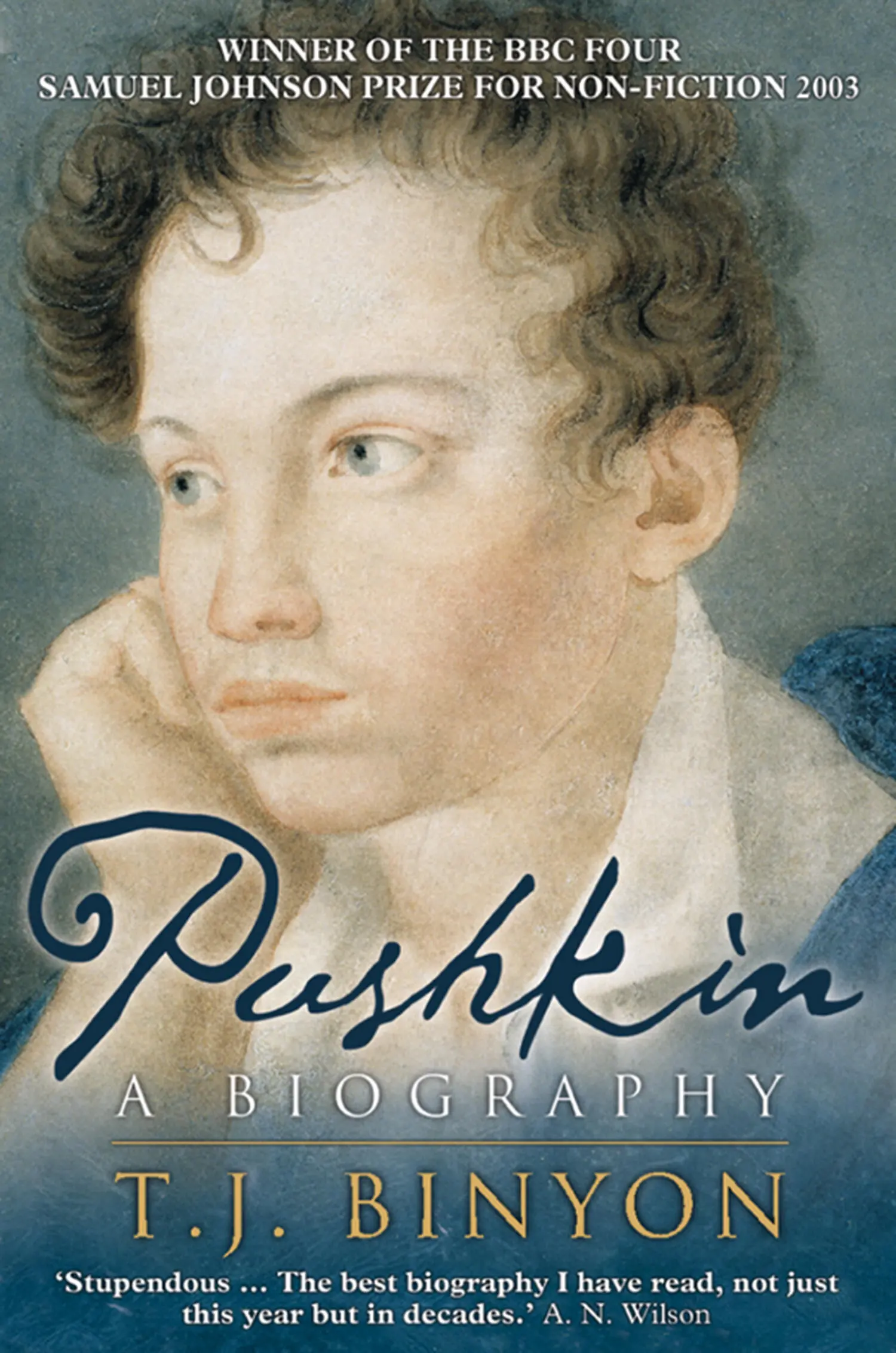
- Название:Pushkin
- Автор:
- Жанр:
- Год:неизвестен
- ISBN:нет данных
- Рейтинг книги:4 / 5. Голосов: 1
-
Избранное:Добавить в избранное
- Отзывы:
-
Ваша оценка:
Pushkin: краткое содержание, описание и аннотация
Предлагаем к чтению аннотацию, описание, краткое содержание или предисловие (зависит от того, что написал сам автор книги «Pushkin»). Если вы не нашли необходимую информацию о книге — напишите в комментариях, мы постараемся отыскать её.
Pushkin — читать онлайн ознакомительный отрывок
Ниже представлен текст книги, разбитый по страницам. Система сохранения места последней прочитанной страницы, позволяет с удобством читать онлайн бесплатно книгу «Pushkin», без необходимости каждый раз заново искать на чём Вы остановились. Поставьте закладку, и сможете в любой момент перейти на страницу, на которой закончили чтение.
Интервал:
Закладка:
The lycéens, thrown intimately together, isolated from outside influence, never leaving the Lycée from one yearâs end to the next, formed a close-knit society: indeed, they referred to themselves as âa nationâ, emphasizing their independence and unity. An extraordinarily strong esprit de corps bound the group together, persisting long after they had quitted the Lycée. For most, 19 October remained a significant anniversary throughout their lives. Pushkin had known little parental affection, and was now, in addition, cut off from his family: though his mother visited him in January 1812, he next saw her in April 1814, after the family had moved to St Petersburg. For him, more than for most of his companions, the Lycée nation became a replacement for the family. The bond was too strong for him to accept, as others did, Engelhardt as a surrogate parent.
Of his tutors only Aleksandr Kunitsyn, the young teacher of moral and political science whose speech had so impressed Alexander, had a lasting influence: his teachings on natural law, on the rights and obligations of the citizen, the relationship between the individual and society are reflected in Pushkinâs work. âHe created us, nourished our flame/He placed the cornerstone,/He lit the pure lamp,â 22 Pushkin wrote of him in 1825; and, sending him in January 1835 a copy of his History of the Pugachev Rebellion , inscribed it âTo Aleksandr Petrovich Kunitsyn from the Author as a token of deep respect and gratitudeâ. 23
Other than as a poet, he had an undistinguished school career. In November 1812 the academic and moral supervisor, Martyn Piletsky, wrote of him:
His talents are more brilliant than fundamental, his mind more ardent and subtle than deep. His application to study is moderate, as diligence has not yet become a virtue with him. Having read a great number of French books, often inappropriate to his age, he has filled his memory with many successful passages of famous authors; he is also reasonably well-read in Russian literature, and knows many fables and light verses. His knowledge is generally superficial, though he is gradually accustoming himself to a more thorough mode of thought. Pride and vanity, which can make him shy, a sensibility of heart, ardent outbursts of temper, frivolity and an especial volubility combined with wit are his chief qualities. At the same time his good-nature is evident; recognizing his weaknesses, he is willing, with some success, to accept advice [â¦] In his character generally there is neither constancy nor firmness. 24
The comments of the different subject teachers echo Piletskyâs assessment: âHis reasonable achievement is due more to talent than to diligenceâ; âvery lazy, inattentive and badly-behaved in the classâ; âempty-headed, frivolous, and inclined to temperâ. 25 In the list of pupils, ordered according to their deportment, which was drawn up at regular intervals, Pushkinâs place was invariably towards the bottom: twenty-third in 1812; twenty-fourth, twenty-eighth and twenty-sixth in the three following years. His best subjects at school were Russian literature, French literature and fencing. In the final examinations, taken in May 1817, he was judged âexcellentâ in those three subjects; âvery goodâ in Latin literature and state economics and finances; and âgoodâ in scripture and Biblical studies, in logic and moral philosophy, in natural, private and public law, and in Russian civil and criminal law. He had also studied, his graduation certificate noted, history, geography, statistics, mathematics and the German language.
Of the lycéens he was closest to Pushchin, Delvig, Küchelbecker, and Yakovlev. Pushchin was upright, honest, honourable; a hard-working, intelligent student; liked by all, yet, perhaps, a little imperceptive. His nickname was âtall Jeannotâ; Pushkin was known as âthe Frenchmanâ, for his proficiency in the language and encyclopaedic knowledge of the countryâs literature. * They are linked in a verse of one of the songs the lycéens composed about each other:
Tall Jeannot
Without knowing how
Makes a million bons mots,
While our Frenchman
Lauds his own taste
With a string of four-letter words. 26
Anton Delvig was plump, clumsy and phenomenally lazy. He was a very poor student, continually rebuked for his behaviour: âHe is rude in his manner, insolent in his speech, and so disobedient and obstinate as to ignore all admonitions and even to laugh when he is reprimanded.â 27 His only interest was Russian literature; he knew a mass of verse by heart. As with Pushkin, his talent for poetry blossomed at the Lycée. He was the first to appear in print, when a poem on the capture of Paris appeared in the Herald of Europe in June 1814. In one Lycée poem â one of the best he ever wrote â dedicated to Pushkin, he prophesies literary immortality for his friend:
Pushkin! Even in the forests he cannot hide himself,
His lyre will betray him with loud singing,
And from the mortals Apollo will carry away
The immortal to rejoicing Olympus. â 28
The third of the Lycéeâs poets was Wilhelm Küchelbecker, in some ways the strangest of all the pupils. Tall and very thin, he had had an attack of St Vitusâs Dance (Sydenhamâs chorea) in childhood, which had left him with a facial tic and deaf in one ear. Engelhardt wrote of him: âHe has read all the books in the world about all the subjects in the world; has much talent, much diligence, much good will, much heart and much feeling, but, alas, with all this he has no taste, tact, grace, moderation or clear aim. However, he is an honest, innocent soul, and the obstinacy he sometimes displays is only the result of a Quixotic honour and virtue with a considerable admixture of vanity.â 29 No other pupil was referred to so often in the lycéensâ songs, or had so many epigrams written about him. In general Küchelbecker bore the attacks stoically, but when Malinovsky threw a plate of soup over his head at dinner he had to be taken to the sickbay with a fever, escaped, and tried to drown himself in the lake. A cartoon in one of the magazines produced by the lycéens shows a boat-load of teachers fishing for him with a boat-hook. His passionate, impractical idealism manifested itself even in his views on literature, in which he preached the virtues of the eighteenth-century ode, of archaic language, and of the hexameter.
âCoarse, passionate, but appreciative, zealous, clean and very diligentâ: so reads a report on Mikhail Yakovlev. 30 A talented musician, who sang to the guitar, he set a number of Delvigâs and Pushkinâs works to music, both at the Lycée and later. At the Lycée, however, where his nickname was âthe clownâ, he was best known for his imitations. He had a huge repertoire of two hundred roles. They include, besides all the teachers and most of the pupils, Italian bears (no. 93), their attendants (no. 94), a samovar (no. 98), Russian bear attendants (no. 109), Alexander I (no. 129), a ship (no. 170) and a mad sergeant of hussars (no. 179). 31 Later, when Pushkin was living in Moscow, he asked a friend from St Petersburg what the subject of Yakovlevâs latest imitation was. âThe St Petersburg floodâ was the reply. âAnd howâs that?â âVery lifelike.â 32
The first three months of the Lycéeâs existence passed quietly; Alexander Iâs birthday was celebrated on 12 December; Volkhovsky was adjudged the best student of the term: his name, and that of Gorchakov (first in deportment), were inscribed in gold letters on a board which was put up in the school hall. Razumovsky ordered it to be taken down and informed Malinovsky that innovations of this kind were not to be introduced without his permission. The last week of the year was a holiday. By the beginning of 1812 war with France seemed imminent. In February and March the lycéens turned out to cheer the guards and army regiments passing through Tsarskoe Selo on their way south to join the Russian First Army in Vilna. Commander-in-chief of this army, and Minister of War, was Mikhail Barclay de Tolly, who was distantly related to Küchelbecker, and had been instrumental in securing a place for him at the Lycée.
Читать дальшеИнтервал:
Закладка:
Похожие книги на «Pushkin»
Представляем Вашему вниманию похожие книги на «Pushkin» списком для выбора. Мы отобрали схожую по названию и смыслу литературу в надежде предоставить читателям больше вариантов отыскать новые, интересные, ещё непрочитанные произведения.






Обсуждение, отзывы о книге «Pushkin» и просто собственные мнения читателей. Оставьте ваши комментарии, напишите, что Вы думаете о произведении, его смысле или главных героях. Укажите что конкретно понравилось, а что нет, и почему Вы так считаете.