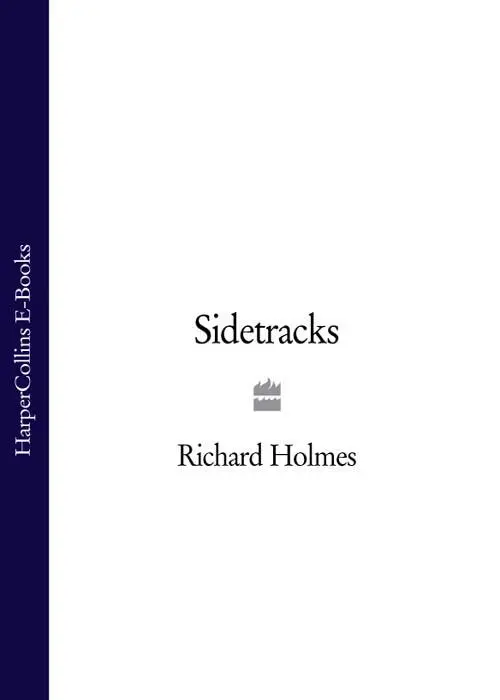
Richard Holmes - Sidetracks
Здесь есть возможность читать онлайн «Richard Holmes - Sidetracks» — ознакомительный отрывок электронной книги совершенно бесплатно, а после прочтения отрывка купить полную версию. В некоторых случаях можно слушать аудио, скачать через торрент в формате fb2 и присутствует краткое содержание. Жанр: unrecognised, на английском языке. Описание произведения, (предисловие) а так же отзывы посетителей доступны на портале библиотеки ЛибКат.
- Название:Sidetracks
- Автор:
- Жанр:
- Год:неизвестен
- ISBN:нет данных
- Рейтинг книги:5 / 5. Голосов: 1
-
Избранное:Добавить в избранное
- Отзывы:
-
Ваша оценка:
Sidetracks: краткое содержание, описание и аннотация
Предлагаем к чтению аннотацию, описание, краткое содержание или предисловие (зависит от того, что написал сам автор книги «Sidetracks»). Если вы не нашли необходимую информацию о книге — напишите в комментариях, мы постараемся отыскать её.
Sidetracks — читать онлайн ознакомительный отрывок
Ниже представлен текст книги, разбитый по страницам. Система сохранения места последней прочитанной страницы, позволяет с удобством читать онлайн бесплатно книгу «Sidetracks», без необходимости каждый раз заново искать на чём Вы остановились. Поставьте закладку, и сможете в любой момент перейти на страницу, на которой закончили чтение.
Интервал:
Закладка:
The childlike symbolism of all this reminds one of those endearingly familiar nursery-rhymes that once announced the terrors and tragedies of popular history, the ‘tishoos of plague, the cherrystones of murder. Pierrot’s origins are mysterious; yet everyone can lament his plight, the gentle distracted ami of the seventeenth-century air, ‘Au clair de la lune’ , the creature of laughter and sadness that we vaguely associate with Paris and unrequited love and the bittersweet light of the moon.
But who, in fact, was Pierrot, and why was he so unhappy? That simple question is one of the profound riddles of folk mythology, and the account that follows is merely one episode in what is perhaps an eternally recurring cycle in the human tragi-comedy. It concerns Jean-Gaspard Deburau, one of the legendary giants of the French Romantic theatre, and a figure almost as mysterious as the White Clown whom he rescued from three centuries of despised obscurity in the travelling fairgrounds and anonymous harlequinades of western Europe.
To begin at the beginning is impossible: but one may start with a birth. Deburau was born in Neukolin in 1796 and can correctly be called a Bohemian. The youngest member of a troupe of touring acrobats, he spent a rootless childhood crossing and recrossing a continent convulsed by Napoleonic dreams. Deburau’s father seems to have been an army deserter, a shrewd businessman and a bully; his mother seems to have died young, exhausted by privations; neither had definite nationality. Deburau grew up into a tall, loose-limbed boy, with a long melancholy face, taciturn and withdrawn, a clumsy acrobat and consequently the comic butt of his nimbler brothers and sisters.
There was something dreamy and elusively ambitious about him. A persistent legend tells of a visit to the Sultan’s palace in Constantinople, where the family troupe were commanded to perform in an apparently deserted hall, partitioned off at one end by a diaphanous curtain. For their finale, young Deburau was required to scamper to the top of a human pyramid: as he faltered on to his brother’s shoulders, he was magically rewarded by a glimpse beyond the softly undulating veil. He was looking down on a secret audience, the entire Sultan’s harem, a giddy vision of silks and jewels and curving flesh, forbidden to all mortal eyes on pain of death. He gazed, overbalanced, and fell.
The Deburau family seemed to have settled in Paris towards 1814, but it is not until 1822 that the father’s name first appears on a cast list of the new pantomime theatre, the Funambules. Young Deburau was employed as a buffoon, and revealed a hidden talent for elegant and sometimes savage mimicry. His emotional life remains hidden: the city archives show that at twenty-three he married a flower girl called Adelaide, for whom he bought dresses on credit at the local couturière, so we may perhaps assume that she was beautiful, and that he loved her. But three months later Adelaide died, in a tiny upper lodgings at the Hôtel Bouffiers. A surviving inventory shows a bed with a straw mattress, a round dining table with two flaps, and a chest of drawers with a marble top.
After seven more years of penurious existence, Deburau père died, the family troupe began to disperse, and one has the sense of a tyranny dissolving. For Deburau, then aged thirty, it was a moment of late blossoming. At last he was able to sign his own contract with the Funambules management, and he concluded a solid three-year agreement with a weekly salary of 35 francs, which was about four times what the musicians earned. He was engaged to play one named role only: that of Pierrot, the White Faced Clown. The contract was dated 10 December 1826.
Until this critical moment in theatrical history, the stock part of Pierrot had been minor and ill-defined. Pierrot was loosely evolved from a number of auxiliary clown figures in the Italian Commedia dell’Arte troupes of the sixteenth and seventeenth centuries. He was a figure of fun, rather than of distinction. Experts are inclined to disagree, but Pierrot’s ancestors have been variously identified with Pedrolino, the honest valet of Flaminio Scala’s plays; the wise peasant Bertoldo whose struggles with the Prince of Bologna were first written down by Giulio Croce in the 1570s; the all-purpose buffoon of the fairground show, Il Pagliaccio (Le Paillasse, Old Strawbags); the Giglio or Gilles of the Neapolitan commedia; and the French Fool Gros-Guillaume (Fat Willy) who played in front of Cardinal Richelieu with a face plastered with baker’s flour and two belts to restrain the catholicity of his belly, one above and one below.
Indeed, the ‘poor Pierrot’ whom Deburau inherited was so rich in ancestry that he was in effect perfectly illegitimate, a restless wanderer who sought his name in every city, a mongrel of the booths, a changeling outcast from the dignified family hierarchies of the traditional Commedia. He was quite simply the White Faced Clown, the enfariné, the Fool whose face is blanched – not with paint or wax – but with the homely naïveté of flour and water. In this single recurrent detail lies the probable foundation of his dramatic character and his earliest symbolism. The Clown with the face of flour seems to represent both servile bumpkin stupidity, and its opposite, an eternal peasant wisdom; he also stands for something of the natural fertility of the earth, as persistent and universal as wheat, from which comes both his greed and his amorousness (consider the appetites of Chaucer’s Miller). These traits give Pierrot’s most primitive psychology. It is essentially innocent.
By the eighteenth century the White-Faced Clown had established himself in supporting roles in many of the harlequinades in France, though the Italian Commedia itself had been banished from Paris in 1697 to protect the drama of Molière. The White Clown was a buffoon, valet, trickster and the eternally unsuccessful rival of Arlequin for the love of Columbine; and it is as ‘Gilles’ that he appears in the famous portrait by Watteau of 1721, executed in eight days as a billboard for the Théâtre de la Foire in Paris.
In a curious way, this painting is a premonition of Deburau. The White Clown stands forth in the parade, his limp arms dangling down his white casaque, his feet turned outwards, a proverb of naïveté. Yet he has become suddenly mysterious. Perhaps this is simply because it is one of Watteau’s very last works, with a consumptive glow of loss and transfiguration about it. But perhaps also, it is because Pierrot is suddenly without his mask of flour. From the ageless anonymity of the White Clown, a completely individual face now looks out, enigmatically, with a faint smile of greeting or mockery, the rims of the eyes and the nostrils slightly swollen and red, as if he had been weeping for some reason yet to be revealed. All this is of course a hundred years before Deburau himself stood forward to be judged.
It began (or began again) with a summer newspaper article by Charles Nodier in the Pandora of 1828, heralding with a certain donnish humour the great new Gilles or Pierrot at the Funambules Theatre, a ‘Satan naïf et bouffon’ , who needed nothing but a large bank account and a smart carriage to give him a Parisian vogue. Nodier rented a box for a year, and wrote a pantomime especially for Deburau, called appropriately enough Le Songe d’or, a dream of riches.
Nodier’s support was influential, for as the eccentric librarian of the Arsenal, and the intimate of Hugo and Sainte-Beuve, his flights of fancy were closely observed by Parisian intellectuals. Deburau and the pantomime soon gained a kind of cult following. The sharp young critic on the Journal des Débats, Jules Janin, headed it with a racy two-volume Histoire du Théâtre à Quatre Sous (1832), proclaiming the classical theatre dead and wildly panegyrizing the Funambules. It was complete with commissioned portraits of Deburau, and a fictionalized account of his early career, including a discussion supposed to have been held with Napoleon before Waterloo on the problems of French drama; and a lawsuit against the theatre management involving an impious toadstool said to have sprouted in the great clown’s dressing-room.
Читать дальшеИнтервал:
Закладка:
Похожие книги на «Sidetracks»
Представляем Вашему вниманию похожие книги на «Sidetracks» списком для выбора. Мы отобрали схожую по названию и смыслу литературу в надежде предоставить читателям больше вариантов отыскать новые, интересные, ещё непрочитанные произведения.











Обсуждение, отзывы о книге «Sidetracks» и просто собственные мнения читателей. Оставьте ваши комментарии, напишите, что Вы думаете о произведении, его смысле или главных героях. Укажите что конкретно понравилось, а что нет, и почему Вы так считаете.