Richard Holmes - Sidetracks
Здесь есть возможность читать онлайн «Richard Holmes - Sidetracks» — ознакомительный отрывок электронной книги совершенно бесплатно, а после прочтения отрывка купить полную версию. В некоторых случаях можно слушать аудио, скачать через торрент в формате fb2 и присутствует краткое содержание. Жанр: unrecognised, на английском языке. Описание произведения, (предисловие) а так же отзывы посетителей доступны на портале библиотеки ЛибКат.
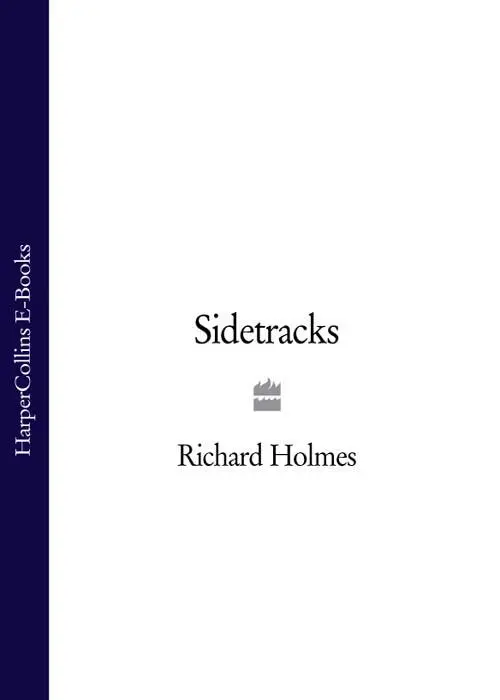
- Название:Sidetracks
- Автор:
- Жанр:
- Год:неизвестен
- ISBN:нет данных
- Рейтинг книги:5 / 5. Голосов: 1
-
Избранное:Добавить в избранное
- Отзывы:
-
Ваша оценка:
Sidetracks: краткое содержание, описание и аннотация
Предлагаем к чтению аннотацию, описание, краткое содержание или предисловие (зависит от того, что написал сам автор книги «Sidetracks»). Если вы не нашли необходимую информацию о книге — напишите в комментариях, мы постараемся отыскать её.
Sidetracks — читать онлайн ознакомительный отрывок
Ниже представлен текст книги, разбитый по страницам. Система сохранения места последней прочитанной страницы, позволяет с удобством читать онлайн бесплатно книгу «Sidetracks», без необходимости каждый раз заново искать на чём Вы остановились. Поставьте закладку, и сможете в любой момент перейти на страницу, на которой закончили чтение.
Интервал:
Закладка:
Moreover, Gautier was acutely conscious of the curiously modern desperation, almost the death-wish, implicit in this passionate longing for other shores, other climes, the other itself. Many of his springtime feuilletons each year played upon this theme with deliberate irony, heralding the age of mass tourism in a distinctly minor key:
‘Nowadays the dream of the masses is – Speed. By iron or steam they seek to conquer that “ancient weight upon all things suspended”. It would seem that their sole concern is to devour Space. Do they do 12 or 15 leagues an hour simply to flee from ennui? If so, the enemy awaits them at the farther platform. Yet how strange is this wild urge for rapid locomotion, seizing people of all nations at the same instant. “The dead go swiftly”, says the ballad. Are we dead then? Or could this be some presentiment of the approaching doom of our planet, possessing us to multiply the means of communication so we may travel over its entire surface in the little time left to us?’ It feels odd to read this paragraph on the faint, blue microfilms for La Presse of 1843.
Yet Gautier’s journeys to London, while part of this lifelong centrifugal urge, seem to have been of a different order. His notes have remained scattered through a score of essays, letters, articles, poems and reviews. London was less a place to visit, than a state of mind to ponder upon. It was a dark mirror, a smoky crystal ball. You could turn it in your hand. Gautier remained profoundly uninterested in its institutions, its monuments, even its literary associations. Rather, it was its atmosphere, its tone, its iridescent qualities, its curious undercurrent of black comedy, which continually drew him back.
On his second visit he summoned an English barber to his rooms at the Hotel Sablonniere, in Leicester Square. His ballet La Péri, with his untouchable amour Carlotta Grisi dancing the title role, was playing at the Theatre Royal, Drury Lane. He was due at the Lord Mayor’s procession and banquet. He needed a shave. The barber knocked, entered, bowed: a thin man with the English whiteness of jowl, dressed entirely in black. In complete silence, with the flowing rapidity of a phantom, he shook out a crisp, white apron, adjusted a chair, and stropped a long razor. Gautier grew increasingly uneasy at each stroke, a victim of those unspeakable suspicions that separate native from foreigner, living from dead.
‘Seeing him so chill, so pale, so mournful, I asked myself if he were not some ill-provisioned resurrectionist who wished to acquire a new subject. At the same time, I instinctively cast my eyes upon that part of the floorboards where my chair rested, anxious to ascertain whether or no there was a hidden trap door through which I should plunge into the cellar bearing a large slit in my throat.’ On the point of calling off the whole operation, Gautier was saved by the inherited logic of Pascal and Voltaire. ‘I made the calming reflexion that, since I was lodged upon the second floor of the hotel, there could hardly be a cellarage beneath my parquet, and that a trap door in opening would make me fall to the first floor, depositing me exactly on top of the pianoforte of an extremely pretty young opera-singer.’ The jolie cantatrice was Ernesta, who subsequently bore Gautier twin daughters. So the English barber was possibly a better Figaro than Gautier concluded at the time.
At Drury Lane, Gautier made extensive notations on the flesh tones of the English girls in the audience. No native painter had ever done justice to their exquisiteness, Gautier felt, except possibly Sir Thomas Lawrence, who could be held ultimately responsible for the creation of the English Rose type, the bloom of a thousand keepsakes, whose torn and treasured leaves were pinned across the dressing-rooms of Europe. A connoisseur of textures, Gautier distinguished sharply between the opulent blonde and the tea-rose blonde, and gazed appreciatively at the complexion of cheek, neck and gorge, which made ‘rice-paper, or the pulpy petal of the magnolia, or the inner pellicle of the egg, or the vellum on which the gothic miniaturists traced their delicate illuminations’ look like coarse cloth by comparison. Yet the genial English passion for decorative gardens, when carried in all its stunning completeness of fruit trees, herbaceous borders and cockle shells, to the top of the English lady’s hat, left him merely stoical.
In the middle of the ballet, Carlotta was required to perform a daring leap in the pas de songe, representing the descent of the péri from the heavenly sphere. It called for the greatest agility and nerve on her part, and perfect timing from her partner Petipa, whose task was to receive her bodily presence on the earth beneath. Occasionally, in Paris, this saute de gazelle had been muffed, and the French audiences, recalled Gautier, had hissed without mercy. At the third performance in London, Carlotta once more misjudged the dangerous jump. As she prepared for another attempt, a ripple ran through the English audience, and murmurs from the stalls were heard begging her not to risk such a frightful plunge a second time. Then a sympathetic voice, from the gods, loudly suggested that it would be better to give Petipa ‘a stiff drink’ first, as he could scarcely ‘stand up on his pins’. Amidst a profound stillness, Carlotta leapt into space, Petipa fielded sinuously, and the house sprang to its feet and gave them three cheers.
But then the English were different in sporting matters. Boats and horses alone really brought out their enthusiasm. There were even moments suggesting lyrical depths, as on the day’s outing at Royal Ascot. Clutching his Oxley’s Authentic Racing Card – which with Robinson Crusoe and the Mansion House menu, was one of the few British texts Gautier ever claimed to have read in the original – he stared round him with calm satisfaction at the scene. There were lawns of ‘vegetable velvet’, ladies with shot-silk dresses and fringed parasols, champagne and Scotch Ale corks flying into the cerulean blue, gypsies dancing round the carriage wheels telling endlessly optimistic fortunes. In the distance, over the undulations of emerald turf, the ‘cherry-red horses ran’. At the far turn, the brightly coloured silks of the jockeys’ caps were ‘like poppies, cornflowers and anemones carried away on the wind’. At the close of each race, the winner stood steaming peacefully in the Royal Enclosure, and a cluster of white pigeons were released into the sky like a shout of purest joy.
It was only later that Gautier learnt that the pigeons simply carried the listings of the betting odds and results to a hundred murky gambling parlours across the nation, which sufficed to transform the occasion into a rather more utilitarian event, ‘a roulette or a Stock Exchange’.
After the mixed triumphs of La Péri, six years elapsed before Gautier next slipped across the Channel. Though his friend’s Tunnel was still inexplicably incomplete, the years of middle age had brought increased travelling comforts. The Chemin de Fer du Nord already ran as far as Rouen, and together with the regular steam packet services, and the celebrated express from Dover, this combined to bring the two capitals within a single day of each other. By the spring of 1849, after nine months of almost continuous political upheavals in Paris, Gautier was already restive for London’s paradoxes and gloomy, introspective charm. His feuilleton of 21 May complained of not being able to take advantage of a newly created package tour, which for 175 francs transported you, housed you, took you on guided tours round the Court, the museums, Richmond, Hampton Court Palace, Greenwich, and even brought you back ‘with all intelligence and care’.
Читать дальшеИнтервал:
Закладка:
Похожие книги на «Sidetracks»
Представляем Вашему вниманию похожие книги на «Sidetracks» списком для выбора. Мы отобрали схожую по названию и смыслу литературу в надежде предоставить читателям больше вариантов отыскать новые, интересные, ещё непрочитанные произведения.










Обсуждение, отзывы о книге «Sidetracks» и просто собственные мнения читателей. Оставьте ваши комментарии, напишите, что Вы думаете о произведении, его смысле или главных героях. Укажите что конкретно понравилось, а что нет, и почему Вы так считаете.