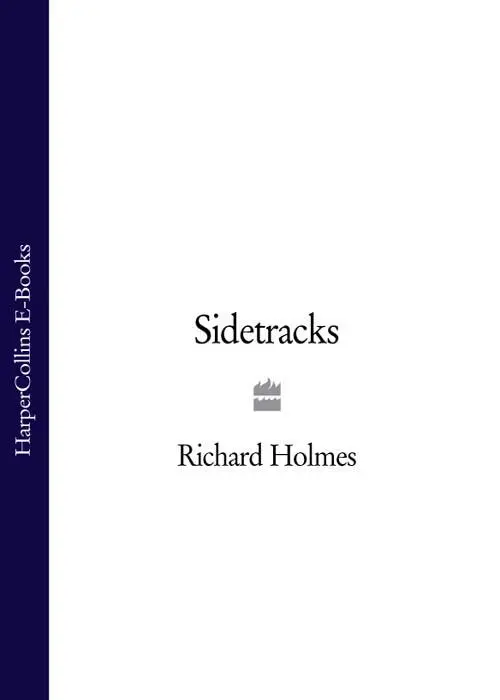
Richard Holmes - Sidetracks
Здесь есть возможность читать онлайн «Richard Holmes - Sidetracks» — ознакомительный отрывок электронной книги совершенно бесплатно, а после прочтения отрывка купить полную версию. В некоторых случаях можно слушать аудио, скачать через торрент в формате fb2 и присутствует краткое содержание. Жанр: unrecognised, на английском языке. Описание произведения, (предисловие) а так же отзывы посетителей доступны на портале библиотеки ЛибКат.
- Название:Sidetracks
- Автор:
- Жанр:
- Год:неизвестен
- ISBN:нет данных
- Рейтинг книги:5 / 5. Голосов: 1
-
Избранное:Добавить в избранное
- Отзывы:
-
Ваша оценка:
Sidetracks: краткое содержание, описание и аннотация
Предлагаем к чтению аннотацию, описание, краткое содержание или предисловие (зависит от того, что написал сам автор книги «Sidetracks»). Если вы не нашли необходимую информацию о книге — напишите в комментариях, мы постараемся отыскать её.
Sidetracks — читать онлайн ознакомительный отрывок
Ниже представлен текст книги, разбитый по страницам. Система сохранения места последней прочитанной страницы, позволяет с удобством читать онлайн бесплатно книгу «Sidetracks», без необходимости каждый раз заново искать на чём Вы остановились. Поставьте закладку, и сможете в любой момент перейти на страницу, на которой закончили чтение.
Интервал:
Закладка:
A month later, his column began mysteriously. ‘In this unhappy week of cholera and insurrection which has just gone by, the theatres of Paris have played nothing. The announcement of some major performance would have brought us back in the twinkling of an eye, despite pestilence and politics: for it is on such evil days that Art has need of all its supporters. But the thunder in the street makes the Muses fall silent, and we would have had nothing to do at our post. So we have profited from this sad congé by accomplishing a voyage to China, no less than the intrepid MacCarthy or Monsieur de Langrenée. This voyage cost us two hours and two shillings.’
This unexpectedly exotic expedition turned out to have been a visit by the ferry from Hungerford Bridge to a Chinese junk moored at St Katharine’s Dock. It brought Gautier a new sense of the equivocations of Progress and Empire, almost, very distantly, a sense of menace. Below decks on the junk, he listened distractedly to a Chinese orchestra, with four young men in dark blue silken smocks and pigtails, playing a melancholy composition on drums, gongs, violins and tambourines. Around them the cabin was cluttered with ornate, open-work ivory boxes, porcelain pots and huge grotesque mandrake roots, twisted into fantastical shapes. Gautier meditated on a pile of Chinese coffins in a dark corner, each hewn out of a single log, and painted a glistening vermilion, ‘stacked there, no doubt, for the benefit of the crew in case of cholera or nostalgia’. He was thoughtful. ‘When a concert is finished, one replaces the instrument in its case: when a life is finished, one slips the man into his coffin: and the rest is silence … But why do violins have cases that resemble the bier? Is it because they have souls and voices, and groan like us?’
Returning on deck, under the leaden sky of London, Gautier gazed curiously at a large lacquer cabinet fitted under the poop of the junk which was carved like some gigantic dream-bird. The cabinet formed an open shrine for Buddhist worship, and in it three golden figurines representing the Chinese trinity. In front of them, coloured spills, jossticks and aromatic tapers sent their sweet oriental perfumes drifting heavily over the dark waters of the Thames.
Perhaps, thought Gautier, the traditional piety of the Chinese crew had not been dissolved ‘by contact with the sceptical barbarians …’ He bent down and peered closely at the little, squat buddhas, miniature replicas of the mighty idols he had earlier seen on display at an antiquarian collection in Hyde Park. He studied their impenetrable good humour … ‘but as for the gods themselves, those circumflex eyebrows, those equivocal smiles, and those gross little bellies, all express an attitude towards the worshipper that is ironic, and even irreverent. The devotee does not lack faith; but it seems that the idol itself lacks conviction. Perhaps all religions will come to an end through the agnosticism of their gods.’
It was a foretaste of a sensation he was to have on one of his last visits, in 1851, as he wandered through the imperial splendours of the Great Exhibition at the Crystal Palace. Dazzled by the endless displays of jewelled armaments, exotic plants, stuffed elephants, priceless fabrics, and amorous potions of liquid pearl, he yet remained inexplicably unexalted, doubtful. What he finally remembered was a barred compartment containing several imprisoned Thuggees, the religious stranglers of Durga, the ‘monsterous wife of Shiva, god of destruction’. These men were sullenly engaged in weaving an immense carpet, ‘of evidently European design … with a greyish background spotted with black and red ornaments resembling burns and badly cleaned bloodstains. Its appearance was infinitely sinister and funereal. (Indeed it was as ugly as a home-made English carpet.) What torture it must have been for those poor Thugs, instinctive lovers of beautiful patterns and harmonious colours, to sit weaving this abominable tapestry of expiation!’ This was the picture that stayed in his mind, from all that palace of wonders. This, and the massive pistons and flywheels of the engineering displays.
Yet in the midst of these later trips, with their thickening associations and suggestions, fell a bright shaft. For London unexpectedly and generously provided Gautier with the last great romance of his life, in the elegant shape of a very pretty Italian widow whom he encountered in Bond Street. Marie Mattei had adopted a smart, fast, modern English style, wore charming white waistcoats, rolled her own cigarettes in ‘papelitos’, sucked peppermints and sipped tea, as Gautier fondly recorded in his sonnets. He rapidly made her his mistress, and back in Montmartre she transformed his ‘small red bed with its spiral bedposts’ into a paradise of sexual blue. And there, with a touch of the renowned English coolness in the heat of battle
… quand le plaisir a brisé nos forces,
Nonchalant entr’acte à la volupté,
Nous fumons tous deux en prenant le thé.
But passion, like all things – except perhaps the art that recorded it – was transitory, no permanent gift. As Gautier grew old, and Paris closed round them like a familiar shawl, there came back the memory of the English Sunday, that Feast of Limbo, when shops and pubs and theatres closed, streets were deserted, and everyone seemed to flee the city by boat or coach or charabanc, until it was like a place of the dead, ‘one of those cities peopled by inhabitants who have turned to stone, as Eastern Tales relate’. It haunted him, that vision of melancholy exuding from the very walls, and he wrote wryly: ‘At such times one longed to have a little portable chemist’s outfit, consisting of opium, prussic acid, and acetate of morphine. The thought of suicide is born in the most resolute heart; it is not prudent to fiddle with your pistols or to lean over the balustrades of the bridges … There is but one recourse, to make oneself abominably drunk, to fill one’s stomach with a blazing sunset of rum-punch … but you have to be English for that.’
On those days the only serious British activity seemed to be attending funerals. But the London cemetery, so icy, stark, flowerless and abandoned, with its low graves retaining ‘like mummies, sarcophagi with a vague appearance of the human corpse’ filled him with nothing but lugubrious imaginings, and gave him only an intense desire to remain alive. He turned the dark shape in his hand. But then, finally, was one not a Parisian? He pulled upon a fresh cigar, and stroked the receptive fur of an attendant cat. He thought of the baroque magnificence of the cemetery of Père Lachaise, the swept alleys, the carved chapels, the bright wreaths of blossom. ‘How can the English, a nation so absolutely wedded to “home and comfort”, how can the English resign themselves to being so dreadfully ill at ease in the next world?’
POOR PIERROT
IF YOU ENCOUNTERED PIERROT in Paris today, he would seem innocent enough, quite innocent. Besides, it would probably be in a children’s toyshop. In the Passage Jouffroy, for example, one of those high melancholy ironwork arcades off the boulevard Montmartre, much frequented by Gérard de Nerval in the long autumn days before his suicide, there is a spacious old-fashioned boutique stuffed with cardboard theatres, packs of Petits Metamorphoses, Second Empire dolls’ house furniture, musical boxes that play Chopin – and Pierrots, dozens of them.
There are Pierrot dolls, Pierrot marionettes, Pierrot paperweights, Pierrot glove-puppets, Pierrot mannikins, Pierrot pipe-cleaners, and Pierrot pantins with flat cardboard limbs linked up with string and brass eyelets, and strangely blank on their reverse sides as if their souls had somehow been misplaced. All of them conform religiously to the same uniform: loose white smock and cap, and austerely blanched face that stares back at you with weird intensity. At a distance, perched there in the arcade window, they look like a flock of fantail pigeons in mourning; close to, they are somewhere between clowns and purgatorial spirits.
Читать дальшеИнтервал:
Закладка:
Похожие книги на «Sidetracks»
Представляем Вашему вниманию похожие книги на «Sidetracks» списком для выбора. Мы отобрали схожую по названию и смыслу литературу в надежде предоставить читателям больше вариантов отыскать новые, интересные, ещё непрочитанные произведения.











Обсуждение, отзывы о книге «Sidetracks» и просто собственные мнения читателей. Оставьте ваши комментарии, напишите, что Вы думаете о произведении, его смысле или главных героях. Укажите что конкретно понравилось, а что нет, и почему Вы так считаете.