Iain Finlayson - Browning
Здесь есть возможность читать онлайн «Iain Finlayson - Browning» — ознакомительный отрывок электронной книги совершенно бесплатно, а после прочтения отрывка купить полную версию. В некоторых случаях можно слушать аудио, скачать через торрент в формате fb2 и присутствует краткое содержание. Жанр: unrecognised, на английском языке. Описание произведения, (предисловие) а так же отзывы посетителей доступны на портале библиотеки ЛибКат.
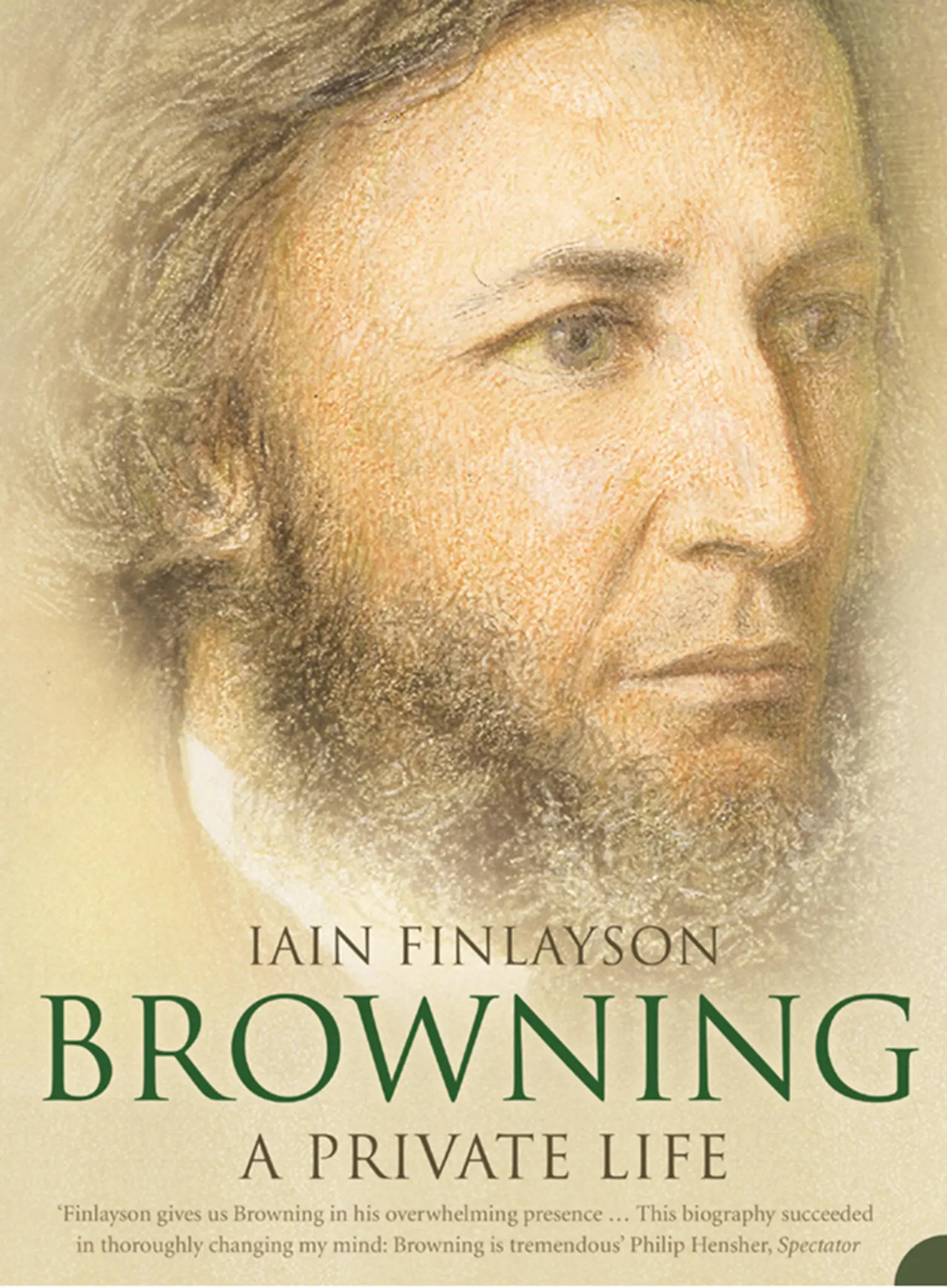
- Название:Browning
- Автор:
- Жанр:
- Год:неизвестен
- ISBN:нет данных
- Рейтинг книги:5 / 5. Голосов: 1
-
Избранное:Добавить в избранное
- Отзывы:
-
Ваша оценка:
Browning: краткое содержание, описание и аннотация
Предлагаем к чтению аннотацию, описание, краткое содержание или предисловие (зависит от того, что написал сам автор книги «Browning»). Если вы не нашли необходимую информацию о книге — напишите в комментариях, мы постараемся отыскать её.
Browning — читать онлайн ознакомительный отрывок
Ниже представлен текст книги, разбитый по страницам. Система сохранения места последней прочитанной страницы, позволяет с удобством читать онлайн бесплатно книгу «Browning», без необходимости каждый раз заново искать на чём Вы остановились. Поставьте закладку, и сможете в любой момент перейти на страницу, на которой закончили чтение.
Интервал:
Закладка:
Robert had rescued the hapless Andromeda from his father’s portfolio, from insalubrious company, and adopted her as his principal muse. Much has been made of this engraving after the painting Perseus et Andromede by Caravaggio di Polidoro—‘my noble Polidori’—which hung in Robert’s room. Elizabeth naturally becomes identified with the captive Andromeda and Robert with her saviour, Perseus. Critics have had no difficulty tracing the powerful emblematic influence of Andromeda and the myth in which she figures throughout Robert’s work. Put shortly, Andromeda was chained to a rock at the edge of the sea by her father as a sacrifice to a monstrous sea serpent. She was saved from death by the hero Perseus, who slew the dragon, released Andromeda, and married her. The figure of Andromeda appears first in Pauline :
Andromeda!
And she is with me: years roll, I shall change,
But change can touch her not—so beautiful
With her fixed eyes, earnest and still, and hair
Lifted and spread by the salt-sweeping breeze,
And one red beam, all the storm leaves in heaven,
Resting upon her eyes and hair, such hair,
As she awaits the snake on the wet beach
By the dark rock and the white wave just breaking
At her feet; quite naked and alone; a thing
I doubt not, nor fear for, secure some god
To save will come in thunder from the stars. (ll. 656–67)
By some interpretations, the young Robert Browning was saved from despair by Andromeda—superficially a Shelleyan, romantically eroticized image but, more profoundly, a symbol of the feminine, signifying creativity—who came to represent the power of poetry and, by extension, the timelessness and thus the immortality of art. Andromeda, in these terms, continued to influence Robert throughout his work of a lifetime, until finally—in the ‘Francis Furini’ section of Parleyings with Certain People of Importance in Their Day , a late (1887) poem—the emblematic image of a beautiful, naked woman in art is examined for its deepest significance which, towards the end of his life, Robert asserted to be a vision that ultimately leads us to God and, by implication, redemption. The poet or painter, by representing such an earthly image, one of many fixed immutable symbols, may, through the transmuting power of art, convey a sense of the spiritual in eternity to the modern, temporal, rational evolutionist.
Meanwhile, with his customary omnivorous appetite for experience and knowledge, Robert set himself to knowing and revealing himself to Miss Barrett. Elizabeth had all but said they might meet in the spring, and now, in his letter post-marked 26 February, Robert wrote on ‘Wednesday Morning-Spring!’ to announce signs of its approach: ‘Real warm Spring, dear Miss Barrett, and the birds know it; and in Spring I shall see you, surely see you—for when did I once fail to get whatever I had set my heart upon?’ Such confidence! Elizabeth replied the next day, wittily temporizing. ‘Yes, but dear Mr Browning, I want the spring according to the new “style” (mine), and not the old one of you and the rest of the poets. To me, unhappily, the snowdrop is much the same as snow—it feels as cold underfoot—and I have grown sceptical about “the voice of the turtle,” and east winds blow so loud. April is a Parthian with a dart, and May (at least the early part of it) a spy in the camp. That is my idea of what you call spring; mine in the new style ! A little later comes my spring; and indeed after such severe weather, from which I have just escaped with my life, I may thank it for coming at all.’
Elizabeth’s health, as usual, was her most useful, well-worn instrument for digging herself deeper into the life she had created for herself, and which allowed her pretty much to please herself. Illness enabled her to manipulate even, and especially, those she most loved to bind them to her own perceived, however irrational, benefit. To get her own way, she sacrificed much, but at some level she must have conceived the sacrifice to be worthwhile. In his own way, Robert too had established a modus vivendi that enabled him to suit himself as to when, or even if, he should do anything at any time not of his own choosing. He owed this considerable liberty to the largely passive indulgence of his parents and his sister, who, for whatever reasons of their own, colluded with him in the gratification of his personal desires, apparently against the prevailing social values of middle-class self-reliance and self-improvement. It is interesting to consider how these apparently opposed yet very similar character traits—there’s no easily getting around the words ‘selfishness’ and ‘ruthlessness’—contended to get their own way in the great things of their lives at the expense of their conventional personal comforts.
Among her family and friends, Elizabeth was considered ‘delicate’: at least they had become accustomed to her presenting herself as a semi-invalid and had collaborated in treating her as such. In a letter post-marked 6 May, Elizabeth recommended sleep to Robert on the ground that ‘we all know that thinking, dreaming, creating people like yourself, have two lives to bear instead of one, and therefore ought to sleep more than others’; and for herself, ‘I think better of sleep than I ever did, now that she will not easily come near me except in a red hood of poppies.’ What we might now call her habit had been acquired over twenty-five years. In March 1845, Elizabeth was thirty-nine years old. Since the age of fifteen, and perhaps earlier, she had regularly been dosed with opium.
The Barretts, like the Brownings, had derived their fortune from the sugar plantations of the West Indies—though Robert’s father had renounced the trade on moral grounds, while Elizabeth’s father had continued to rely upon it for his income. Edward Barrett Moulton Barrett, who came to England in 1792 at the age of seven and married Mary Graham-Clarke on 14 May 1805, was the grandson of Edward Barrett (usually known as Edward of Cinnamon Hill), a hugely rich Jamaican plantation owner who died in 1798. Edward’s father, Charles Moulton, was the son of another Jamaican family that also worked its plantations by slave labour. Charles seems to have been known for his savagery towards his slaves and, even for those times and in that place, acquired a bad reputation. Elizabeth, born to Edward and Mary on 6 March 1806, was formally christened with Edward, her younger brother by fifteen months, in February 1809. By that time, she had become known as Ba, an abbreviation for Baby—but the ‘a’ pronounced as in ‘babby’ rather than as in ‘baby’.
At the time of Elizabeth’s birth, the Barretts were living at Coxhoe Hall, near Durham, close to the Graham-Clarkes, but in 1809 Edward bought a property of some four hundred acres, Hope End, near Ledbury in Herefordshire, and moved his family (which by now included Henrietta, born on 4 March that year) to the house he almost immediately began—with an energy and taste for the exotic that William Beckford would have admired—to embellish, inside and out, in a Turkish style, to the extent of commissioning concrete and cast iron minarets from his architects. Edward’s neighbours might mutter about grandiosity and flamboyance, even of nouveau riche vulgarity, but he didn’t care; and Mary Barrett was captivated by a ‘beautiful and unique’ fantasy she thought worthy of an Arabian Nights story.
This extensive, expensive ornamentation of the house continued for nigh on ten years, in his absence as much as his presence. When Edward was not at Hope End, he was in London and Jamaica, attending to business. Mary’s business consisted in almost constant childbearing and child rearing: after Elizabeth, little Edward (known as ‘Bro’), and Henrietta (‘Addles’), at regular intervals of about eighteen months came Sam (known as ‘Storm’, ‘Stormy’, or ‘Stormie’), Arabella (‘Arabel’), Mary (who died young, aged four), Charles, George (‘Pudding’), Henry, Alfred (‘Daisy’), Septimus (‘Sette’), and—the youngest, born in 1824—Octavius (‘Occie’ or ‘Occy’). It was, by all accounts, not only a large but a mutually loving family, bossed by Elizabeth as the senior sister, and devoted to their sweet-natured, occasionally harassed mother. She in turn devoted herself to her dozen children, who occupied all her time. They were adored by their indulgent father, who took no great offence when his children were affectionately disrespectful. If anything, boldness and curiosity in his brood was encouraged: none of the children felt repressed, and they all looked forward eagerly to the fun they would have with him when he returned home from his business trips. They felt not just materially and emotionally safe, but, like little animals, secure in the predictable domestic routines and the regular disciplines of daily family prayers and other religious observances insisted upon by Mr Barrett. It was a fixed, solid world in which the Barretts, from eldest to youngest, were sure of their proper places—which did not exclude some natural jealousies and jostling for position—in the pecking order of Hope End.
Читать дальшеИнтервал:
Закладка:
Похожие книги на «Browning»
Представляем Вашему вниманию похожие книги на «Browning» списком для выбора. Мы отобрали схожую по названию и смыслу литературу в надежде предоставить читателям больше вариантов отыскать новые, интересные, ещё непрочитанные произведения.









Обсуждение, отзывы о книге «Browning» и просто собственные мнения читателей. Оставьте ваши комментарии, напишите, что Вы думаете о произведении, его смысле или главных героях. Укажите что конкретно понравилось, а что нет, и почему Вы так считаете.