Iain Finlayson - Browning
Здесь есть возможность читать онлайн «Iain Finlayson - Browning» — ознакомительный отрывок электронной книги совершенно бесплатно, а после прочтения отрывка купить полную версию. В некоторых случаях можно слушать аудио, скачать через торрент в формате fb2 и присутствует краткое содержание. Жанр: unrecognised, на английском языке. Описание произведения, (предисловие) а так же отзывы посетителей доступны на портале библиотеки ЛибКат.
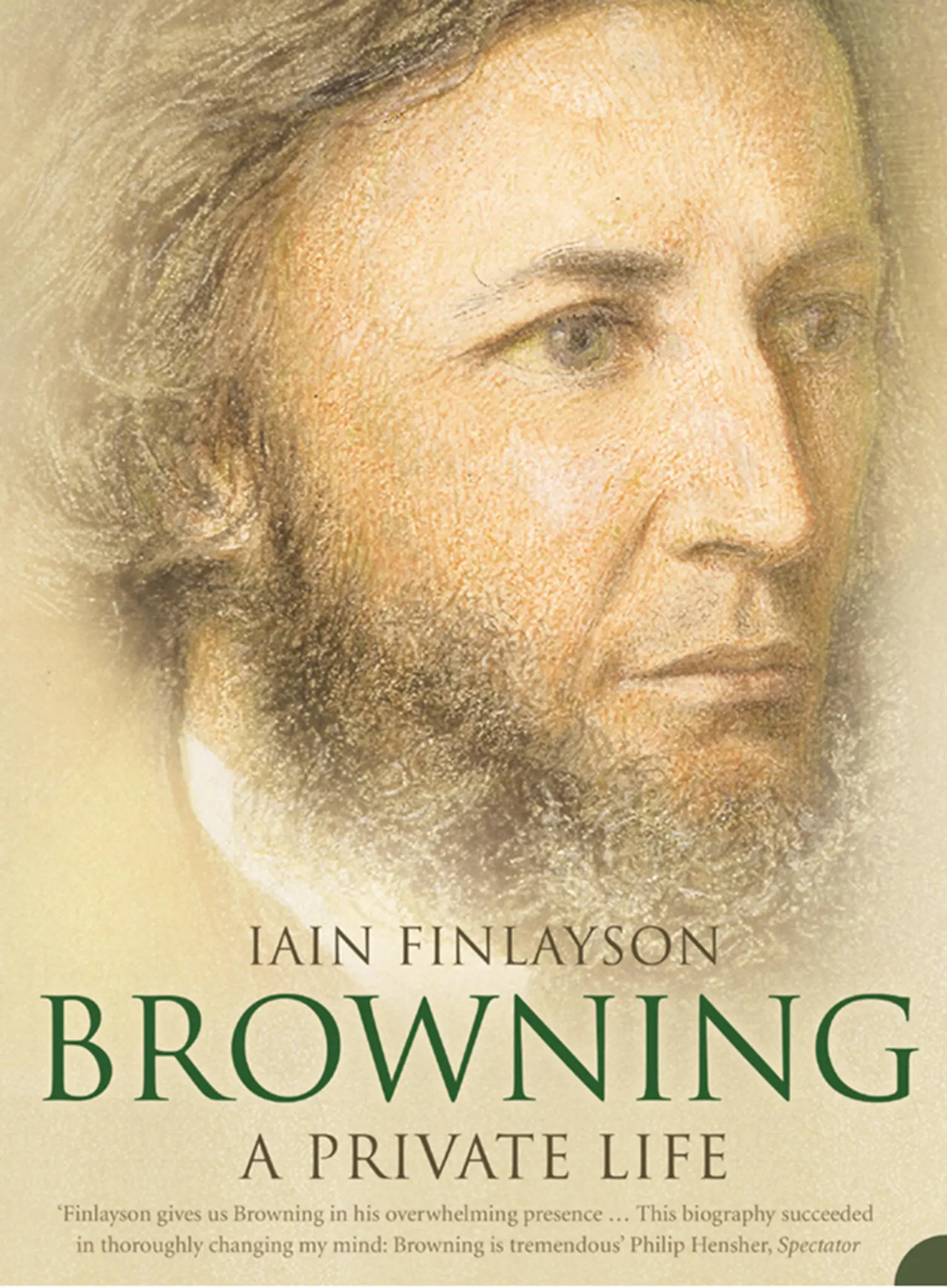
- Название:Browning
- Автор:
- Жанр:
- Год:неизвестен
- ISBN:нет данных
- Рейтинг книги:5 / 5. Голосов: 1
-
Избранное:Добавить в избранное
- Отзывы:
-
Ваша оценка:
Browning: краткое содержание, описание и аннотация
Предлагаем к чтению аннотацию, описание, краткое содержание или предисловие (зависит от того, что написал сам автор книги «Browning»). Если вы не нашли необходимую информацию о книге — напишите в комментариях, мы постараемся отыскать её.
Browning — читать онлайн ознакомительный отрывок
Ниже представлен текст книги, разбитый по страницам. Система сохранения места последней прочитанной страницы, позволяет с удобством читать онлайн бесплатно книгу «Browning», без необходимости каждый раз заново искать на чём Вы остановились. Поставьте закладку, и сможете в любой момент перейти на страницу, на которой закончили чтение.
Интервал:
Закладка:
In 1820, aged fourteen years, Elizabeth Barrett had privately published an epic, The Battle of Marathon , dedicated to her father, Edward Barrett Moulton Barrett. She had begun writing this at the age of eleven. Though imitative of the styles of Homer, Pope, and Byron, it was an impressive achievement—and would have been so if only by reason of its pastiche and precocious learning, far less as evidence of genuine poetic ability. This effort was followed the next year by ‘Stanzas, Excited by Some Reflections on the Present State of Greece’, published in the New Monthly Magazine (1821), and ‘Stanzas on the Death of Lord Byron’ in 1824. In 1826, at the age of twenty, she published an Essay on Mind, with Other Poems , the printing costs being paid by Mary Trepsack, a Barrett slave from Jamaica, who lived in the Barrett household. Elizabeth’s correspondence with a family friend, Sir Uvedale Price, contributed substantially to Price’s Essay on the Modern Pronunciation of the Greek and Latin Languages , published in 1827. On her own account, in 1832, she translated Prometheus Bound by Aeschylus, published with Miscellaneous Poems in 1833.
All these were given anonymously to the world, until she finally put her name to The Seraphim, and Other Poems in 1838, and followed these verses with occasional poems and translations published in Blackwood’s Edinburgh Magazine and in the Athenaeum . In 1842, she published three hymns translated from the Greek of Gregory Nazianzen and ‘Some Account of the Greek Christian Poets’. In 1844, there appeared her Poems , which famously included ‘Lady Geraldine’s Courtship’ (the story of a beautiful, talented, high-born lady who chooses to marry Bertram, a low-born poet, rather than a suitor of her own rank) and, within that poem, the references to Robert Browning’s own poems. Elizabeth Barrett was, by 1844, esteemed by the best and most influential literary magazines. Her classical and metaphysical learning, her poetic accomplishments, her mysterious reluctance to make any public appearances, all astonished and somewhat intimidated the literary establishment. There were some who muttered ungraciously about poetical obscurity and mysticism, but by and large her work was treated more reverently, more indulgently, than the irredeemable obscurities and impenetrable mystifications of Robert Browning’s poetry.
Some three years before, John Kenyon had attempted to arrange a meeting between Robert and Elizabeth. He had enthusiastically told her about him, him about her; he had discussed his poetry with her, hers with him; and at one point this middle-aged romantic go-between had almost brought his plan to a satisfactory conclusion, only to have it frustrated by Elizabeth putting off the encounter with a perfectly plausible, believable plea of indisposition—though in fact, as she admitted, it was because of her ‘blind dislike to seeing strangers’. Still, there it was—the reference to Robert Browning, in ‘Lady Geraldine’s Courtship’, and in the best poetic company, his work linked favourably, equal in rank, with ‘poems/Made by Tuscan flutes … the pastoral parts of Spenser—or the subtle interflowings/Found in Petrarch’s sonnets’.
On 10 January 1845, Robert—having read the copy of Elizabeth’s Poems given to Sarianna by John Kenyon, having punctiliously asked Kenyon if it would be in order for him to write, and having been assured by Kenyon that she would be pleased to hear from him—posted a letter from New Cross, Hatcham, Surrey, to Elizabeth Barrett at 50 Wimpole Street. The first sentence of his first letter to her is this:
I love your verses with all my heart, dear Miss Barrett,—and this is no off-hand complimentary letter that I shall write,—whatever else, no prompt matter-of-course recognition of your genius, and there a graceful and natural end of the thing.
Several sentences further into the letter, Robert declares, ‘I do, as I say, love these books with all my heart—and I love you too.’
And so it began.
But what was begun, and how was it begun? We know the upshot, the happy ending—the lovestruck drama has become the stuff of potent myth; but our sentimentality may misinterpret the beginning and our romantic predisposition may rose-colour our perceptions of the whole courtship correspondence as the simple singing of two flirtatious love birds, the coy cooing of two eroticized turtle doves. In The Courtship of Robert Browning and Elizabeth Barrett , Daniel Karlin points out that Robert, from his first letter, from the first sentence of that letter, knew what he was doing. Artless is the very last word that should be adduced to characterize Robert’s letters. Different in kind to Elizabeth’s, they are—insists Karlin—dramatic compositions. They may not be premeditated, but they are not spontaneous. Robert ‘composes his love for Elizabeth in the same terms as he composes the action of his poems’. In all Robert’s letters ‘there is not a single casual allusion, there is not a single pointless digression; an all-embracing objective cannot tolerate unconnected images or associations. Elizabeth Barrett’s best letters remind you of Byron; Browning’s of St Paul.’ 121
Karlin makes the original and persuasive point—though some, enticed by the fairy-tale aspects of the Browning-Barrett courtship, will find it startling—that Robert, the composer of the initiating letter, stands behind Robert, the character in the letter, whose apparently impetuous, ornamental, gallant sincerity is deliberately presented. Elizabeth also has a role scripted by Robert: ‘though’, says Karlin, ‘it is not made explicit until his second letter. He told her then, “your poetry must be, cannot but be, infinitely more to me than mine to you—for you do what I always hoped to do … You speak out, you ,—I only make men & women speak—give you truth broken into prismatic hues, and fear the pure white light, even if it is in me …”. 122 And so Elizabeth’s poetry, being pure white light, the very essence of her personality, is not dissociated from her being. In this sense, Elizabeth and her poetry are one, indissoluble, and thus Robert could write, ‘I do, as I say, love these books with all my heart—and I love you too.’
Elizabeth thought this fanciful—‘an illusion of a confusion between the woman and the poetry’, as she wrote much later to Mary Mitford. At the time, she remarked, ‘Browning writes letters to me … saying he “loves” me . Who can resist that … Of course it is all in the uttermost innocence.’ Nevertheless, her interest had been stimulated—tickled rather than touched, says Karlin—by this well-mannered, if superficially effusive, letter from a poet whose work she admired and who came well recommended by John Kenyon and Richard Horne, whose judgement she respected. The next day, the 11th, she replied. She responded rather formally as a fellow-poet, beginning by thanking ‘dear Mr Browning, from the bottom of my heart. You meant to give me pleasure by your letter—and even if the object had not been answered, I ought still to thank you. But it is thoroughly answered. Such a letter from such a hand! Sympathy is dear—very dear to me: but the sympathy of a poet, & of such a poet, is the quintessence of sympathy to me!’
Thus the correspondence—the long fuse, leading to the startling denouement—was sparked not simply by poetry but by the shared experience of being poets and, crucially, by the differences between them in that respect. Karlin defines this central concern: ‘The ways in which each praised the other’s poetry—Browning because Elizabeth Barrett seemed to him an examplar of “pure” poetry, she because of Browning’s “power” and “experience as an artist”—rapidly acquired a personal as well as an aesthetic edge. Browning and Elizabeth Barrett were to debate their relative status up to and beyond the altar, and it was in and through this debate that their feeling for each other defined and developed itself.’ 123
Читать дальшеИнтервал:
Закладка:
Похожие книги на «Browning»
Представляем Вашему вниманию похожие книги на «Browning» списком для выбора. Мы отобрали схожую по названию и смыслу литературу в надежде предоставить читателям больше вариантов отыскать новые, интересные, ещё непрочитанные произведения.






Обсуждение, отзывы о книге «Browning» и просто собственные мнения читателей. Оставьте ваши комментарии, напишите, что Вы думаете о произведении, его смысле или главных героях. Укажите что конкретно понравилось, а что нет, и почему Вы так считаете.