Iain Finlayson - Browning
Здесь есть возможность читать онлайн «Iain Finlayson - Browning» — ознакомительный отрывок электронной книги совершенно бесплатно, а после прочтения отрывка купить полную версию. В некоторых случаях можно слушать аудио, скачать через торрент в формате fb2 и присутствует краткое содержание. Жанр: unrecognised, на английском языке. Описание произведения, (предисловие) а так же отзывы посетителей доступны на портале библиотеки ЛибКат.
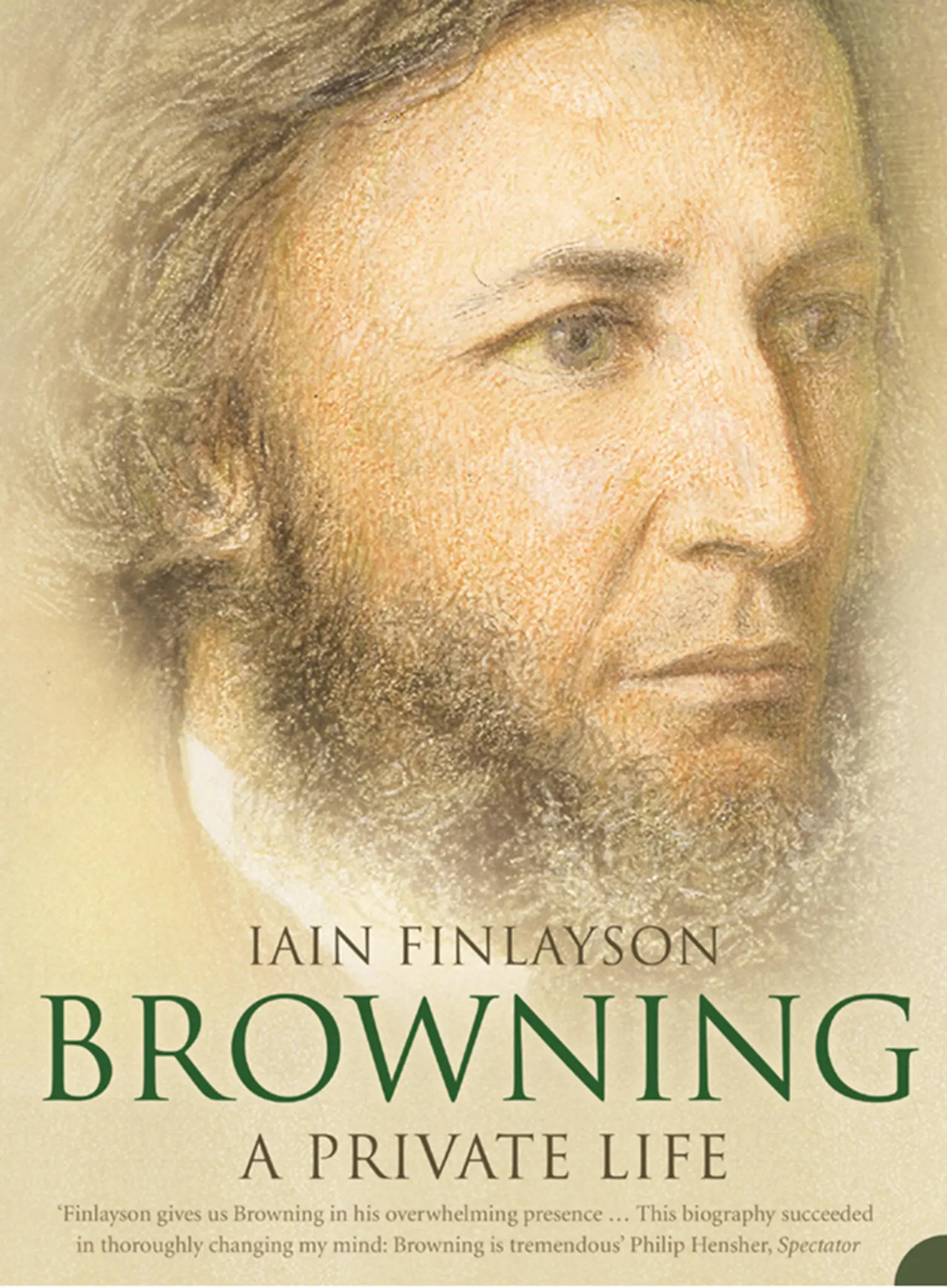
- Название:Browning
- Автор:
- Жанр:
- Год:неизвестен
- ISBN:нет данных
- Рейтинг книги:5 / 5. Голосов: 1
-
Избранное:Добавить в избранное
- Отзывы:
-
Ваша оценка:
Browning: краткое содержание, описание и аннотация
Предлагаем к чтению аннотацию, описание, краткое содержание или предисловие (зависит от того, что написал сам автор книги «Browning»). Если вы не нашли необходимую информацию о книге — напишите в комментариях, мы постараемся отыскать её.
Browning — читать онлайн ознакомительный отрывок
Ниже представлен текст книги, разбитый по страницам. Система сохранения места последней прочитанной страницы, позволяет с удобством читать онлайн бесплатно книгу «Browning», без необходимости каждый раз заново искать на чём Вы остановились. Поставьте закладку, и сможете в любой момент перейти на страницу, на которой закончили чтение.
Интервал:
Закладка:
This is the letter of a man whose lightning or lighthouse flashes illuminate his world fitfully and reveal himself, though captain of his own ship, becalmed on a dark flood. Robert’s perplexity and discouragement was of long standing. In short, he was depressed: the weeks passed, Carlyle talked wisely and beautifully, there had been quarrels with Macready and Forster, the rarely positive critical response to his work was pleasing enough but misguided, the plays were defunct, the poems had sold disappointingly. On 9 October 1843 he wrote to Alfred Domett, who had thrown up the law and disappeared to the colonies, to New-Zealand, ‘People read my works a little more, they say, and I have some real works here in hand; but now that I could find it in my heart to labour earnestly, I doubt if I shall ever find it in my head , which sings and whirls and stops me even now—an evening minute by the way.’ 118 Perhaps to still his whirligig head, or to give it something substantial to dance around, Robert sailed for Naples in the late summer of 1844.
As is the case with his previous journeyings abroad, precious few relics survive to substantiate the itinerary or illuminate the events. There is some dispute as to whether Robert wrote the poems ‘Home Thoughts from the Sea’ and ‘How They Brought the Good News from Ghent to Aix’ on this voyage or on the first voyage to Italy—Robert himself said the one, then the other. And if he could not remember, then attribution by others is just as credible one way or the other. Mrs Orr is virtually the sole source of information for Robert’s second trip to Italy, and she gives no circumstantial detail about how he met ‘a young Neapolitan gentleman’, by name of Scotti, ‘who had spent most of his life in Paris’ and with whom, very likely, Robert talked his proper French and improved his vernacular Italian. Quickly becoming good friends, they travelled together from Naples to Rome, Scotti helpfully haggling over their joint expenses. ‘As I write’, reported Robert in a letter to Sarianna, ‘I hear him disputing our bill in the next room. He does not see why we should pay for six wax candles when we have used only two.’ 119 One can see why Robert, who had learned to be careful of money, should warm to a man with a mind similarly concentrated on his own short purse. Says Mrs Orr of Scotti, ‘he certainly bore no appearance of being the least prosperous’. In Rome, Scotti was judged by Countess Carducci—an acquaintance of Robert’s father—‘the handsomest man she had ever seen.’ But Mr Scotti ‘blew out his brains soon after he and his new friend had parted; and I do not think the act was ever fully accounted for’. 120
We could wish to pause there, at that sensational moment, to inquire further about the impoverished Signor Scotti and his suicide: he sounds just the man, and his death just the circumstance, to stop Robert in his tracks to add his friend and his end to his repertory company of characters fit for a poem. But all we know of Robert’s time in Rome is that he visited Shelley’s tomb in the New Protestant Cemetery, in commemoration of which he wrote the few lines on ‘Fame’ which form the first part of ‘Earth’s Immortalities’, inspected the grotto of Egeria, the scene imagined by Byron of the supposed interview between King Numa Pompilius of Rome and the advisory nymph, and the recently restored church of Santa Prassede, close by Santa Maria Maggiore, where the tomb of Cardinal Cetive may have partly inspired the poem ‘The Bishop Orders His Tomb at Saint Praxed’s Church’. These are all occasions of the most tantalizing interest, and about which too little—if any—first-hand evidence exists.
We fall back upon Mrs Orr, too, for information about the journey home to Hatcham, via Livorno where he found Edward John Trelawny who had been an intimate of the poets Shelley and Byron. Trelawny might have been in a better condition to discuss the poets had he not been stoically—‘indifferently’, says Mrs Orr—enduring a painful operation to have a troublesome bullet dug from his leg by a surgeon. Trelawny’s cool fortitude struck Robert very much. That the veteran was able to talk at all, far less reminisce about poets and poetry, was very remarkable.
Robert returned from Italy in December 1844. During his absence, he had missed the much-acclaimed publication of Miss Elizabeth Barrett Barrett’s Poems in the summer of that same year; but once back in Hatcham he read the volumes, which, if they had not in themselves been of the greatest interest, would certainly have caught—or been brought to—his attention on account of two delicately allusive lines that ran:
Or from Browning some ‘Pomegranate’, which, if cut deep down
the middle,
Shows a heart within blood-tinctured, of a veined humanity.
What, in 1844, did Robert know of Elizabeth Barrett Moulton Barrett? No more than anyone else, which wasn’t much in the way of first-hand information, far less reliable gossip—though uninformed speculation (it was said that Miss Barrett was completely crippled, unable to move) was never short as a negotiable commodity. The poet, essayist, and former seafaring man Richard Hengist Horne, who had experienced enough maritime and military adventure to qualify him as a Baron Munchausen (except that most of his tales, like those of ‘Abyssinia’ Bruce, were largely true) put it about that she was in very delicate health and had lived for years hermetically sealed in her room, her only contact with the outside world being through the medium of letters very erudite and literary in tone. He was more authoritative than most, since she had recently collaborated with him on a two-volume book, A New Spirit of the Age , in which ‘Orion’ Horne, ably assisted by the contributions of others (including Robert Browning as well as Elizabeth Barrett) had aspired to make a general estimate of contemporary literature without, alas!, possessing much literary ability or even critical faculty himself.
In retrospect, from the distance of our own times, Horne’s judgement in 1844, when the book appeared, was naturally coloured by the florid taste of his age, lengthily praising the likes of Talfourd, who is now not much more than a literary footnote to the period. But critical perspectives inevitably alter: to Horne’s credit, he did rate highly those big guns who have survived as literary heroes: Carlyle, Macaulay, Tennyson, and Dickens—though he’d have found it difficult not to notice them respectfully at appropriate length; and he devoted generous space to the ‘little known works of Mr Robert Browning’, whose Paracelsus he praised over five pages and whose Sordello , at the length of a dozen pages, he sorrowfully judged would remain obscure but to have been treated unjustly by critics since the poem, in Horne’s estimation, ‘abounded with beauties’. And so, her hand dabbled in Horne’s book, Elizabeth Barrett, the famously reclusive poetess, would have known not only of Mr Robert Browning’s work but, less intimately, something of the poet himself.
In his book, Horne reflected upon his collaborator’s invisibility among her contemporaries, supposing that future generations might doubt her very existence. But some, he knew, had actually seen her. Miss Mitford, for one, told him that Miss Barrett ‘lies folded in Indian shawls upon her sofa with her long black tresses streaming over her bent-down head, all attention’ while having her new poems read to her by an unnamed gentleman who, we suppose, must have been John Kenyon. Through the medium of Kenyon, then, we may also suppose that Robert learned more even than Horne gleaned from the gossiping Miss Mitford about the interesting lady poet who preferred to call herself Elizabeth Barrett Barrett rather than to use her full family name of Barrett Moulton Barrett. From Kenyon, Robert received a manuscript poem, ‘Dead Pan’, written by Elizabeth, and Kenyon was happy to communicate Robert’s enthusiasm to its author.
Читать дальшеИнтервал:
Закладка:
Похожие книги на «Browning»
Представляем Вашему вниманию похожие книги на «Browning» списком для выбора. Мы отобрали схожую по названию и смыслу литературу в надежде предоставить читателям больше вариантов отыскать новые, интересные, ещё непрочитанные произведения.






Обсуждение, отзывы о книге «Browning» и просто собственные мнения читателей. Оставьте ваши комментарии, напишите, что Вы думаете о произведении, его смысле или главных героях. Укажите что конкретно понравилось, а что нет, и почему Вы так считаете.