Iain Finlayson - Browning
Здесь есть возможность читать онлайн «Iain Finlayson - Browning» — ознакомительный отрывок электронной книги совершенно бесплатно, а после прочтения отрывка купить полную версию. В некоторых случаях можно слушать аудио, скачать через торрент в формате fb2 и присутствует краткое содержание. Жанр: unrecognised, на английском языке. Описание произведения, (предисловие) а так же отзывы посетителей доступны на портале библиотеки ЛибКат.
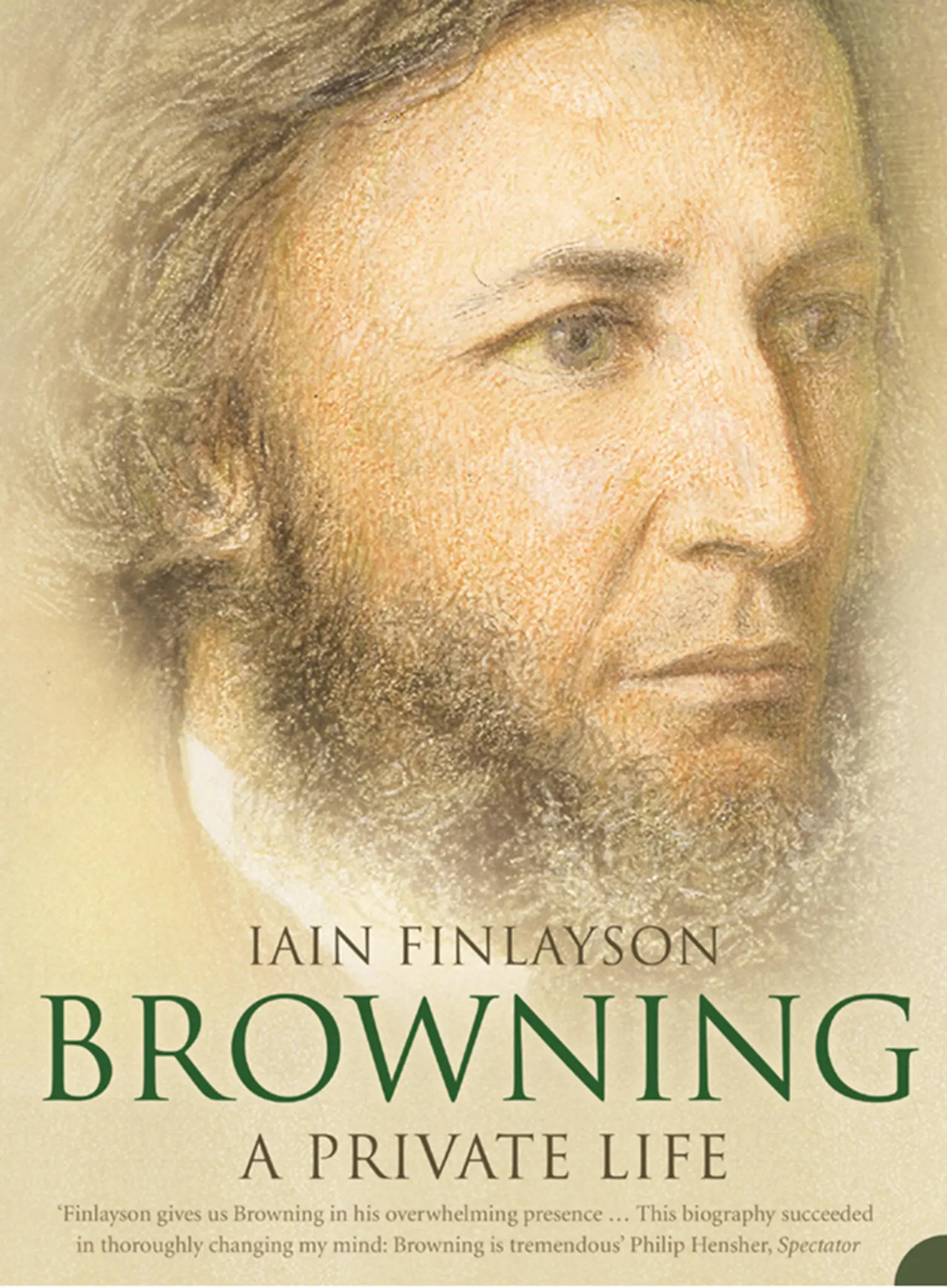
- Название:Browning
- Автор:
- Жанр:
- Год:неизвестен
- ISBN:нет данных
- Рейтинг книги:5 / 5. Голосов: 1
-
Избранное:Добавить в избранное
- Отзывы:
-
Ваша оценка:
Browning: краткое содержание, описание и аннотация
Предлагаем к чтению аннотацию, описание, краткое содержание или предисловие (зависит от того, что написал сам автор книги «Browning»). Если вы не нашли необходимую информацию о книге — напишите в комментариях, мы постараемся отыскать её.
Browning — читать онлайн ознакомительный отрывок
Ниже представлен текст книги, разбитый по страницам. Система сохранения места последней прочитанной страницы, позволяет с удобством читать онлайн бесплатно книгу «Browning», без необходимости каждый раз заново искать на чём Вы остановились. Поставьте закладку, и сможете в любой момент перейти на страницу, на которой закончили чтение.
Интервал:
Закладка:
If your own choice happened to point that way, I for one should hail it as a good omen that your next work were written in prose! Not that I deny you poetic faculty; far, very far from that. But unless poetic faculty mean a higher-power of common understanding, I know not what it means. One must first make a true intellectual representation of a thing, before any poetic interest that is true will supervene. All cartoons are geometrical withal; and cannot be made till we have fully learnt to make mere diagrams well. It is this that I mean by prose;—which hint of mine, most probably inapplicable at present, may perhaps at some future day come usefully to mind.
Carlyle concluded his letter, sugaring the salt, by admitting to Robert that, ‘I esteem yours no common case; and think such a man is not to be treated in the common way. And so persist in God’s name as you best see and can; and understand always that my true prayer for you is, Good Speed in the name of God!’
Whatever Robert may have thought then of this letter would surely have been tempered later by a letter of 17 February 1845 from Elizabeth Barrett. She had sent her poems to Carlyle, who had evidently offered her the same advice as he had given to Robert Browning, and indeed freely to every other poet except Tennyson: ‘And does Mr Carlyle tell you that he has forbidden all “singing” to this perverse and froward generation, which should work and not sing? And have you told Mr Carlyle that song is work, and also the condition of work? I am a devout sitter at his feet—and it is an effort for me to think him wrong in anything—and once when he told me to write prose and not verse, I fancied that his opinion was I had mistaken my calling,—a fancy which in infinite kindness and gentleness he stooped immediately to correct. I never shall forget the grace of that kindness—but then! For him to have thought ill of me , would not have been strange—I often think ill of myself, as God knows. But for Carlyle to think of putting away, even for a season, the poetry of the world, was wonderful, and has left me ruffled in my thoughts ever since.’ And whatever Carlyle might think about Pippa Passes , the conception of it was, to Miss Barrett’s mind, ‘most exquisite and altogether original—and the contrast in the working out of the plan, singularly expressive of various faculty’. 108
Thomas Carlyle was from the beginning, and remained, an important friend to Robert Browning and a significant intellectual influence in his life. On 5 May 1840, Macready attended a lecture by Carlyle. What it was about he could not recollect, ‘although I listened with the utmost attention to it, and was greatly pleased with it’. 109 The title and subject matter of the lecture, which Macready could not well recall, was ‘The Hero as Divinity’. The second, on 8 May, he recollected very well: ‘“The Hero as Prophet: Mahomet”; on which he [Carlyle] descanted with a fervour and eloquence that only a conviction of truth could give. I was charmed, carried away by him. Met Browning there.’ Macready had met Robert at the earlier lecture, too, three days before. Robert also attended the third lecture, ‘The Hero as Poet’. This series of six lectures, the remaining subjects of which were ‘The Hero as Priest’, ‘The Hero as Man of Letters’, and ‘The Hero as King’, ran from 5 to 22 May. This lecture series, the sensation of the season, was published as that great and curious Carlylean work, On Heroes, Hero-Worship, and the Heroic in History in 1841.
Carlyle’s first impression of Robert Browning had not been wholly positive. Forty years later, Robert, in a letter of 18 March 1881, 110 candidly admitted that Carlyle ‘confessed once to me that, on the first occasion of my first visiting him, he was anything but favorably impressed by my “smart green coat”—I being in riding costume: and if then and there had begun and ended our acquaintanceship, very likely I might have figured in some corner of a page as a poor scribbling-man with proclivities for the turf and scamphood. What then? He wrote Sartor [ Resartus ]—and such letters to me in those old days. No, I am his devotedly.’
Carlyle, seventeen years older than Robert, might deplore his dandyism, but he admitted his young friend to be beautiful, striking in his facial features, and possessing a full head of dark, flowing hair. Besides, the ‘neat dainty little fellow’ professed a marked enthusiasm for the philosophy of the Scottish philosopher whose intellectual distinction in London literary society added a lustre to his otherwise gaunt, somewhat dour appearance. As Carlyle got to know Robert better, he formed a close personal attachment to him and a high opinion of his capabilities. To Gavan Duffy, the young Irish nationalist, Carlyle declared Robert Browning to possess not only a powerful intellect but, ‘among the men engaged in England in literature just now was one of the few from which it was possible to expect something’. Browning, said Carlyle, responding in 1849 to Duffy’s suggestion that the poet might be an imitator of Coleridge’s ‘The Suicide’s Argument’ (first published in 1828), ‘was an original man and by no means a person who would consciously imitate anyone’. 111
Robert and Thomas Carlyle had certainly met by 27 March 1839, when they are recorded as dining together at Macready’s table. 112 In a letter of 30 December 1841 to Fanny Haworth, Robert tells her that he ‘dined with dear Carlyle and his wife (catch me calling people “dear,” in a hurry, except in letter-beginings!) yesterday—I don’t know any people like them—there was a son of [Robert] Burns’ there, Major Burns whom Macready knows—he sung “Of all the airts”—“John Anderson”—and another song of his father’s.’ This reference speaks confidently of some considerable intimacy and friendship beyond mere literary respect or intellectual hero-worship. In a letter to Robert of 1 December 1841, Carlyle lamented that, ‘The sight of your card instead of yourself, the other day when I came down stairs, was a real vexation to me! The orders here are rigorous. “Hermetically sealed till 2 o’clock!” But had you chanced to ask for my Wife, she would have guessed that you formed an exception, and would have brought me down.’ Carlyle goes on to invite Robert to pay visits on Friday nights for tea at six or half-past six. A letter of 1842 from Robert to Mrs Carlyle accepts an invitation to breakfast. Carlyle’s letters to Robert in this period are those of a man corresponding with an intellectual equal and a friend interested in the common domestic matters of life as well as the more rarefied matters of the mind and the human condition. Browning had, wrote Carlyle to Moncure Daniel Conway, ‘simple speech and manners and ideas of his own’. He was ‘a fine young man … I liked him better than any young man about here.’ And though Carlyle ‘did not make much out of’ Paracelsus , he conceded that ‘that and his other works proved a strong man’. 113
Robert not only rode into town to visit Carlyle at his house in Cheyne Row, Chelsea, but Carlyle rode out to Hatcham to visit the Brownings, whose decent domestic respectability he admired as much as the tidy trim of ‘the little room’ in which Robert kept his books. Perhaps Mrs Browning played the piano for him, perhaps Carlyle now and again burst into song. It was not unlikely—despite Elizabeth Barrett being convinced of his having ‘forbidden all “singing” to this perverse and froward generation, which should work and not sing’. Robert revealed to her, in a letter of 26 February 1845, an occasion a couple of weeks before when Carlyle had abruptly asked him, ‘Did you never try to write a Song? Of all the things in the world, that I should be proudest to do.’ It may be that Carlyle was mindful of Andrew Fletcher of Saltoun’s remark in 1703, ‘I knew a very wise man so much of Sir Chr—’s sentiment, that he believed if a man were permitted to make all the ballads, he need not care who should make the laws of a nation.’ If he could not make a song, Carlyle could at least sing one. Six months before, Robert had heard the sage of Ecclefechan, the prophet of Craigenputtock, the great Cham of Chelsea, ‘croon if not certainly sing, “Charlie is my darling” (“my darling ” with an adoring emphasis)’.
Читать дальшеИнтервал:
Закладка:
Похожие книги на «Browning»
Представляем Вашему вниманию похожие книги на «Browning» списком для выбора. Мы отобрали схожую по названию и смыслу литературу в надежде предоставить читателям больше вариантов отыскать новые, интересные, ещё непрочитанные произведения.





Обсуждение, отзывы о книге «Browning» и просто собственные мнения читателей. Оставьте ваши комментарии, напишите, что Вы думаете о произведении, его смысле или главных героях. Укажите что конкретно понравилось, а что нет, и почему Вы так считаете.