Iain Finlayson - Browning
Здесь есть возможность читать онлайн «Iain Finlayson - Browning» — ознакомительный отрывок электронной книги совершенно бесплатно, а после прочтения отрывка купить полную версию. В некоторых случаях можно слушать аудио, скачать через торрент в формате fb2 и присутствует краткое содержание. Жанр: unrecognised, на английском языке. Описание произведения, (предисловие) а так же отзывы посетителей доступны на портале библиотеки ЛибКат.
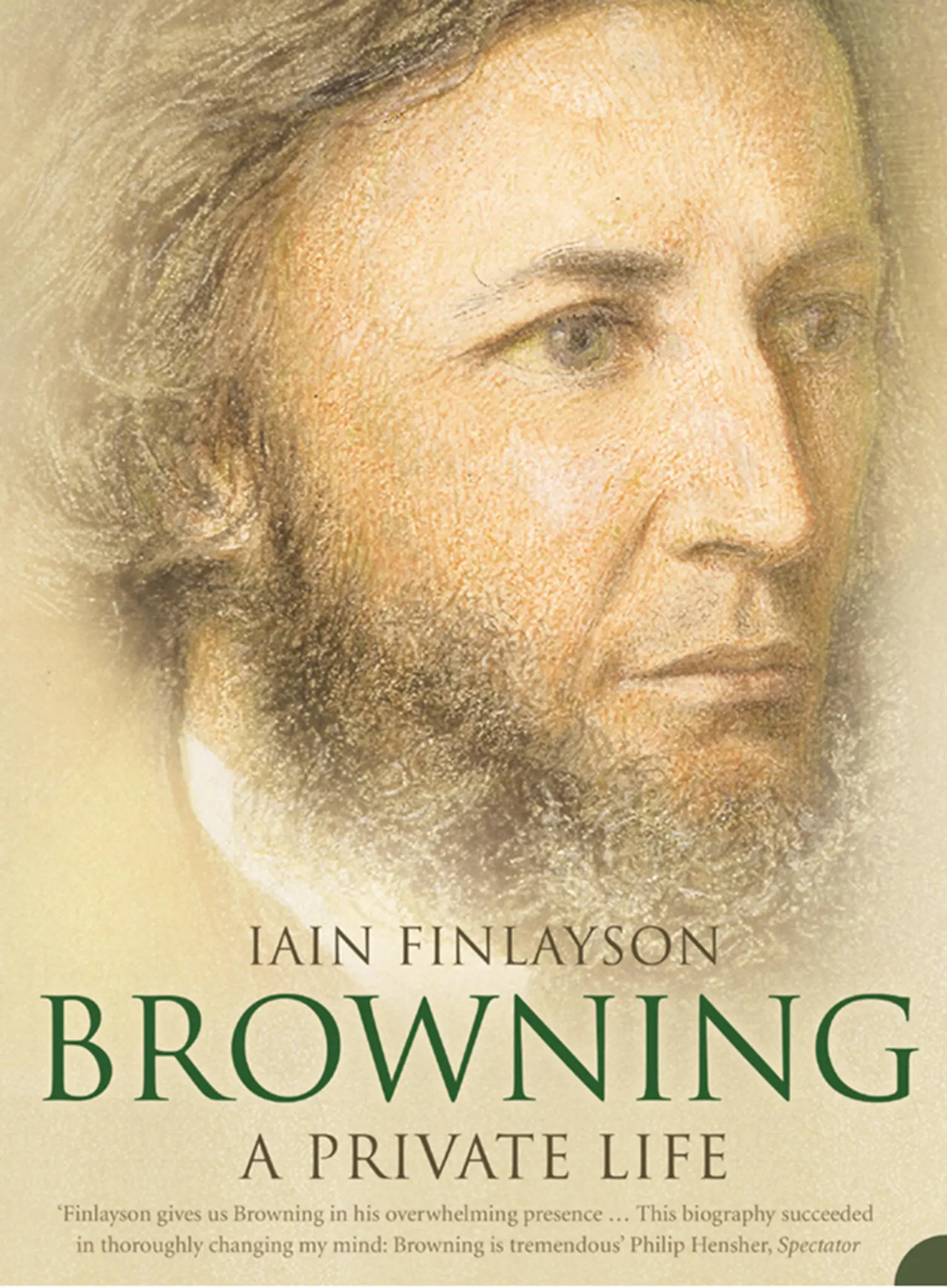
- Название:Browning
- Автор:
- Жанр:
- Год:неизвестен
- ISBN:нет данных
- Рейтинг книги:5 / 5. Голосов: 1
-
Избранное:Добавить в избранное
- Отзывы:
-
Ваша оценка:
Browning: краткое содержание, описание и аннотация
Предлагаем к чтению аннотацию, описание, краткое содержание или предисловие (зависит от того, что написал сам автор книги «Browning»). Если вы не нашли необходимую информацию о книге — напишите в комментариях, мы постараемся отыскать её.
Browning — читать онлайн ознакомительный отрывок
Ниже представлен текст книги, разбитый по страницам. Система сохранения места последней прочитанной страницы, позволяет с удобством читать онлайн бесплатно книгу «Browning», без необходимости каждый раз заново искать на чём Вы остановились. Поставьте закладку, и сможете в любой момент перейти на страницу, на которой закончили чтение.
Интервал:
Закладка:
Arnould’s letter also painted in the background, backstage machinations, and mischief-making that, as much as the obvious shortcomings of the play, contributed substantially to its failure. The fault was not all Robert Browning’s, even allowing for the profundity of his anxiety that did him no good in the way it influenced his own behaviour towards Macready. Macready had his own agenda in respect of A Blot in the ’Scutcheon that contributed to its short, disastrous run, and it is possible that he deliberately undermined the play by orchestrating a bad reception for its performances.
Robert Browning’s own scrupulously detailed version to Frank Hill of the Daily News in a letter of 15 December 1884 reads thus:
Macready received and accepted the play, while he was engaged at the Haymarket, and retained it for Drury Lane, of which I was ignorant that he was about to become the manager: he accepted it ‘at the instigation’ of nobody,—and Charles Dickens was not in England when he did so: it was read to him after his return, by Forster—and the glowing letter which contains his opinion of it, although directed by him to be shown to myself, was never heard of nor seen by me till printed in Forster’s book some thirty years after. When the Drury Lane season began, Macready informed me that he should act the play when he had brought out two others—‘The Patrician’s Daughter’ and ‘Plighted Troth:’ having done so, he wrote to me that the former had been unsuccessful in money-drawing, and the latter had ‘smashed his arrangements altogether:’ but he would still produce my play. I had—in my ignorance of certain symptoms better understood by Macready’s professional acquaintances—I had no notion that it was a proper thing, in such a case, to ‘release him from his promise;’ on the contrary, I should have fancied that such a proposal was offensive. Soon after, Macready begged that I would call on him: he said the play had been read to the actors the day before, ‘and laughed at from beginning to end:’ on my speaking my mind about this, he explained that the reading had been done by the Prompter, a grotesque person with a red nose and a wooden leg, ill at ease in the love scenes, and that he would himself make amends by reading the play next morning—which he did, and very adequately—but apprised me that, in consequence of the state of his mind, harassed by business and various trouble, the principal character must be taken by Mr Phelps; and again I failed to understand—, what Forster subsequently assured me was plain as the sun at noonday,—that to allow at Macready’s Theatre any other than Macready to play the principal part in a new piece was suicidal,—and really believed I was meeting his exigencies by accepting the substitution. At the rehearsal, Macready announced that Mr Phelps was ill, and that he himself would read the part: on the third rehearsal, Mr Phelps appeared for the first time, while Macready more than read, rehearsed the part. The next morning Mr Phelps waylaid me at the stage-door to say, with much emotion, that it was never intended that he should be instrumental in the success of a new tragedy, and that Macready would play Tresham on the ground that himself, Phelps, was unable to do so. He added that he could not expect me to waive such an advantage,—but that, if I were prepared to waive it, ‘he would take ether, sit up all night, and have the words in his memory by next day.’ I bade him follow me to the green-room, and hear what I decided upon—which was that as Macready had given him the part, he should keep it: this was on a Thursday; he rehearsed on Friday and Saturday,—the play being acted the same evening,— of the fifth day after the ‘reading’ by Macready . Macready at once wished to reduce the importance of the ‘play,’—as he styled it in the bills,—tried to leave out so much of the text, that I baffled him by getting it printed in four-and-twenty hours, by Moxon’s assistance. He wanted me to call it ‘The Sister’!—and I have before me, while I write, the stage-acting copy, with two lines of his own insertion to avoid the tragical ending—Tresham was to announce his intention of going into a monastery! all this, to keep up the belief that Macready, and Macready alone, could produce a veritable ‘tragedy,’ unproduced before. Not a shilling was spent on scenery or dresses—and a striking scene which had been used for the ‘Patrician’s Daughter,’ did duty a second time. If your critic considers this treatment of the play an instance of ‘the failure of powerful and experienced actors’ to ensure its success,—I can only say that my own opinion was shown by at once breaking off a friendship of many years—a friendship which had a right to be plainly and simply told that the play I had contributed as a proof of it, would through a change of circumstances, no longer be to my friend’s advantage,—all I could possibly care for. 102
One can hear Robert, in the course of this letter, warming to his reminiscence, waxing again with the indignation that through long years had not seriously cooled in his breast. If sin there had been in this dolorous sequence of events, it was that Macready had finally, fatally, been false to friendship. The heat of this disgrace flares through the letter, and Robert remarks that ‘my play subsists and is as open to praise or blame as it was forty-one years ago’. He is not about to encourage positively any latter-day production of the play: ‘This particular experience was sufficient: but the Play is out of my power now; though amateurs and actors may do what they please.’ In his account of an interview with Robert Browning on the subject of A Blot in the ’Scutcheon , Edmund Gosse gives the Browning version a dramatic, journalistic, jaunty air that somewhat plays up the admittedly farcical aspects of the business that, nevertheless, caused Robert real pain. And Mrs Orr, uncharacteristically, cannot resist a humorous touch: ‘I well remember Mr Browning’s telling me how, when he returned to the green-room, on that critical day, he drove his hat more firmly on to his head and said to Macready, “I beg pardon, sir, but you have given the part to Mr Phelps, and I am satisfied that he should act it;” and how Macready, on hearing this, crushed up the MS., and flung it on to the ground. He also admitted that his own manner had been provocative; but he was indignant at what he deemed the unjust treatment which Mr Phelps had received.’ 103
The version according to Gosse admits what Robert had confessed in his letter to Hill: that he was not merely deceived in his dealings with Macready, but that his disappointments were founded less on simple misunderstandings than on total ignorance. Macready’s financial embarrassments only became clear to Robert on publication of the old actor’s diaries, and only in the light of these revelations, he wrote to Hill, ‘could I in a measure understand his motives for such conduct—and less than ever understand why he so strangely disguised and disfigured them. If “applause” means success, the play thus maimed and maltreated was successful enough: it “made way” for Macready’s own Benefit, and the Theatre closed a fortnight after.’ 104
Robert’s final excursion into the legitimate theatre was Colombe’s Birthday , which he finished writing in March 1844 but which was not produced until 1853—by Mr Phelps, as it happened, at the Haymarket Theatre, with Helen Faucit taking the role of the heroine. It played seven nights before vanishing forever from the boards of the London stage. The play had been originally written for Edmund Kean’s son, Charles, who was performing at Covent Garden and who was looking for new parts to play. His wife, Ellen Tree, was designated for the part of Colombe. Kean offered, it is said, £500 to Robert for a play, though Robert himself speaks in a letter to Christopher Dowson of ‘two or three hundred pounds’. But several complications got in the way of production. Kean wanted to postpone the play’s performance until Easter the following year; the engagement at the Haymarket was to be for twelve nights only; Kean was off to Scotland; Kean was a slow studier of new roles (a failing that incited Robert’s scorn as a fast-writing author). Robert was disinclined to ‘let this new work lie stifled for a year and odd, and work double tides to bring out something as likely to be popular this present season’. 105 It was a disappointment that the play should not go immediately into production, particularly as Robert had been busy turning out other dramas—notably, Luria and A Soul’s Tragedy , which ‘I have by me in a state of forwardness’.
Читать дальшеИнтервал:
Закладка:
Похожие книги на «Browning»
Представляем Вашему вниманию похожие книги на «Browning» списком для выбора. Мы отобрали схожую по названию и смыслу литературу в надежде предоставить читателям больше вариантов отыскать новые, интересные, ещё непрочитанные произведения.











Обсуждение, отзывы о книге «Browning» и просто собственные мнения читателей. Оставьте ваши комментарии, напишите, что Вы думаете о произведении, его смысле или главных героях. Укажите что конкретно понравилось, а что нет, и почему Вы так считаете.