Iain Finlayson - Browning
Здесь есть возможность читать онлайн «Iain Finlayson - Browning» — ознакомительный отрывок электронной книги совершенно бесплатно, а после прочтения отрывка купить полную версию. В некоторых случаях можно слушать аудио, скачать через торрент в формате fb2 и присутствует краткое содержание. Жанр: unrecognised, на английском языке. Описание произведения, (предисловие) а так же отзывы посетителей доступны на портале библиотеки ЛибКат.
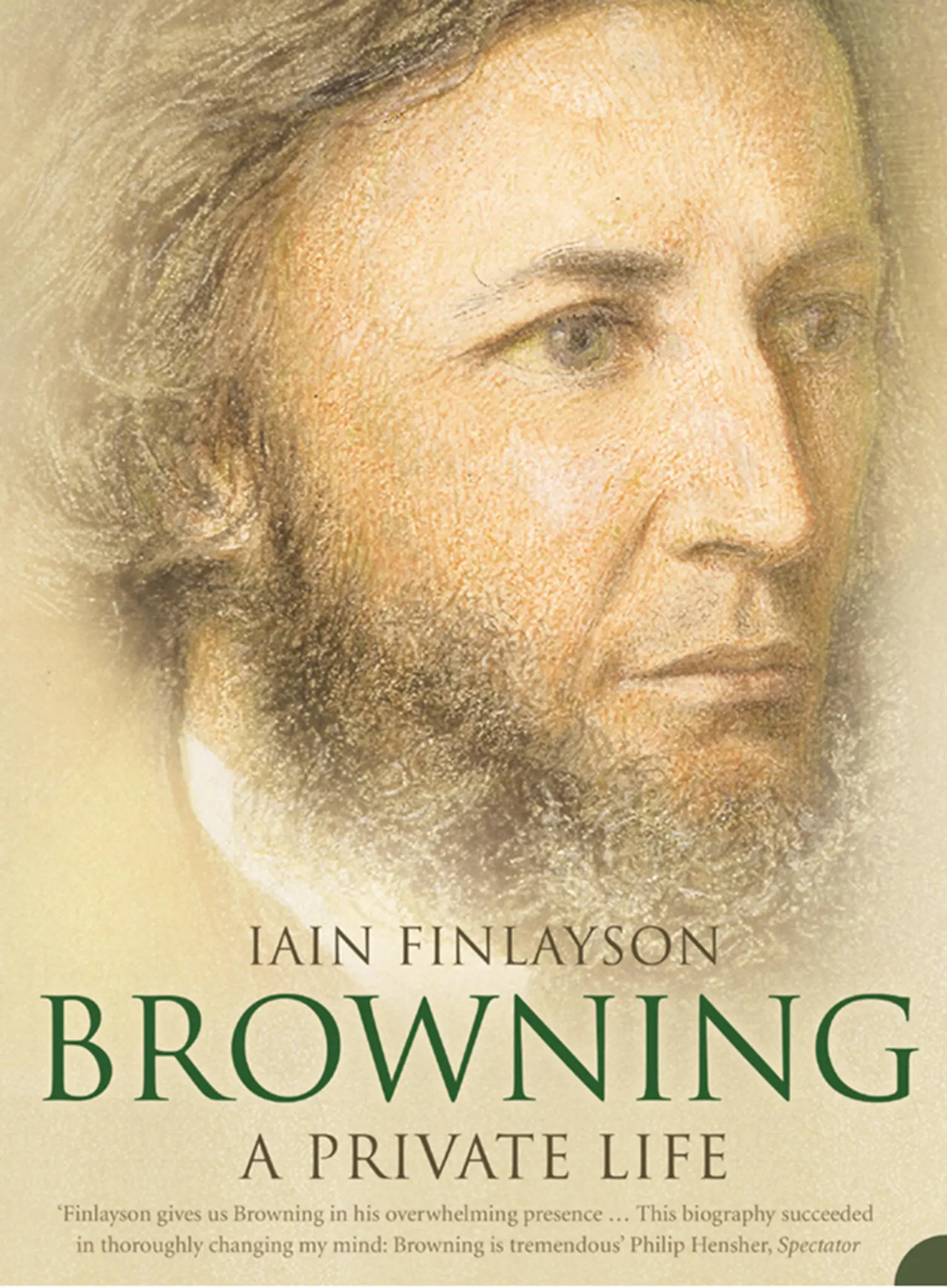
- Название:Browning
- Автор:
- Жанр:
- Год:неизвестен
- ISBN:нет данных
- Рейтинг книги:5 / 5. Голосов: 1
-
Избранное:Добавить в избранное
- Отзывы:
-
Ваша оценка:
Browning: краткое содержание, описание и аннотация
Предлагаем к чтению аннотацию, описание, краткое содержание или предисловие (зависит от того, что написал сам автор книги «Browning»). Если вы не нашли необходимую информацию о книге — напишите в комментариях, мы постараемся отыскать её.
Browning — читать онлайн ознакомительный отрывок
Ниже представлен текст книги, разбитый по страницам. Система сохранения места последней прочитанной страницы, позволяет с удобством читать онлайн бесплатно книгу «Browning», без необходимости каждый раз заново искать на чём Вы остановились. Поставьте закладку, и сможете в любой момент перейти на страницу, на которой закончили чтение.
Интервал:
Закладка:
Poetry was the principal string to Robert’s bow; but he could not help pulling on another, trying to shoot a true arrow from it. As he had written to Fanny Haworth, it suited his way of working to keep several things on the go simultaneously. This is interesting to know, but nothing to make too much of: it is not uncommon—few writers conscientiously finish one job (book, play, poem or essay), dotting the ‘i’s and crossing the ‘t’s, before committing themselves to the next. Writers tend to work on several (more than one, anyhow) projects in parallel rather than serially or consecutively, and none of them will ever be at the same stage of development at the same time. It is only pedants and plodders and publishers who insist that one cannot do two things (or three, or four or more) at the same time. Since Strafford , Robert had taken his opportunities to keep up and broaden his acquaintance with the theatre and those associated with it. The untimely death of Strafford had been a blow, but his fascination with the stage had not died with it. Somewhat smoke-scented, its feathers a little ruffled, shaking out the ashes and preening the charred tips from its wings, the phoenix of Robert’s theatrical ambition was ready for another flight.
Macready, in his tenure as manager of Covent Garden (he reigned there from 30 September 1837 to 18 July 1839), was one focus of Robert’s attention; another was the well-disposed William Johnson Fox. Between Macready and Fox, two substantial rocks in the social life of London, Robert was naturally pulled by the eddies and currents that flowed around and between them into contact with a wide literary, legal, political, and social acquaintance.
This included men such as Charles Dickens (exactly Browning’s age and already prolific, with Sketches by ‘ Boz ’, The Pickwick Papers, Oliver Twist , and Nicholas Nickleby under his belt); Walter Savage Landor (the famously and intractably temperamental poet, dramatist, and polemicist, recently returned from Italy after bitter separation from his wife); Edward Bulwer (the fashionable novelist, playwright, and politician who was to become Bulwer-Lytton in 1843, when he inherited the great house Knebworth from his mother, and thereafter first Baron Lytton); Daniel Maclise (the Irish portrait and history painter); Leigh Hunt (who had personally known Byron, Shelley, and Keats and whom Robert liked for his childlike nature and because he had rescued Shelley’s heart from the funeral pyre on the beach at Viareggio and now treasured it, along with a wisp of Milton’s hair, in his collection of literary relics); John Forster, of course, who was by now a close friend of Dickens and was to become his biographer; Richard Henry (sometimes Hengist) Horne (adventurer, critic, sometime editor of the Monthly Repository , author of plays that were never acted); Richard Monckton Milnes (later the first Baron Houghton, a tremendous social swell of wide literary and political acquaintance who amassed a large library of pornography that included the thrillingly wicked works of the Marquis de Sade); the literary and legal lion Thomas Noon Talfourd; and other playwrights, critics, actors, and men and women of fashion who thronged the times, the theatres, the salons and the dinner tables of London.
From the time of Strafford , Robert became a regular diner-out: he seems, indeed, rarely to have refused a decent invitation. Such social activity was useful: having attracted the public eye, he was not about to drop out of its sight. Acquaintance with the author was more sought after than with his books: Robert was talkative, intelligent, personable, and—having got over early reserve in company—was by now confident in conversation and socially assured. By chance, fatefully, when dining at Talfourd’s in 1839, Robert made the acquaintance of John Kenyon, described by Mrs Orr as being at that date ‘a pleasant, elderly man’, who turned out to have been a schoolfellow of Robert’s father. 90 This encounter led to the reunion of Mr Browning and Mr Kenyon, who were as delighted with one another in their advancing years as they had been as schoolboys. This first meeting after so long a break prospered into an enduringly warm friendship with the whole Browning family. Mrs Orr quotes from a letter, dated 10 January 1884, from Robert to Professor Knight of St Andrews, some twenty-eight years after Kenyon’s death: ‘He was one of the best of human beings, with a general sympathy for excellence of every kind. He enjoyed the friendship of Wordsworth, of Southey, of Landor, and in later days, was intimate with most of my contemporaries of excellence.’ 91
At about this time—even the thorough Mrs Orr cannot put an exact date on it—the Brownings moved to a larger, three-storeyed house, Hanover Cottage, to be near Jane Browning, Robert the First’s widow, who had moved nearby from Islington with her daughter Jemima and son Reuben. A letter conjecturally dated December 1840 by Robert to William Macready specifically states, ‘we remove into a new house, the week after next,—a place really not impossible to be got at’, and another to Macready, which on internal evidence must be dated no earlier than 1840, gives ‘Hanover Cottage Southampton [St]’ as Robert’s address. The reference to Southampton [St] must be provisional. To Laman Blanchard, the author of Offerings , Robert wrote in April 1841 to advise him of his new address: ‘if, in a week or two you will conquer the interminable Kent Road, and on passing the turnpike at New Cross, you will take the first lane with a quickset hedge to the right, you will “descry a house resembling a goose-pie”; only a crooked, hasty and rash goose-pie. We have a garden and trees, and little green hills of a sort to go out on.’ Mr Browning’s books, six thousand and more, were lodged in ‘the long low rooms of its upper storey.’ 92
Robert’s description of the house as ‘resembling a goose-pie’ has vexed many Browning scholars, who have scoured all of literature to discover an appropriate association. One might offer to this inquiry the eighteenth-century Scottish poet and perruquier Allan Ramsay, who became a bookseller in Edinburgh and promoted the city’s first circulating library. He built a round house known as the ‘Goose-Pie’ on the lower slopes of the Edinburgh Castle hill, above what are now the Princes Street gardens. Perhaps—and it’s not unlikely: Carlyle would have known them—Robert had read Ramsay’s The Tea-Table Miscellany , a collection of Scottish songs and ballads, the first volume of which was published in 1723, or The Ever Green (1724), which contained Ramsay’s revisions of representative work by the late medieval Makars of Scotland, notably the great poets Dunbar and Henryson. From Ramsay’s editions of Scottish poetry Robert might have gone on to glean a little gossip about Ramsay’s life, and a house known as the ‘Goose-Pie’ is striking enough to have stuck in anyone’s memory to be retrieved later as an amusing and typically recondite reference.
Mr Browning’s stepbrother Reuben, Robert’s young uncle, was allowed to put up York, his horse, which Robert was encouraged to ride, in the stable and coach-house which was attached to the house and accessible from it. The horse was groomed by the gardener, who was also responsible, with Mrs Browning, for the large garden ‘opening on to the Surrey hills’. 93 Sarianna spoke later of trees in the front of the new house, and Mrs Orr refers specifically to a white rose tree in the garden under which lived a toad which became so much attached to Robert that it would follow him about and suffer him to tickle its head. Hanover Cottage was larger than the family’s previous house and is referred to in several literary memoirs of the period, always with affection and respect for the warmth of its welcome to Robert’s guests.
Читать дальшеИнтервал:
Закладка:
Похожие книги на «Browning»
Представляем Вашему вниманию похожие книги на «Browning» списком для выбора. Мы отобрали схожую по названию и смыслу литературу в надежде предоставить читателям больше вариантов отыскать новые, интересные, ещё непрочитанные произведения.







Обсуждение, отзывы о книге «Browning» и просто собственные мнения читателей. Оставьте ваши комментарии, напишите, что Вы думаете о произведении, его смысле или главных героях. Укажите что конкретно понравилось, а что нет, и почему Вы так считаете.