Iain Finlayson - Browning
Здесь есть возможность читать онлайн «Iain Finlayson - Browning» — ознакомительный отрывок электронной книги совершенно бесплатно, а после прочтения отрывка купить полную версию. В некоторых случаях можно слушать аудио, скачать через торрент в формате fb2 и присутствует краткое содержание. Жанр: unrecognised, на английском языке. Описание произведения, (предисловие) а так же отзывы посетителей доступны на портале библиотеки ЛибКат.
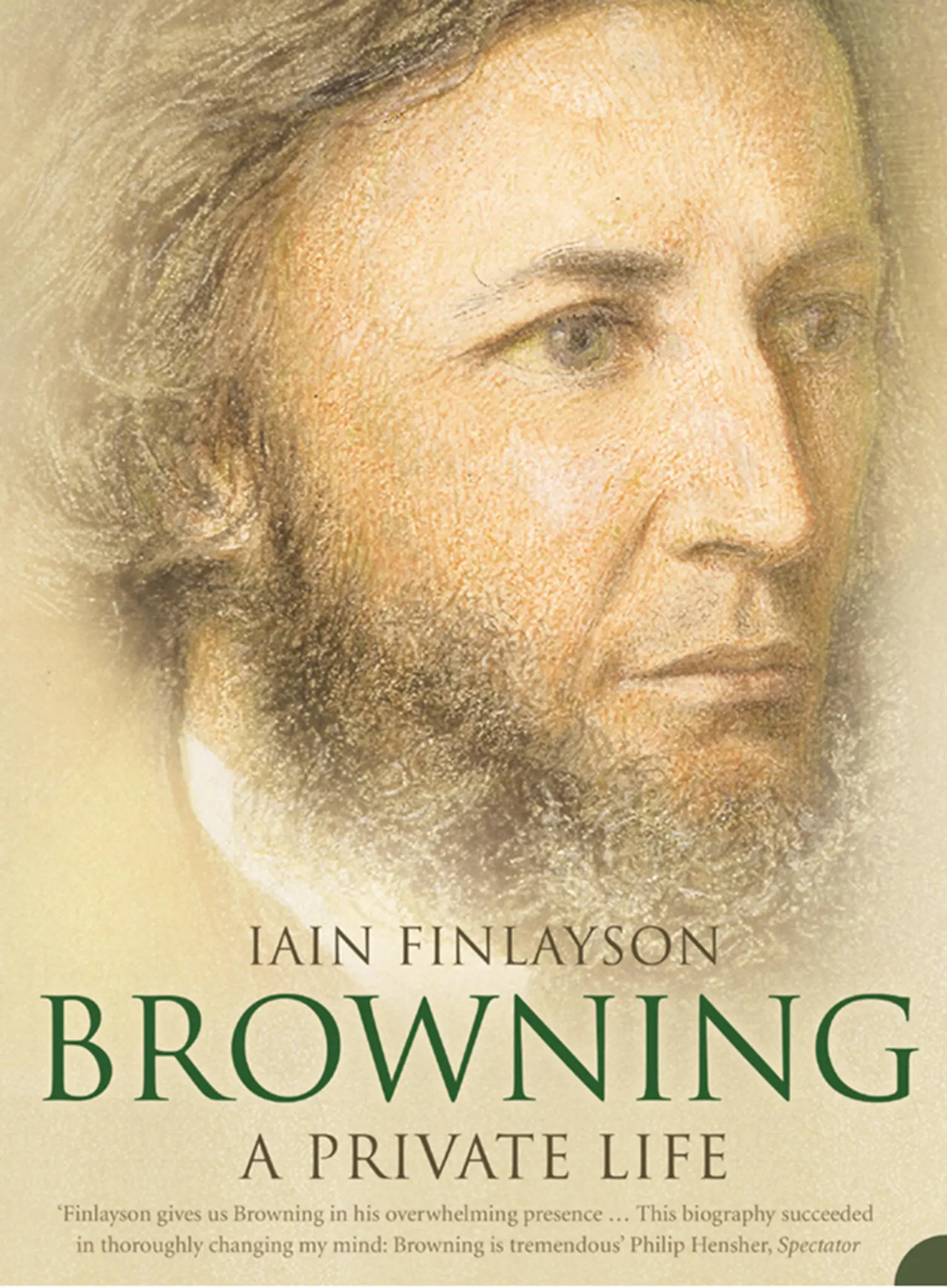
- Название:Browning
- Автор:
- Жанр:
- Год:неизвестен
- ISBN:нет данных
- Рейтинг книги:5 / 5. Голосов: 1
-
Избранное:Добавить в избранное
- Отзывы:
-
Ваша оценка:
Browning: краткое содержание, описание и аннотация
Предлагаем к чтению аннотацию, описание, краткое содержание или предисловие (зависит от того, что написал сам автор книги «Browning»). Если вы не нашли необходимую информацию о книге — напишите в комментариях, мы постараемся отыскать её.
Browning — читать онлайн ознакомительный отрывок
Ниже представлен текст книги, разбитый по страницам. Система сохранения места последней прочитанной страницы, позволяет с удобством читать онлайн бесплатно книгу «Browning», без необходимости каждый раз заново искать на чём Вы остановились. Поставьте закладку, и сможете в любой момент перейти на страницу, на которой закончили чтение.
Интервал:
Закладка:
Chesterton perceptively and properly disputes and demolishes the persistent myth of Sordello ’s unintelligibility: its literary qualities, when perceived and understood, render the poem clearer. As Sharp admits, too, ‘its motive thought is not obscure’ and is perceptible to intelligent critical analysis. The final verdict on Sordello ’s appeal to posterity may be given by Ezra Pound, who, perhaps exasperatedly, exclaimed, ‘Hang it—there is but one Sordello!’ And yes, there is no getting round it—we could not now or for the future do without Sordello , any more than Robert Browning could then or later have done without it. Since Pound regarded Browning as ‘my poetic father’, it is not irrelevant here to refer to T. S. Eliot, who admitted that Pound himself, in his time, suffered from being simultaneously judged to be ‘objectionably modern’ and ‘objectionably antiquarian’. The fellow-feeling and the sense of paternity that Pound bore for Browning is, in this sense, perfectly understandable.
The charge of Browning’s wilful obscurity, though it does not begin with Sordello , is sometimes attributed to Browning’s intellectual vanity and, by extension, arrogance. Chesterton speaks true when he says that ‘throughout his long and very public life, there is not one iota of evidence that he was a man who was intellectually vain.’ It is plain that, in his early career, he had little or no awareness that nobody knew as much as he did, and that that profound ignorance made him unaware that what was perfectly clear to Robert Browning was of the uttermost obscurity to almost everyone else. But that is a different matter: had he been aware of it, and had he made allowance for it, he would have committed a worse sin of being consciously condescending and patronising, of writing de haut en bas —which is one fault for which he is never successfully prosecuted.
‘He was not unintelligible because he was proud,’ says Chesterton, decisively and characteristically turning the difficulty on its head, ‘but unintelligible because he was humble. He was not unintelligible because his thoughts were vague, but because to him they were obvious.’ 85 And because they were obvious, he fell into that concision of expression, allusion, and imagery which Sharp perceives as a fault and which, admittedly, compounded the unintelligibility of the poem for his readers. If Browning is accused of intellectual complexity, it is paradoxical that that complexity derives from his efforts to reduce it to a simplicity that, in the event, was fully comprehensible—and then only intermittently—solely to himself. By not writing down to his readership, Browning’s Sordello , says Chesterton, was ‘the most glorious compliment that has ever been paid to the average man’. It is a compliment that has not, then or now, been easily understood or greatly appreciated. The compliment was rebuffed, indeed, by the Athenaeum on 30 May with reference to the poem’s ‘puerilities and affectations’, and by the Atlas on 28 May which found Sordello full of ‘pitching, hysterical, and broken sobs of sentences’.
Even Macready finally gave up on the book: ‘After dinner tried—another attempt—utterly desperate—on Sordello ; it is not readable.’ 86 Only Fanny Haworth had much good to say for it, a kindness to which Robert responded gratefully in a letter to her of May 1840: ‘You say roses and lilies and lilac-bunches and lemon-flowers about it while everybody else pelts cabbage stump after potato-paring—nay, not everybody—for Carlyle … but I won’t tell you what [Richard Monckton] Milnes told me Carlyle told him the other day: (thus I make you believe it was something singular in the way of praise—connu!).’ In fact, it is pleasing to report that Carlyle did have a good word to say.
Nobody now reads Sordello —or if they do, not idly, not without a good reason, and rarely without a concordance conveniently to hand. This is fair enough: Robert himself, in later life, when asked to explain a reference in one of his poems, was obliged to reply that once God and Browning knew what he meant, but ‘now only God knows’. And in modern times, quite aside from the poem’s literary difficulties, its sheer length—divided into six cantos (or ‘Books’) it amounts to five or six lines short of a total of 6,000 lines—is a deterrent to the casual reader. Chesterton is kindly inclined to exonerate Browning, finally, on the grounds of innocence and inexperience: ‘The Browning then who published Sordello we have to conceive, not as a young pedant anxious to exaggerate his superiority to the public, but as a hot-headed, strong-minded, inexperienced, and essentially humble man, who had more ideas than he knew how to disentangle from each other.’ 87 Substitute, then, for Sharp’s image of ‘the sustained throe of a wrestling Titan’, the idea of Robert Browning as a Laocoön entangled in the coils of serpents so intertwined that they become one indistinguishable, roiling mass. Robert, all unwitting, called up leviathans from the vasty deep of his unconscious mind and conjured them off the pages of his conscious reading, so that they devoured him.
‘A very great part of the difficulty of Sordello ,’ instances Chesterton, ‘is in the fact that before the reader even approaches to tackling the difficulties of Browning’s actual narrative, he is supposed to start with an exhaustive knowledge of that most shadowy and bewildering of all human epochs—the period of the Guelph and Ghibelline struggles in medieval Italy.’ Griffin and Minchin 88 say that, ‘In 1844, when Browning landed at Naples, among the first sights that met his view were advertisements of the performance of an opera on Sordello’, and that as late as 1910 (the publication date of their biography) ‘in the windows of Italian bookshops, one may see paper-covered volumes on the legend of Sordello and of the Ezzelini family who figure so prominently in Browning’s poem’. This is like saying an Italian arriving in London and seeing advertisements of the performance of a play on the Earl of Strafford would know instantly the historical treat he might expect from a stage version of the story, or that paper-covered volumes on the legend of Richard the Lionheart and Blondel the troubador would immediately engage his attention with a thrill of long familiarity.
Chesterton and others might later, with hindsight, excuse Sordello on several counts, but youth, except by the special indulgence of Mrs Orr, 89 cannot be one of them. In 1840, Robert was twenty-eight years old and henceforth, says Mrs Orr, ‘his work ceases to be autobiographic in the sense in which, perhaps erroneously, we have felt it to be’. Erroneously, certainly, if we take it to be true-to-fact; not so far off the mark if we take it and interpret it, in the light of the known biographical facts about Browning, as perceptive emotional self-confession. His future work will, says Mrs Orr, be ‘inspired by every variety of conscious motive, but never again by the old (real or imagined) self-centred, self-directing Will … in Pippa Passes , published one year later, the poet and the man show themselves full-grown. Each has entered on the inheritance of the other.’
Chesterton picks up this cue from Mrs Orr and runs with it a little further, saying that Sordello ‘does not present any very significant advance in Browning on that already represented by Pauline and Paracelsus. Pauline, Paracelsus and Sordello stand together in the general fact that they are all, in the excellent phrase used about the first by Mr Johnson Fox, “confessional” … Browning is still writing about himself, a subject of which he, like all good and brave men, was profoundly ignorant.’ And Chesterton, like Mrs Orr, recognizes Pippa Passes as a significant step forward not only in the technical development of Browning’s poetry but in the personal development of the poet himself. Both speak in a new voice from another place.
Читать дальшеИнтервал:
Закладка:
Похожие книги на «Browning»
Представляем Вашему вниманию похожие книги на «Browning» списком для выбора. Мы отобрали схожую по названию и смыслу литературу в надежде предоставить читателям больше вариантов отыскать новые, интересные, ещё непрочитанные произведения.




Обсуждение, отзывы о книге «Browning» и просто собственные мнения читателей. Оставьте ваши комментарии, напишите, что Вы думаете о произведении, его смысле или главных героях. Укажите что конкретно понравилось, а что нет, и почему Вы так считаете.