Iain Finlayson - Browning
Здесь есть возможность читать онлайн «Iain Finlayson - Browning» — ознакомительный отрывок электронной книги совершенно бесплатно, а после прочтения отрывка купить полную версию. В некоторых случаях можно слушать аудио, скачать через торрент в формате fb2 и присутствует краткое содержание. Жанр: unrecognised, на английском языке. Описание произведения, (предисловие) а так же отзывы посетителей доступны на портале библиотеки ЛибКат.
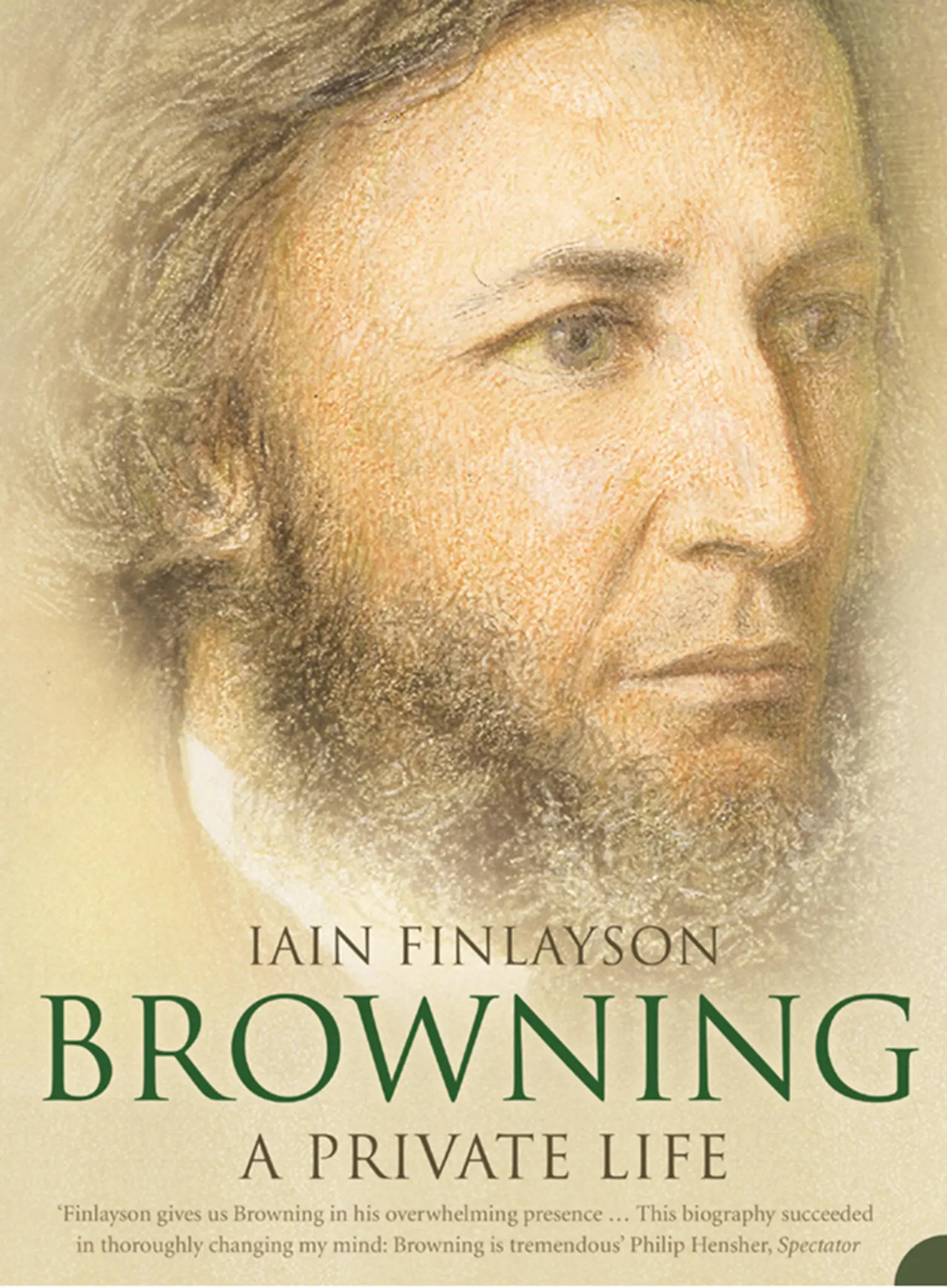
- Название:Browning
- Автор:
- Жанр:
- Год:неизвестен
- ISBN:нет данных
- Рейтинг книги:5 / 5. Голосов: 1
-
Избранное:Добавить в избранное
- Отзывы:
-
Ваша оценка:
Browning: краткое содержание, описание и аннотация
Предлагаем к чтению аннотацию, описание, краткое содержание или предисловие (зависит от того, что написал сам автор книги «Browning»). Если вы не нашли необходимую информацию о книге — напишите в комментариях, мы постараемся отыскать её.
Browning — читать онлайн ознакомительный отрывок
Ниже представлен текст книги, разбитый по страницам. Система сохранения места последней прочитанной страницы, позволяет с удобством читать онлайн бесплатно книгу «Browning», без необходимости каждый раз заново искать на чём Вы остановились. Поставьте закладку, и сможете в любой момент перейти на страницу, на которой закончили чтение.
Интервал:
Закладка:
The image of the loosed boat as a ‘mutilated creature’ turning to look at Robert Browning and his shipmates before reeling off into a luridly effulgent sunset is stunning—worthy of Mary Shelley’s Frankenstein , published in 1818, or any of the tuppence-coloured gothic horrors in Wanley’s Wonders of the Little World . Mrs Orr provides some supplementary detail, which Robert confided to Sarianna but withheld from Fanny as too sensational: 75 ‘Of the dead pirates, one had his hand clasped as if praying; another, a severe gash in his head. The captain burnt disinfectants and blew gunpowder, before venturing on board, but even then, he, a powerful man, turned very sick with the smell and the sight. They stayed one whole day by the side, but the sailors, in spite of orders, began to plunder the cigars, etc. The captain said privately to Robert, “I cannot restrain my men, and they will bring the plague into our ship, so I mean quietly in the night to sail away.” Robert took two cutlasses and a dagger; they were of the coarsest workmanship, intended for use. At the end of one of the sheaths was a heavy bullet, so that it could be used as a sling. The day after, to their great relief, a heavy rain fell and cleansed the ship. Captain Davidson reported the sight of the wreck and its condition as soon as he arrived at Trieste.’
Robert’s letter to Fanny continues with a brisk itinerary: ‘“What I did?” I went to Trieste, then Venice—then thro’ Treviso and Bassano to the mountains, delicious Asolo, all my places and castles, you will see.’ Presumably Robert means that Fanny will see them if not first in poetical form in Sordello , then certainly in other poems in due course—Pippa would soon and significantly pass, in April 1841, through delicious Asolo. ‘Then to Vicenza, Padua and Venice again. Then to Verona, Trent, Inspruck (the Tyrol) Munich, “Wurzburg in Franconia”! Frankfort and Mayence,—down the Rhine to Cologne, thence to Aix-la-Chapelle, Liège, and Antwerp—then home.’ Robert here carefully blots out four lines, asking Fanny Haworth to ‘Forgive this blurring, and believe it was only a foolish quotation:—shall you come to town, anywhere near town, soon? I shall be off again as soon as my book is out—whenever that will be.’ 76
It may or may not have been true that Robert had written only four for sure, no more than six, lines of poetry: while the Norham Castle passed through the Pillars of Hercules (Robert being hauled up to the deck by Captain Davidson and supported in his tottering, nauseous state so that he might see the tremendous Rock of Gibraltar), and skirted the north African coast, he wrote either now on this first journey to Italy, or later on a second trip, one of his best known poems, ‘How they Brought the Good News from Ghent to Aix’, written in pencil on the cover of Bartoli’s De’ Simboli Trasportati al Morale , according to Mrs Orr a favourite book and constant companion of Robert’s. 77 Robert himself declared, in a letter of 20 October 1871 responding to an inquiry about the antecedents of the journey from Ghent to Aix, ‘I have to say there were none but the sitting down under the bulwark of a ship off the coast of Tangiers, and writing it on the fly-leaf of Bartoli’s Simboli ; the whole “Ride” being purely imaginary.’ This seems definite, but Robert could be often contradictory and sometimes plain wrong in his recollections about where and when and how a particular poem was written.
‘We can imagine,’ says Mrs Orr with a sympathetic shudder, ‘in what revulsion of feeling towards firm land and healthy motion this dream of a headlong gallop was born in him.’
I sprang to the stirrup, and Joris, and he;
I galloped, Dirck galloped, we galloped all three …
Behind shut the postern, the lights sank to rest,
And into the midnight we galloped abreast.
Better, perhaps, to think of happier times, of Robert inspired by this floundering journey on the swell of the sea to recall the first journey into Russia, and hear again in the slap of water against the sides of the Norham Castle the rhythmic beat of his own and Benkhausen’s galloping horses as they ran through northern Europe, their hooves thudding through the silences of white snow and green firs. He wrote, too, ‘Home Thoughts, from the Sea’, a short poem ‘written at the same time, and in the same manner’ 78 —in pencil on the cover of a book—a colourful riot of geography (‘Nobly, nobly Cape Saint Vincent to the North-west died away’), history (‘Bluish ’mid the burning water, full in face Trafalgar lay’), and triumphant English victory (‘Here and here did England help me: how can I help England?—say’) in eight rhythmic, rhyming, ringing lines.
Not much remains of first-hand information about Robert’s first excursion to Italy and his journey home through Germany and the Low Countries. On his return, he was back in touch with William Johnson Fox, that great man who, as Robert wrote to Fanny Howarth in April 1839, ‘is my Chiron in a small way’, referring to him as the possessor of a ‘magnificent and poetical nature’. Robert regarded Fox as ‘my literary father’ and took care to maintain the connection with him and his family. William Sharp 79 reports a reminiscence of Fox’s daughter ‘Tottie’ (later Mrs Bridell-Fox), who wrote: ‘I remember him as looking in often in the evenings, having just returned from his first visit to Venice. I cannot tell the date for certain. He was full of enthusiasm for that Queen of Cities. He used to illustrate his glowing descriptions of its beauties, the palaces, the sunsets, the moonrises, by a most original kind of etching. Taking up a bit of stray notepaper, he would hold it over a lighted candle, moving the paper about gently till it was cloudily smoked over, and then utilising the darker smears for clouds, shadows, water, or what not, would etch with a dry pen the forms of lights on cloud and palaces, on bridge or gondola on the vague and dreamy surface he had produced.’
Robert had spent two weeks in Venice out of his four in Italy, and images of his impressions would surface later in poems such as Pippa Passes , ‘In a Gondola’, ‘A Toccata of Galuppi’s’, and—significantly for the time being—in the work in hand, Sordello , the poem that is confirmed as having been in the making since at least 1835, and probably for a while before, very likely soon after Pauline . Robert wrote to Fox on 16 April 1835, in a letter referring to Paracelsus , that ‘I have another affair on hand, rather of a more popular nature, I conceive, but not so decisive and explicit on a point or two.’ This ‘other affair’, Sordello , had already been subject to several revisions since its inception in or about 1833, and would again be revised to incorporate first-hand impressions of the Italian sites and sights still remaining, however much altered, some six hundred years after the thirteenth-century troubador ( trovatore or, more literarily, trouvère ) Sordello had walked and talked among them.
On the day of his departure for Italy, Robert had written to John Robertson, a friend who was connected with the Westminster Review , to say, ‘I sail this morning for Venice—intending to finish my poem among the scenes it describes.’ 80 Sordello , the poem, is also referred to in a letter to Fanny Haworth that Mrs Orr cannot date precisely but is likely to have been written in the summer of 1838 or 1839: ‘I am going to begin finishing Sordello —and to begin thinking a Tragedy (an Historical one, so I shall want heaps of criticism on Strafford ) and I want to have another tragedy in prospect, I write best so provided: I had chosen a splendid subject for it, when I learned that a magazine for next, this, month, will have a scene founded on my story; vulgarizing or doing no good to it: and I accordingly throw it up. I want a subject of the most wild and passionate love, to contrast with the one I mean to have ready in a short time.’ 81 The plays he had in mind were to be King Victor and King Charles , and The Return of the Druses . With his hopes for the popular appeal of Sordello , and the prospective play devoted to a theme of ‘the most wild and passionate love’, it can be taken that Robert was aiming now at the wild hearts as well as the impassioned minds of the market for poetry and plays.
Читать дальшеИнтервал:
Закладка:
Похожие книги на «Browning»
Представляем Вашему вниманию похожие книги на «Browning» списком для выбора. Мы отобрали схожую по названию и смыслу литературу в надежде предоставить читателям больше вариантов отыскать новые, интересные, ещё непрочитанные произведения.







Обсуждение, отзывы о книге «Browning» и просто собственные мнения читателей. Оставьте ваши комментарии, напишите, что Вы думаете о произведении, его смысле или главных героях. Укажите что конкретно понравилось, а что нет, и почему Вы так считаете.